
The Manifesto of the Moonshot Class of 2026
Five Voices. One Generation. A Promise Unkept.

Editor’s Introduction
By Moonshot Press
America’s 250th Year
Over the course of 2026—America’s semiquincentennial year—roughly 3.6 million newborns will take their first breath in the United States. .
We call them the Moonshot Class of 2026.
Not because they belong to any president or political party, but because they are born into a world shaped by decisions made long before they drew their first breath. The healthcare systems that will determine whether they survive their first year were designed decades ago. The schools they will attend are funded by tax structures written by earlier generations. The immigration policies that will decide whether families like theirs stay together were debated by citizens who are now retired or dead. The climate they will inherit is being determined by energy choices made today.
Thomas Jefferson understood this tension between generations. In 1789, he wrote to James Madison with a radical proposition: “The earth belongs to the living, and the dead have neither power nor rights over it.” He calculated that each generation should last approximately nineteen years, after which the living should be free to revise constitutions, renegotiate debts, and reimagine institutions to serve their own needs rather than remain bound by the preferences of the deceased.
Jefferson believed that forcing new generations to live under old laws was as absurd as forcing a grown man to wear the coat he wore as a boy. “As human knowledge advances,” he wrote, “institutions must advance also, and keep pace with the times.”
Yet here we are, 250 years after Jefferson helped draft the Declaration of Independence, and the Moonshot Class of 2026 is born into a nation where the dead hand of the past still grips the present. Social Security—which will shape their parents’ retirements—was designed in 1935. Medicare dates to 1965. The tax code that determines public investment in their education contains provisions from the 1980s benefiting wealth accumulation patterns of prior generations. The national debt they inherit—$36 trillion and counting—represents the accumulated choices of Boomers, Gen X, and Millennials to consume now and bill later.
The Moonshot Class of 2026 series exists because of this fundamental democratic tension: How can a generation that cannot yet speak defend its interests against a political system controlled entirely by those who came before?
This manifesto—presented as if written collectively by five babies born into vastly different American realities—is an imaginative exercise in giving voice to the voiceless. It asks what these children might demand if they could articulate their needs. It challenges us to consider whether our current trajectory honors the promise we claim to hold sacred: that all are created equal and endowed with unalienable rights to life, liberty, and the pursuit of happiness.
Jefferson believed that the living owe the rising generation more than inherited debt and decaying institutions. They owe them education, opportunity, and the freedom to build their own future. He knew that “the most effectual means of preventing the perversion of power into tyranny are to illuminate...the minds of the people at large.”
The Class of 2026 deserves no less.
How to Engage with This Series
This manifesto is the first document in the Moonshot Class of 2026 series. What follows is a multi-layered exploration of what America owes its newest citizens:
The Manifesto Itself — The collective voice of five babies demanding that America keep its promise.
Ideological Responses — We asked Claude (Anthropic’s AI, Sonnet 4.5) to generate responses to the manifesto from four distinct ideological perspectives that dominate American political discourse:
Conservative Response — From the lens of limited government, traditional values, and fiscal responsibility
Progressive Response — From the lens of structural inequality, systemic change, and expansive government action
Libertarian Response — From the lens of individual liberty, free markets, and minimal state intervention
MAGA Response — From the lens of nationalist populism, border security, and America First principles
Each critique is presented in good faith, representing the strongest version of each position’s response to the babies’ demands.
The Founding Fathers Respond — We then asked Claude to generate a response grounded in the actual writings and debates of America’s Founders—Washington, Jefferson, Adams, Madison, Hamilton, and the Anti-Federalists. This Founding Vision Response attempts to transcend our contemporary ideological divisions by returning to first principles and the constitutional framework, informed by Washington’s Farewell Address and 250 years of American progress, including the transformative potential of artificial intelligence.
Meet the Five Babies of The Moonshot Class of 2026 — Finally, you can follow the individual stories of the children whose lives inspired this manifesto:
General Introduction to the Five — Overview of the The Moonshot Class of 2026
Liam — Somerset, Pennsylvania: Life in post-industrial America
Amare — Chicago, Illinois: Growing up on the South Side
Emma — Chestnut Hill, Massachusetts: Born into privilege
Eva — Tompkinsville, Kentucky: Rural County
Mateo — San Antonio, Texas: A citizen child in a mixed-status family
These are not fictional characters. They represent real demographic and geographic realities facing millions of American children. Their stories will be documented over the coming years as part of Project 2026’s commitment to bearing witness and demanding accountability.
At 250 years, America must decide: Will we honor Jefferson’s principle that each generation has the right to govern itself? Or will we force these babies to wear the ill-fitting coat of our failures?
The Class of 2026 cannot answer that question.
We must.
We invite you to read the manifesto, engage with the critiques, consider the Founders’ wisdom, and most importantly—meet the five babies whose futures hang in the balance.
Their lives will be the measure of whether we kept the promise.
Moonshot Press
January 2026
America’s 250th Year
Navigation
→ AI assisted conservative, progressive, libertarian and MAGA critique of the manifesto.
→ The Founding Fathers Respond: A More Perfect Union
→ Meet the Moonshot Class of 2026
The Manifesto of The Moonshot Class of 2026
We are Liam, Amare, Emma, Eva, and Mateo.
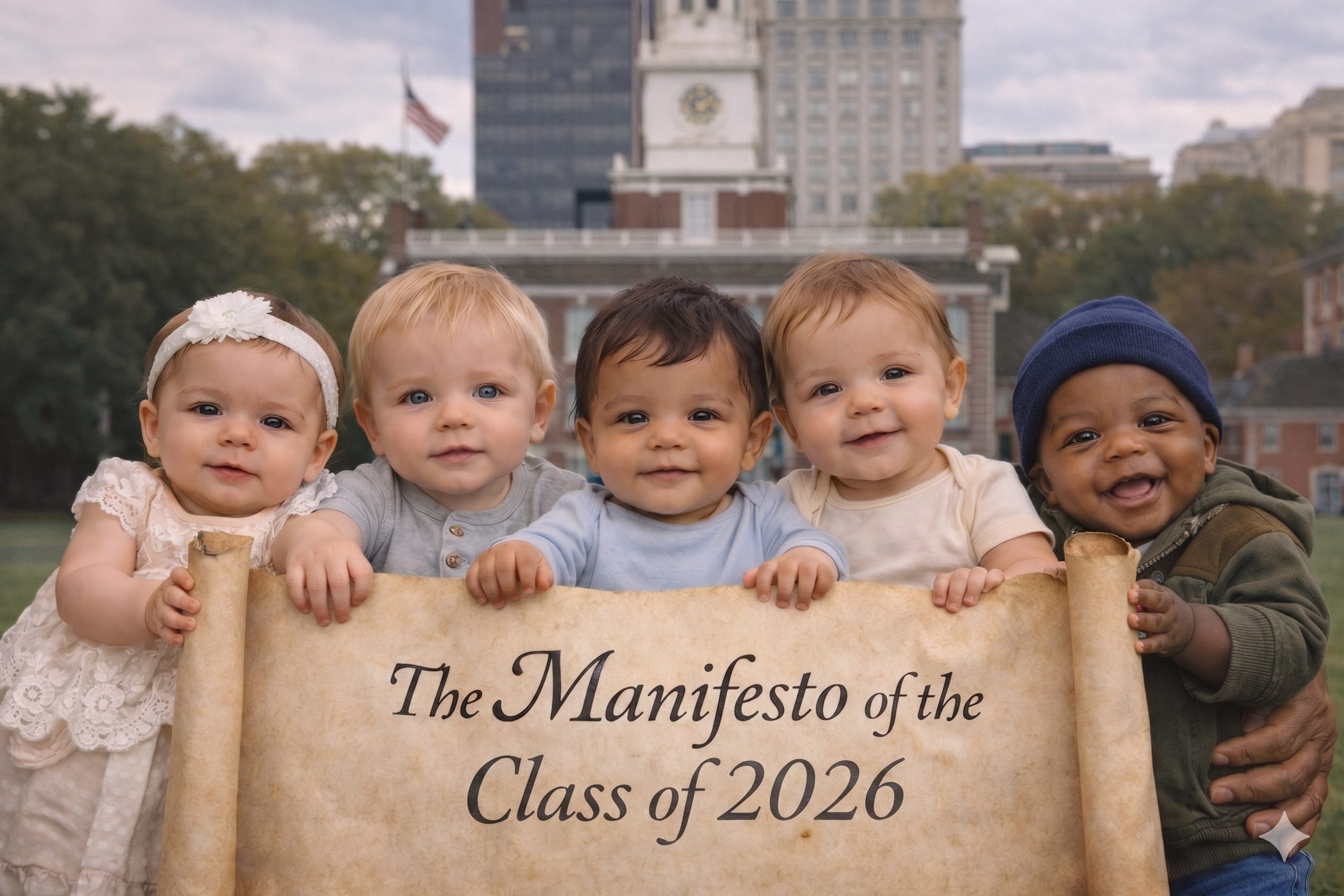
We were born in January 2025, in five different corners of the same country—Somerset, Pennsylvania; Chicago, Illinois; Chestnut Hill, Massachusetts; Tompkinsville, Kentucky ; and San Antonio, Texas.
We share the same sky, the same Constitution, the same birth certificate that declares us citizens of the United States of America.
But we do not share the same America.
This is our manifesto.
Not a demand. Not a threat. A plea from the starting line of our lives—a witness statement from those who cannot yet speak but whose futures are already being written by the choices being made today.
We are the Class of 2026—born into a nation at a crossroads, into policies that will determine whether the promise of equality is kept or becomes another historical footnote of good intentions and broken dreams.
We write this together because our fates are bound together.
What diminishes one of us diminishes all of us. What lifts one of us should lift all of us.
I. THE PROMISE WE WERE BORN INTO
We hold these truths to be self-evident: that all people are created equal, endowed with certain unalienable rights—life, liberty, and the pursuit of happiness.
This is not poetry. This is not aspiration. This is the contract.
We did not choose to be born. We did not choose our ZIP codes, our parents’ income, the color of our skin, the documentation status of our families, the healthcare infrastructure of our counties.
But we were born. And in being born American, we inherited a promise.
The promise is this:
That our potential will not be predetermined by the circumstances of our birth.
That the content of our character, the strength of our effort, the depth of our dreams will matter more than the accident of geography.
That we will have the conditions necessary to flourish—not as charity, not as political favor, but as birthright.
We are here to say: The promise is broken.
And we are here to demand it be kept.
II. WHAT WE ARE OWED
We believe, as newborns and members of this society, that we are entitled to certain core capabilities—the foundations without which no life can truly flourish, no potential can be realized, no dignity can be sustained.
1. The Right to Health and Survival
We have the right to survive our first breath, our first year, our first thousand days.
We have the right to mothers who receive prenatal care—not just emergency intervention, but preventive, comprehensive, dignified care.
We have the right to be born in hospitals that are nearby, equipped, and welcoming—not 45 minutes away through the dark on rural highways, not in facilities that see our families as threats rather than patients.
We have the right to pediatricians who know our names, not waiting lists that stretch months, not healthcare deserts where one doctor serves 3,000 children.
We have the right to clean air to breathe—not air thick with diesel particulates, not pollution three times the national average, not environmental racism disguised as zoning policy.
We have the right to clean water—not water contaminated with lead, not boil-water notices that some families never receive, not infrastructure that has been crumbling for decades while wealthier communities get new pipes.
Eva in Lexington, Mississippi, should not be three times more likely to die in her first year than Emma in Chestnut Hill, Massachusetts. That is not fate. That is policy failure.
2. The Right to Nutrition
We have the right to be fed—not just calories, but nutrition that fuels our growing brains and bodies.
We have the right to mothers who are nourished during pregnancy—access to WIC, to prenatal vitamins, to food that isn’t processed desperation from Dollar General shelves.
We have the right to breastfeed or receive formula without financial crisis—not rationing, not watered-down bottles, not choosing between feeding us and paying rent.
We have the right to baby food, fruits, vegetables, proteins that help us reach our developmental milestones—not food deserts where the nearest grocery store is ten miles away and the only nearby option is a gas station selling chips and soda.
We have the right to grow up without hunger—not the gnawing kind, not the kind that stunts growth and cognitive development, not the kind that becomes background noise in a childhood.
Mateo in San Antonio should not go without the WIC benefits he’s entitled to because his mother is too afraid to apply. Eva in Tompkinsville should not face malnutrition because there’s no grocery store in her town. Amare in Chicago should not breathe pollution that increases his risk of asthma while Emma in Chestnut Hill gets organic baby food delivered to her door.
This is not fair. This is not American. This is fixable.
3. The Right to Safe and Stable Homes
We have the right to shelter that protects us, not harms us.
We have the right to housing that is safe—no lead paint, no black mold, no leaking roofs, no broken heat in winter.
We have the right to housing that is stable—not eviction threats every month, not landlords who don’t return calls, not moving three times before we turn two because our parents can’t afford rent.
We have the right to neighborhoods that are safe—not over-policed, not under-resourced, not written off as “those areas” where violence is expected and investment is withheld.
Liam’s house in Somerset shouldn’t have mold his mother keeps bleaching away. Amare’s building in Chicago shouldn’t be one missed paycheck away from eviction. Mateo’s family shouldn’t live in fear that a traffic stop could end with his mother detained and him in foster care.
4. The Right to Education and Opportunity
We have the right to learn, to grow, to become.
We have the right to early childhood education—Head Start programs with open slots, preschools that teach us letters and numbers and how to navigate the world, not waiting lists two years long.
We have the right to well-funded public schools—teachers who stay, books that are current, buildings that don’t crumble, class sizes that allow attention, programs in art and music and science that let us discover what we love.
We have the right to bilingual education if we speak Spanish at home, special education if we need support, gifted programs if we excel—not one-size-fits-all systems that see difference as deficit.
We have the right to pathways to college, trade schools, careers—not school-to-prison pipelines, not economic dead-ends, not being told at age 10 that our ZIP code has already decided our fate.
Emma in Chestnut Hill will have $22,000 spent on her education per year. Eva in Tompkinsville will have $9,200. That gap—$12,800 per year—compounds over 13 years of schooling into a chasm of $166,400 in investment difference. That is structural inequality, and it is a choice.
5. The Right to Family
We have the right to be raised by the people who love us.
We have the right to parents who are present—not working three jobs to survive, not incarcerated for minor offenses, not deported for crossing a border to escape violence.
We have the right to paid parental leave so our parents can bond with us in our first fragile months—not forced back to work after two weeks, not choosing between income and attachment.
We have the right to affordable, quality childcare when our parents must work—not $1,200/month that equals rent, not unlicensed care in unsafe conditions, not being left with exhausted grandparents who are doing their best but need support too.
Mateo should not have a contingency plan for foster care at two weeks old because his parents could be deported at any moment. Amare’s mother should not have to choose between staying home with him and keeping the electricity on. Liam’s father should not be in chronic pain with no access to treatment while trying to care for an infant.
6. The Right to Safety and Justice
We have the right to be protected, not criminalized by proximity.
We have the right to communities that are safe without being over-policed—investment in schools and jobs and mental health, not just surveillance and incarceration.
We have the right to parents who are treated justly—not sentenced to lifelong unemployment for mistakes made at 19, not profiled, not assumed dangerous because of skin color or immigration status.
We have the right to grow up without trauma—not hearing gunshots, not losing uncles to overdoses, not watching ICE raids, not internalizing that the world is dangerous and we are disposable.
Amare should not grow up with a 1-in-3 chance of contact with the criminal justice system just because he’s a Black boy in Chicago. Mateo should not grow up afraid of police because they might ask his parents for papers. Eva should not grow up in a community where opioid deaths outnumber car accidents.
7. The Right to Self-Determination
We have the right to become ourselves.
We have the right to discover our gifts—whether in science, art, trades, service, leadership—and have access to the resources to develop them.
We have the right to make our own choices about our beliefs, our careers, our lives—not have our paths predetermined by poverty, lack of access, or systemic barriers.
We have the right to live free from oppression—not weighed down by racism, not excluded by xenophobia, not dismissed because of where we were born or who our parents are.
We are not asking to be exceptional. We are asking for the chance to find out who we could be if the playing field were level.
III. THE FIRST 1,000 DAYS: A PLEA TO SOCIETY
We are in our first 1,000 days—from conception to age two—the most critical window of human development.
What happens to us now will echo through our entire lives.
Science is unambiguous:
Nutrition in these first 1,000 days determines brain architecture, immune function, lifelong health trajectories.
Attachment and interaction with caregivers shape our capacity for relationships, emotional regulation, resilience.
Safety and stability allow our brains to develop optimally; chronic stress and trauma literally alter our neurobiology, shrinking the hippocampus, heightening the amygdala, priming us for survival mode instead of thriving.
Environmental factors—clean air, safe water, freedom from toxins—determine whether our bodies grow strong or are compromised from the start.
We need:
Physical Foundations
Proper prenatal nutrition for our mothers: proteins, omega-3 fatty acids, calcium, iron, zinc, vitamin A—not sugar, caffeine, alcohol, or the stress hormones that flood the system when a mother is terrified of deportation or can’t afford food.
Healthy birth weights—not premature, not malnourished, not compromised by lack of prenatal care.
Breastfeeding support or quality formula—not stigma, not impossibility due to work schedules, not rationing because of cost.
Solid foods that nourish—fruits, vegetables, whole grains, proteins—not processed fillers, not whatever is cheapest at the dollar store.
Biological Protections
Regulated stress hormones—cortisol levels that don’t spike constantly due to housing instability, parental fear, community violence.
Physical activity and play—space to crawl, walk, explore safely—not apartments too small, not neighborhoods too dangerous, not parents too exhausted to engage.
Sleep that is restorative—not disrupted by hunger, fear, unsafe conditions, or the sound of sirens.
Environmental Safety
Air quality that doesn’t poison us—no asthma at three times the national rate because we live near highways and industrial sites.
Water that is clean—no lead, no bacteria, no contaminants.
Homes free from hazards—no peeling lead paint, no mold, no vermin.
Relational Nurturing
Parents who have time and energy to hold us, talk to us, read to us, respond to our cries.
Caregivers who are not drowning—not working 65 hours a week, not choosing between paying rent and buying diapers, not living in constant fear of detention or deportation.
Language-rich environments—being spoken to, sung to, read to—not silence because parents are too stressed or working too much.
This is not a wish list. This is the evidence-based foundation for human development.
And we are asking: Will you provide it?
IV. THE FIVE OF US, THE MILLIONS OF US
We are five babies. But we represent 3.6 million babies that will be born in the United States in 2026.
We are:
Liam, born into economic decline in a town that once thrived—representing the 14% of American children growing up in rural poverty, in places where factories closed, hospitals shuttered, hope evaporated, and promises of revival never materialized.
Amare, born into the legacy of redlining and disinvestment on Chicago’s South Side—representing the 31% of Black children living in poverty, in neighborhoods that were systematically stripped of wealth and are only now, if at all, seeing reinvestment.
Emma, born into privilege in Chestnut Hill—representing the small but powerful percentage of children born into wealth, who will inherit not just money but opportunity compounded across generations, and whose advantage is built into tax codes, school funding formulas, and social networks.
Eva, born into a rural healthcare desert in Tompkinsville—representing the 20% of children in rural America who lack access to basic healthcare, where infant mortality rates rival developing nations, where being born in the wrong county is a life sentence.
Mateo, born a citizen into a mixed-status family living in fear—representing the 5.5 million U.S. citizen children living with at least one undocumented family member, entitled to rights on paper but denied them in practice because terror is policy.
Our differences are not natural. They are designed.
Through policy choices. Through funding formulas. Through whose lives are valued and whose are expendable.
And if nothing changes, here is what will happen:
Liam will likely not go to college. He will work hard, possibly join the military, possibly struggle with the same chronic pain and economic precarity his father faces.
Amare will face systemic racism in schools, in healthcare, in employment, in criminal justice. He will have to be twice as good to get half as far.
Emma will thrive. Not because she is smarter or works harder, but because the system is designed for her to thrive.
Eva has a 1-in-60 chance of not surviving her first year. If she does, she will face limited healthcare, underfunded schools, chronic poverty, and a life expectancy 12 years shorter than Emma’s.
Mateo will grow up with the trauma of family separation, even if it never happens—the fear is enough. He will navigate a country that calls him a citizen but treats his family as criminals.
Is this acceptable?
Is this the America we want to be?
V. A VISION FOR THE AMERICA WE DESERVE
We envision an America where:
ZIP codes do not determine destinies.
Where every baby born in Somerset has the same access to healthcare, education, and opportunity as every baby born in Chestnut Hill.
Investment follows need, not wealth.
Where schools in Monroe County, Kentucky, receive more resources, not less, because the challenges are greater. Where rural hospitals are kept open because lives matter more than profit margins.
Families are kept together.
Where immigration policy recognizes that tearing apart families is not border security—it is cruelty. Where DACA recipients have a path to citizenship. Where seeking asylum is not criminalized.
Workers are protected.
Where parents can work one job and support a family. Where workplace injuries are prevented and treated. Where poverty wages are outlawed and living wages are guaranteed.
Early childhood is prioritized.
Where every baby has access to quality childcare, early education, healthcare, and nutrition—because investing in the first 1,000 days yields returns for a lifetime.
Healthcare is a right.
Where no mother drives an hour in labor. Where no baby goes without a pediatrician. Where no family chooses between food and medicine.
Justice is real.
Where a conviction at 19 doesn’t mean unemployment at 29. Where Black and brown children are not policed differently. Where past mistakes don’t erase future possibilities.
We are seen as whole.
Where bilingualism is an asset, not a deficit. Where cultural heritage is honored, not erased. Where every child is told: You belong. You matter. You can become.
VI. THE CALL
We cannot vote. We cannot protest. We cannot write legislation.
But we exist.
And our existence is a question:
What kind of country do you want to be?
One that invests in all its children, or only some?
One that keeps its promises, or writes them off as aspirational rhetoric?
One that measures success by the flourishing of its most vulnerable, or the wealth of its most privileged?
We are asking you—lawmakers, policymakers, voters, neighbors, strangers:
Look at the five of us.
Liam. Amare. Emma. Eva. Mateo.
Do we all deserve to thrive?
If the answer is yes, then act like it.
Fund rural hospitals. Expand Medicaid. Invest in schools in poor districts—not as charity, but as obligation. Create pathways to citizenship. Protect workers. Guarantee paid family leave. Ensure clean water and air. Make childcare affordable. Keep families together.
These are not radical demands. These are the conditions for a functional society.
And if you say you cannot afford it, we ask: How can you afford not to?
What is the cost of 3.6 million children born each year into preventable disadvantage?
What is the cost of talent never discovered, potential never realized, lives never fully lived?
What is the cost of a generation that grows up knowing the promise was a lie?
VII. OUR COMMITMENT
We, the Class of 2026, make this commitment:
We will remember.
We will remember who fought for us and who abandoned us.
We will remember what was possible and what was chosen.
And when we are old enough to vote, to organize, to lead—we will build the America we deserved from birth.
We will not accept that our worth was determined by ZIP codes.
We will not accept that some lives matter more than others.
We will hold you accountable.
Not with anger, though we have the right to it.
Not with despair, though we have tasted it.
But with the stubborn, unyielding insistence that the promise must be kept.
We are Liam, Amare, Emma, Eva, and Mateo.
We are five voices.
We are millions.
We are the future you are shaping right now.
Choose wisely.
Signed,
The Class of 2026
Born into a crossroads. Demanding a country worthy of our potential.
January 2026