


DISCLAIMER:
The five Moonshot Class of 2026 Babies are AI-generated composites and images, not real individuals
The communities are real places, drawn on through AI-facilitated data and research, used as representative settings rather than precise portraits of those localities
They serve as a vehicle to understand varied American experiences from birth
Readers uncomfortable with AI-generated content may choose not to engage
Feedback to improve accuracy is welcomed.
I’m Emma.
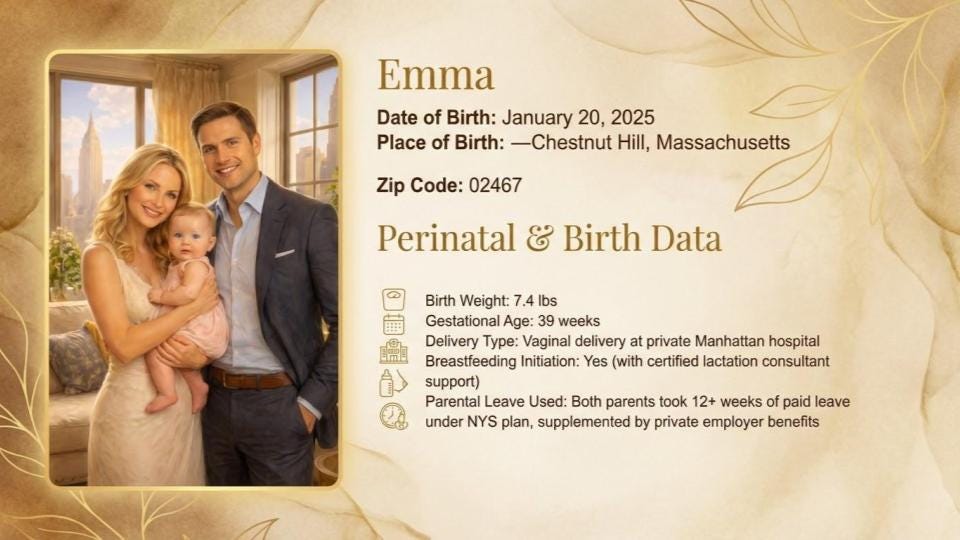
I was born on a bright January morning in 2026, at Brigham and Women’s Hospital in Boston—one of the top-ranked hospitals in the country. My delivery was scheduled, a planned C-section at 39 weeks because my mother’s OB-GYN wanted to ensure everything went perfectly. And it did.
I came into the world in ZIP code 02467—Chestnut Hill, Massachusetts. If you know anything about Boston, you know that means something. If you don’t, let me paint you a picture.
The Neighborhood That Has Everything
Chestnut Hill sits at the intersection of Boston, Brookline, and Newton—three of the wealthiest municipalities in Massachusetts. It’s not technically its own town, but it functions like one. Tree-lined streets. Historic homes. Manicured lawns. A reservoir for morning jogs. The kind of place where people say “good morning” on walking trails and actually mean it.
ZIP code 02467 in 2026:
Median household income: $157,000 (more than double the national average)
Poverty rate: 4.2% (national average: 12.8%)
Unemployment: 2.1% (effectively full employment)
Homeownership rate: 68%, with median home values around $1.2 million
College degree attainment: 79% of adults (national average: 33%)
Graduate/professional degrees: 48% of adults
This isn’t just a wealthy neighborhood. This is a neighborhood of accumulated advantage—generational wealth, educational capital, social networks, institutional access. The kind of place where opportunity doesn’t knock; it’s already in the room.
My Parents: The Safety Net I’ll Never See
My mother, Katherine, is 34. She has a Master’s degree in public health from Boston University and works as a program director at a nonprofit focused on healthcare access. The irony isn’t lost on her—she spends her days working to expand healthcare for underserved communities while living in one of the most served communities in America.
She makes $95,000 a year, plus benefits.
My father, David, is 36. He has an MBA from Babson and works in financial services, managing investment portfolios for high-net-worth clients. He makes $180,000 a year, plus annual bonuses that can add another $30,000-$50,000.
Combined household income: roughly $275,000 before bonuses.
They have:
Employer-sponsored health insurance (Blue Cross Blue Shield PPO, premium plan) that covered every single dollar of my mother’s prenatal care—monthly check-ups, two ultrasounds, genetic testing, nutritionist consultations, the delivery, the private recovery room, the pediatrician who examined me within hours of birth
Paid parental leave—my mother gets 16 weeks fully paid, my father gets 6 weeks
Life insurance, disability insurance, dental, vision—all through their employers
A 401(k) matching program (both employers match up to 6%)
Flexible spending accounts for healthcare and dependent care
This is what a safety net actually looks like when you don’t need one.

The Home I Was Brought To
We live in a four-bedroom Colonial that my parents bought three years ago for $1.1 million. They put down 20% ($220,000—a gift from my father’s parents combined with their savings). Their mortgage is $5,200/month, which sounds astronomical until you remember what they make.
The house has:
A nursery that was designed before I was born (soft green walls, custom shelving, a glider chair, blackout curtains, a SNOO smart bassinet that cost $1,700 and regulates my sleep)
Central air with HEPA filtration
A finished basement
A backyard with mature trees
Two-car garage
A neighborhood where people leave their doors unlocked
We have a Peloton in the basement. A KitchenAid stand mixer that’s never been used. Subscriptions to the New York Times, The Atlantic, Boston Globe. A Sonos sound system. Books—so many books, shelved floor-to-ceiling in the living room.
This is the environment I’m growing up in. Not just physical comfort, but cultural capital. Conversations about ideas. Exposure to art, music, language. The assumption that the world is knowable and I will be equipped to know it.
The Advantages I Was Born Into
Let me be specific about what ZIP code 02467 provides:
Healthcare Access:
Pediatrician-to-child ratio: 1:280 (national average: 1:1,500)
My pediatrician’s office is 7 minutes away, takes our insurance, has same-day appointments
Children’s Hospital Boston—one of the best pediatric hospitals in the world—is 15 minutes away
If I get sick, I will be seen, diagnosed, and treated quickly by the best doctors available
Air Quality:
Meets every EPA standard—no industrial sites, no highways cutting through, no diesel truck routes
My risk of childhood asthma: half the national average
The air I breathe is clean, and that alone gives me a developmental advantage
Education:
Newton Public Schools: ranked in the top 1% nationally
Per-pupil spending: $22,000/year (compared to $13,000 national average)
Teacher-to-student ratio: 12:1
Nearly 100% of students go to college; 85% graduate within six years
I will have access to AP classes, arts programs, STEM labs, mental health counselors, college advisors who know how to navigate Ivy League admissions
Safety:
Violent crime rate: 0.4 per 1,000 residents (national average: 4 per 1,000)
I will grow up never hearing gunshots, never worried about walking home from school, never experiencing the low-grade trauma of living in a community where violence is normal
Early Childhood Resources:
Private preschools within a 10-minute drive (my parents are already on waitlists)
Music classes, swim lessons, toddler gymnastics—all within reach
Public library with story time, sensory play sessions, lending libraries for toys and educational materials
Parks with new equipment, maintained fields, summer camps that cost $500/week but will teach me coding and marine biology
My First Year: The Details That Matter
My parents can afford:
Organic baby food (or a $400 baby food maker to make their own)
BPA-free bottles, non-toxic toys, organic cotton clothing
A baby monitor that tracks my sleep patterns, breathing, room temperature
Books—board books, cloth books, high-contrast books for visual development—dozens of them, already on my nursery shelf
Educational toys designed by child development experts
A nanny starting when my mother goes back to work (20 hours/week, $25/hour)
Music classes at a local studio ($200 for a 10-week session)
But more than the things, they can afford time and attention.
My mother isn’t working two jobs. She’s not coming home too exhausted to read to me. She’s not stressed about whether we’ll have enough food this month or whether the heat will stay on.
She has the mental space to track my milestones, research sleep training methods, notice if my development seems off, advocate for me immediately if something’s wrong.
That space—that freedom from survival mode—is an advantage that’s invisible until you don’t have it.
The Tax Benefits That Widen the Gap
Under current federal policies, my family benefits from:
Child Tax Credit: $2,000 (they’re in the income range to receive the full amount)
Mortgage interest deduction: Saves them roughly $12,000/year in taxes
State and local tax (SALT) deduction: Another $10,000
529 College Savings Plan: Tax-advantaged growth (they’ve already deposited $10,000 for me)
Capital gains tax rates: Lower than income tax rates, benefiting their investment portfolio
These aren’t handouts—these are structural advantages written into the tax code. They reward homeownership, investment, wealth accumulation.
Meanwhile, families making $35,000/year can’t benefit from mortgage interest deductions because they don’t own homes. They can’t max out 529 plans because they don’t have savings. They can’t benefit from capital gains rates because they don’t have capital.
The system is designed to compound advantage.
What My Likely Trajectory Looks Like
Let me tell you what the data says about babies born in ZIP code 02467:
Health:
Infant mortality rate: 1.8 per 1,000 live births (one of the lowest in the nation)
Childhood obesity rate: 8% (national average: 19.7%)
Mental health support: accessible and destigmatized
Life expectancy: 86+ years
Early Childhood:
Will attend high-quality preschool (likely Montessori or Reggio Emilia-inspired)
Will enter kindergarten at or above grade level in literacy, numeracy, social-emotional skills
Will have been read to daily, exposed to museums, concerts, nature centers
Will speak in complex sentences, have a vocabulary in the 90th percentile
Education:
Will attend Newton South or Newton North High School (both ranked top 50 nationally)
Will take 6-8 AP classes
Will have access to college counselors, test prep, extracurricular activities that look good on applications
College acceptance rate: near 100%
Will likely attend a selective university (BC, Tufts, Ivy League schools are common destinations)
College completion rate: 90%+
Will graduate with manageable debt or none at all (parents will contribute significantly)
Economic Outcomes:
With college degree from selective institution: median lifetime earnings $3.2+ million
Will likely enter professional fields—law, medicine, finance, tech, academia
Homeownership: highly likely, potentially with parental help for down payment
Wealth accumulation: expected (inheritance, investments, property appreciation)
Retirement security: strong (maxed-out 401(k)s, IRAs, investment portfolios)
Social Capital:
Networks built through education and family connections
Access to internships, mentorships, “hidden” job markets
Social fluency in professional environments
Comfort navigating institutions (healthcare, legal, financial, educational)
Life Trajectory:
Statistically likely to marry someone with similar educational/economic background
Likely to raise children in a similar environment
Advantage reproduces itself
The Question I Raise
Here’s the thing: my parents are good people.
My mother works for a nonprofit. She genuinely cares about equity in healthcare access. She donates to causes. She votes for policies she believes will help others.
My father mentors first-generation college students. He volunteers with Junior Achievement, teaching financial literacy in underserved schools.
They didn’t design this system. They’re not villains.
But they benefit from it. Enormously.
And so will I.
The question isn’t whether I’ll thrive—of course I will. The infrastructure is already in place. The resources are there. The opportunities will unfold naturally because that’s what happens in ZIP code 02467.
The question is: How much of my success is actually mine?
How much is:
My talent and hard work?
My parents’ love and investment?
Or simply the system itself, designed over generations to protect and compound the advantages of people who look like me, live where I live, were born into what I was born into?
The Invisible Architecture of Advantage
I will grow up in a world where:
Healthcare is accessible and excellent
Education is well-funded and rigorous
Safety is assumed
Opportunity is abundant
Failure has a cushion
I won’t experience:
Food insecurity
Housing instability
Medical bankruptcy
Chronic stress from financial precarity
Under-resourced schools
Environmental toxins
Community violence
Discrimination in lending, employment, education
I won’t have to overcome nearly as much to achieve.
And here’s what’s insidious: I’ll grow up believing my success is entirely earned. Because I’ll work hard—I will. I’ll study, I’ll practice, I’ll persevere. But I’ll do all of that with wind at my back that I can’t see because I’ve never known what it’s like to run against it.
The Uncomfortable Truth
The American narrative says: work hard, and you’ll succeed.
But the data shows: where you’re born predicts your outcomes more than almost anything else.
I was born in the right ZIP code. That’s not virtue. That’s luck. And that luck is worth hundreds of thousands of dollars, maybe millions, over the course of my lifetime.
Meanwhile, babies born 15 miles away in Roxbury, in Dorchester, in Mattapan—they’ll work just as hard, maybe harder, and still face barriers I’ll never encounter.
Is that merit? Or is that a system that’s rigged from the start?
What My First 1,000 Days Will Look Like
I will be:
Well-fed (organic, nutrient-rich, on a pediatrician-approved schedule)
Well-rested (sleep-trained, monitored, in a safe environment)
Well-stimulated (age-appropriate toys, books, music, interaction)
Well-protected (vaccinated, insured, in a home free from hazards)
Well-loved (parents with time, energy, resources to be fully present)
I will not experience:
Hunger
Neglect (even unintentional neglect from overstressed, overworked parents)
Exposure to violence or chronic instability
Toxic stress
Developmental delays from lack of stimulation
By the time I’m three years old, I will have heard 30 million more words than a child born into poverty. That gap—the “word gap”—will translate into vocabulary differences, cognitive differences, educational differences that compound over time.
Not because I’m smarter. Because I was born into a system that invests in me from day one.
[A baby’s coo. The rustle of organic cotton sheets. The quiet confidence of a life that will unfold exactly as planned.]
My name is Emma.
I was born in Chestnut Hill, Massachusetts, in ZIP code 02467.
My story is just beginning.
And I want you to ask: What would it take for every baby—regardless of ZIP code—to have what I have?
Not the luxury. Not the wealth.
But the foundation. The safety. The opportunity. The belief that they matter and the world will invest in them accordingly.
Because if we believe in the promise of the Declaration of Independence—that all people are created equal, endowed with unalienable rights to life, liberty, and the pursuit of happiness—then the question isn’t whether I deserve what I have.
It’s whether everyone else deserves it too.
And if the answer is yes, then what are we willing to change to make that real?