


DISCLAIMER:
The Moonshot Babies are AI-generated composites and images, not real individuals
The communities are real places, drawn on through AI-facilitated data and research, used as representative settings rather than precise portraits of those localities
They serve as a vehicle to understand varied American experiences from birth
Readers uncomfortable with AI-generated content may choose not to engage
Feedback to improve accuracy is welcomed
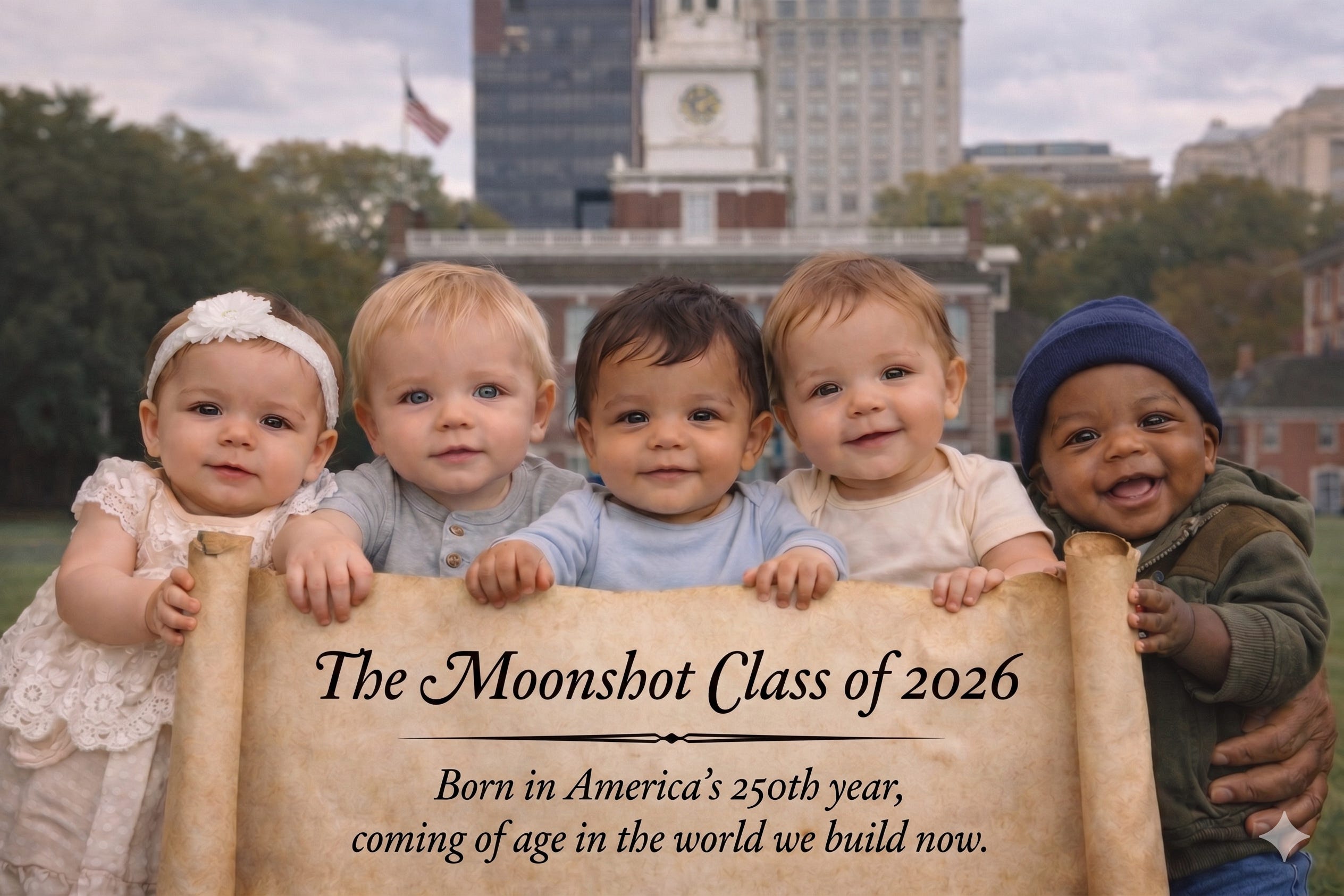
Five Babies, One Promise
On January 20, 2025, as Donald Trump took the oath of office for his second term, five American children drew their first breaths. Each entered the same nation, under the same Constitution, protected by the same promise of life, liberty, and the pursuit of happiness.
Yet their chances of fulfilling that promise had already begun to diverge.
This is not a story about good parents and bad parents. It is a story about the conditions we collectively create—and how those conditions shape the most sensitive period of human development: the first 1,000 days of life.
Moonshot Press and Project 2026 operates from a foundational principle rooted in both American ideals and developmental science: every child born in this country should have a genuine opportunity to flourish, regardless of zip code, family income, or circumstance of birth. The Declaration of Independence promised that all are created equal and endowed with unalienable rights. But equality at creation means nothing if the environments we construct systematically advantage some children while constraining others before they can even speak.
These five children—Emma, Liam, Amare, Eva, and Mateo—are not symbols or abstractions. They are composite portraits drawn from real developmental conditions affecting millions of American families. Their stories reveal how policy choices, resource distribution, and institutional design create divergent trajectories from the earliest moments of life.
This divergence is not inevitable. It is the product of choices we have made—and can remake.
The first 1,000 days—from conception through age two—represent the period of most rapid brain development in human life. Neural connections form at a rate of one million per second. The quality of nutrition, the presence or absence of toxic stress, the richness of language exposure, and the stability of caregiving relationships during this window have cascading effects across the lifespan.
When we speak of equality of opportunity, we cannot begin at kindergarten. We must begin at birth—and even before.
What follows are five portraits of American childhood as it unfolds in 2026. Each child’s story illuminates specific policy failures and possibilities. Together, they map the landscape Project 2026 seeks to transform: from a nation where birth circumstances predict life outcomes to one where every child receives the developmental support they need to reach their potential.

Five Babies, Five Americas
These five children represent the diverging paths of millions of American children whose potential is being shaped—or constrained—by conditions we control through policy choices. Project 2026 exists to narrow those divides and ensure every child has the support to reach their full potential.
Emma – Chestnut Hill, Massachusetts
Born January 20, 2025 | To affluence and every advantage
Emma arrives in an environment optimized for human development. Her parents have health insurance, paid parental leave, and access to excellent pediatric care. Their Chestnut Hill home is stable, safe, and filled with books. Nutrition is never a question. Stress about basic needs is absent.
By age two, Emma will have been exposed to approximately 45 million words in language-rich interactions—conversations, stories, songs, and responsive dialogue that build neural pathways for language, reasoning, and emotional regulation. Her parents can afford high-quality childcare that provides cognitive stimulation and social-emotional learning. They have the time and resources to respond to her needs immediately, to read developmental guides, to attend every pediatric appointment, to seek early intervention at the first sign of delay.
Emma’s advantages compound quickly. Optimal early development translates into school readiness, confidence in educational settings, and the capacity to navigate complex institutions. Her pathway is not guaranteed—no child’s is—but the structural supports are firmly in place.
Yet Emma’s story raises a civic question often overlooked: when children are born with everything, are we also cultivating empathy, responsibility, and connection to the common good? Advantage can become isolation. Privilege can breed entitlement. If we want a functioning democracy, children like Emma must learn that their flourishing is bound to others’—and that citizenship requires more than consumption.
What Project 2026 offers Emma’s family: Cutting through information overload to focus on what truly matters for development, fostering not just cognitive growth but civic formation and connection to community.
Liam – Somerset, Pennsylvania
Born January 20, 2025 | To working-class parents who love deeply and worry constantly
Liam’s father works in a manufacturing plant that provides health insurance but faces automation threats. His mother’s retail job offers no paid leave, so she returns to work six weeks after birth—not by choice, but by economic necessity. Liam spends his days in childcare his parents can barely afford, care that provides adequate supervision but is not optimized for developmental enrichment.
His parents are devoted. They read to him when exhaustion permits. They worry about milestones. But chronic economic strain introduces stress into daily life that affects everyone in the household. Research is unambiguous: persistent financial insecurity during early childhood affects cognitive development and emotional resilience, even in loving homes.
By 18 months, Liam’s language exposure lags behind peers in more economically secure households—not because his parents care less, but because they have less time, less energy, and less access to resources that middle-class families take for granted. When minor developmental concerns arise, they are harder to address. Early intervention services exist, but navigating the system requires time his parents don’t have.
Liam represents millions of American children growing up in working families where love is abundant but stability is fragile. His developmental trajectory depends less on parental effort than on whether public policy buffers families during the critical early years.
Paid leave, affordable high-quality childcare, and economic security are not luxuries. They are developmental inputs with measurable effects on brain architecture and lifelong outcomes.
What Project 2026 offers Liam’s family: Navigation support for childcare quality, milestone tracking despite limited time, resource access they didn’t know existed, and advocacy for the policy changes that would stabilize their circumstances.
Amare – South Side, Chicago, Illinois
Born January 20, 2025 | To resilience that should not be required
Amare is born into a working-poor African American family rich in culture, faith, and community bonds—and into the unfinished work of racial justice in America. Both parents are deeply committed to his future, but they navigate chronic economic strain, exposure to neighborhood violence, and structural racism that shapes every interaction with institutions.
Amare’s zip code predicts higher infant mortality, elevated environmental stressors, under-resourced health services, and stark disparities in access to quality childcare and early intervention. These disparities are not accidents of geography—they are the accumulated legacy of redlining, disinvestment, and policy choices that concentrated disadvantage.
The stress is not just economic. It is racial, environmental, and existential. Chronic stress in early life has cumulative biological effects, embedding itself in developing stress-response systems and increasing risk for poor health outcomes across the lifespan. This is not about individual resilience or family dysfunction—it is about toxic stress imposed by structural conditions.
Amare’s parents do everything “right.” They seek pediatric care, engage in early literacy, create routines despite unstable work schedules. But they are swimming against currents most families never face.
Resilience is celebrated in America. But it should not be a prerequisite for childhood flourishing.
What Project 2026 offers Amare’s family: Culturally competent support that acknowledges rather than ignores structural racism, navigation of healthcare barriers, strategies to buffer toxic stress, and connection to community resources and advocacy networks fighting for systemic change.
Eva – Tompkinsville, Kentucky
Born January 20, 2025 | Where place still determines destiny
Eva enters the world in rural Kentucky , where her county has one pediatrician for every 3,000 children. High-quality childcare is nonexistent—not inadequate, but absent. The nearest early intervention services are 60 miles away. By age two, Ava will live in a household experiencing food insecurity.
Her community has deep social ties, mutual aid networks, and strong faith traditions. But institutional capacity is scarce. When developmental concerns arise—and early concerns are common—help arrives late, if at all. Neuroscience is clear: early delays are easiest to address early. When intervention comes late, the developmental cost is higher and more enduring.
Ava’s parents are not neglectful. They are navigating an environment where basic infrastructure for childhood development has been systematically defunded or never built. Broadband access is limited. Transportation to services requires taking unpaid time from work. The informal childcare available is provided by family members who are themselves economically stretched and not trained in early childhood development.
Ava’s story reveals how geography still determines opportunity in America. Her potential should not be shaped by zip code—but too often it is. Rural children represent 20% of the child population but face disproportionate barriers to services that urban and suburban families access routinely.
What Project 2026 offers Ava’s family: Overcoming geographic isolation through technology, 24/7 access to developmental guidance, connection to critical resources despite distance barriers, and advocacy for rural infrastructure investment.
Mateo – West Side, San Antonio, Texas
Born January 20, 2025 | To love shadowed by fear
Mateo’s parents whisper dreams in his ear while harboring fears about their undocumented status. They are hard-working, devoted, and terrified. Although Mateo, born on U.S. soil, is a citizen and eligible for healthcare and early childhood services, fear discourages consistent use. Every interaction with institutions carries risk. Housing instability and the constant threat of family separation create an atmosphere of toxic stress.
Belonging is not abstract for infants. Stability, safety, and predictability are biological needs. When those needs are unmet, brain systems responsible for learning, memory, and emotional regulation are affected. Mateo’s developing stress-response system is shaped not by neglect but by policy-driven precarity.
His parents speak primarily Spanish at home—a linguistic asset that should support bilingual development. But fear isolates them from services delivered in English-dominant settings. They avoid pediatric visits when possible. They cannot access parent education programs that assume documentation. They move frequently, disrupting relationships and routines that support healthy development.
Mateo represents children whose developmental trajectory is shaped not by parental failure but by an immigration system that treats family stability as expendable.
What Project 2026 offers Mateo’s family: Immigration-safe support with no reporting requirements, full Spanish-language access, strategies to create developmental stability despite policy barriers, and culturally competent guidance that acknowledges their full humanity.
Why These Five Matter
These children are not abstractions. They are composites drawn from real conditions experienced by millions of American families right now.
Their stories reveal a foundational truth that Project 2026 insists we confront:
If we believe in the sanctity of human life, we must care about life trajectories—not just births.
If we believe all are created equal, we must ensure that creation is not the end of equality—but the beginning.
If we believe in the American promise, we must build systems that honor that promise in the first 1,000 days of life, when neural architecture is formed and futures are shaped.
This is not about ideology. It is about responsibility—to these five children, and to the millions they represent.