


Hey. I’m Amare.
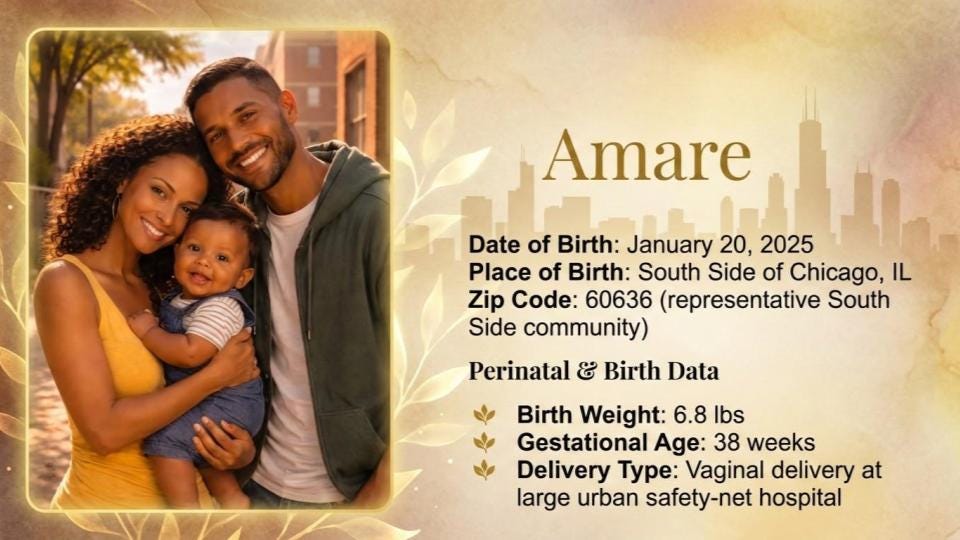
I came into this world on a gray January afternoon in 2026, at the University of Chicago Medical Center. My mama jokes that I couldn’t wait—came two weeks early, like I was in a hurry to get started. She says I came out crying loud, fists clenched, already fighting.
She says that’s good. Says I’ll need that fight.
I was born in ZIP code 60619—Chatham and Avalon Park, on Chicago’s South Side. If you know the city, you know what that means. If you don’t, let me explain.
The Neighborhood That Raised Generations
Chatham used to be different. My grandmother tells me stories—back in the ‘60s and ‘70s, this was a thriving Black middle-class neighborhood. Doctors, teachers, postal workers, families who’d fled the deep South looking for opportunity and found it here. Tree-lined streets. Block clubs. Homeownership. Pride.
But that was before the disinvestment. Before the redlining that’s still visible if you know where to look.
You can see it in the maps—literal red lines drawn around neighborhoods like mine decades ago, marking them as “hazardous” for investment. Banks wouldn’t give mortgages. Businesses wouldn’t open. The city stopped maintaining infrastructure. And when white families left, they took the tax base with them.
What’s left? ZIP code 60619 in 2026:
Median household income: $32,000 (Chicago average: $65,000)
Poverty rate: 34% (more than double the city average)
Unemployment: 16% (triple the national average)
Vacant lots and boarded-up buildings on blocks that used to bustle
Food deserts—nearest full-service grocery store is a 25-minute bus ride
Bank branches replaced by currency exchanges that charge 3% to cash a check
This is my inheritance. Not the wealth my great-grandparents tried to build—that got extracted, redlined, divested away. What I inherited is the aftermath.
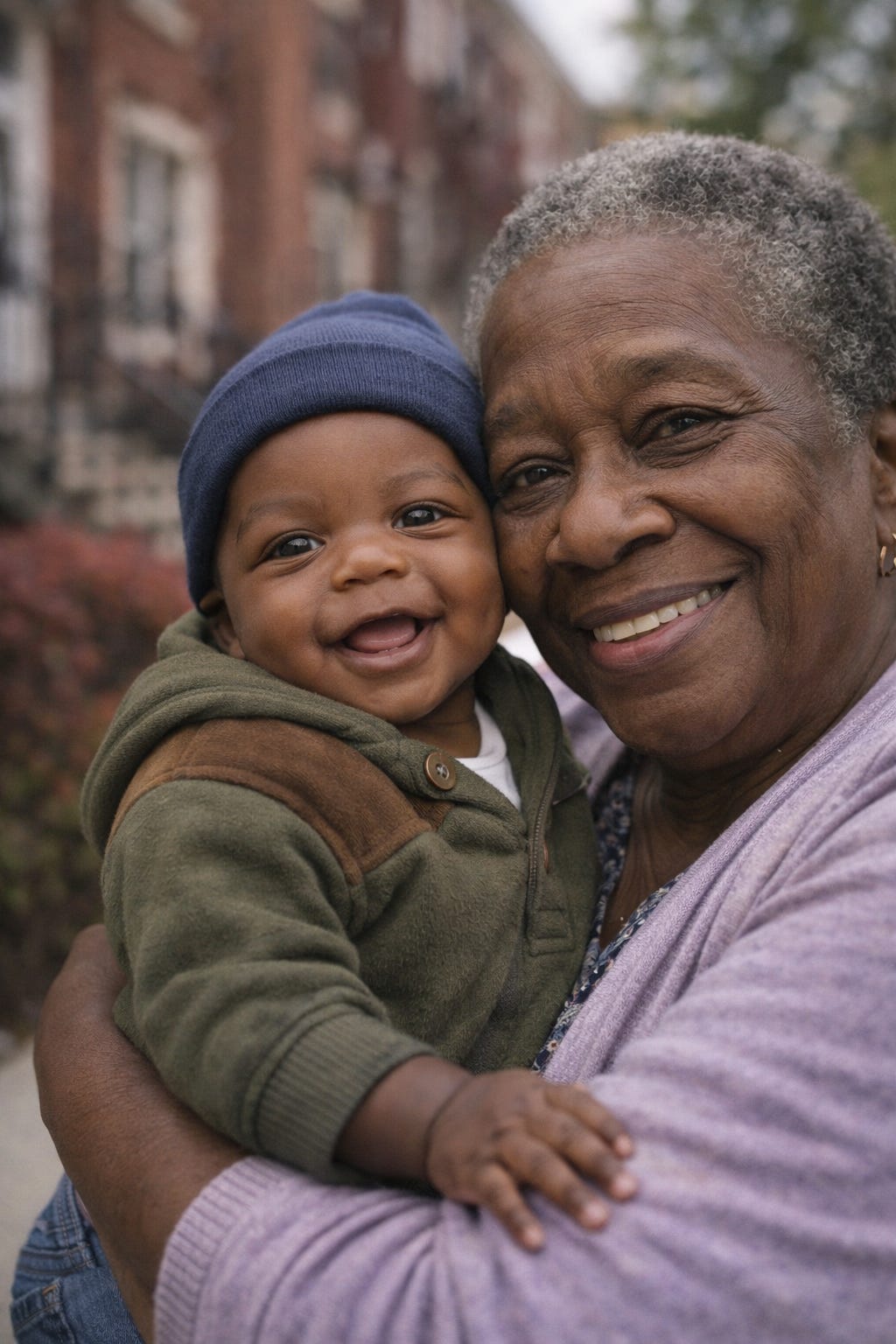
Mother: Working Twice as Hard
My mama is 26 years old. Her name is Keisha, and she works two jobs.
Days, she’s a medical assistant at a community clinic in Englewood—$16.50 an hour, helping people who look like her access the healthcare they need. She takes blood pressure, updates charts, translates medical jargon into language people can understand, holds hands when test results come back bad.
Evenings and weekends, she works retail at a Target in the Loop—$15 an hour, employee discount she can’t really afford to use, standing on her feet for six-hour shifts, coming home after I’m already asleep.
She brings in about $2,600 a month before taxes. After taxes, closer to $2,100.
Our rent for a two-bedroom apartment in a building that needs work? $1,100.
That leaves $1,000 for everything else. Food. Utilities. Diapers. Formula when her milk dried up from stress and exhaustion. The CTA pass she needs to get to both jobs. Her phone. Internet. The debt from the hospital bill when I was born, even with Medicaid—there were “additional fees” they said weren’t covered.
She qualifies for Medicaid. She qualifies for SNAP (we get $189/month in food assistance). She qualifies for WIC.
And she’s grateful for it—it’s what’s keeping us alive—but she also knows what people say. She hears the words. “Welfare.” “Handout.” “Why doesn’t she just work harder?”
She works 65 hours a week and still can’t afford childcare.
My Father: The Conviction That Won’t Fade
My father’s name is Marcus. He’s 28. And he’s trying.
When he was 19, he got caught with half an ounce of weed. Possession with intent to distribute, they called it, even though he was just selling to friends to make rent. He took a plea deal—18 months probation, a misdemeanor conviction.
That was nine years ago. The conviction is still following him.
He applies for jobs—warehouse work, delivery driver, retail, anything. He’s applied to over 60 places in the last year. Most don’t call back. The ones that do, he makes it to the interview, fills out the background check form, checks the box that says “yes, I have been convicted of a crime,” and then... silence.
There are companies that say they’ll hire people with records. But they’re not calling him back either. Maybe it’s the job market. Maybe it’s something else. He doesn’t know. Not knowing is its own kind of torture.
Right now, he does gig work—DoorDash, Instacart, whatever he can get. Some weeks he makes $400. Some weeks, $150. It’s unpredictable. No benefits. No stability. He uses his cousin’s car and pays him gas money.
He wants to be more for me. He aches to be more. But the system isn’t built for second chances—it’s built for permanent punishment.
The Air I Breathe
Let me tell you about the air in ZIP code 60619.
I have a three times higher chance of developing childhood asthma than kids born in wealthier, whiter parts of Chicago. Three times.
Why? Because my neighborhood sits near:
The Bishop Ford Freeway (I-94), with constant diesel truck traffic
Industrial sites that were zoned here decades ago because Black neighborhoods had less political power to fight back
Warehouses and distribution centers that operate 24/7, spewing particulates into the air
The environmental racism is measurable. Literally. Air quality monitors show it. Hospitalization rates prove it.
My mama already has an inhaler ready, just in case. I’m two weeks old, and she’s preparing for my lungs to struggle because of where we live.
The School That Lost Everything
Three blocks from our apartment is William E. Doar Elementary School. That’s where I’ll go when I’m old enough, if we’re still here.
Last year, Chicago Public Schools cut funding. Doar lost:
Two teaching positions
The art program
The full-time nurse (now shared with two other schools)
After-school tutoring
Music class
The library is still there, technically, but the librarian position was eliminated. It’s staffed by parent volunteers now, open three days a week.
The community center that used to offer free childcare, youth programs, job training? Cut its hours from six days to three. My mama was relying on that for when she went back to work.
Meanwhile, schools in Lincoln Park and Lakeview—wealthier, whiter neighborhoods—they’re getting new STEM labs and renovated playgrounds.
Same city. Different worlds.
Living with Fear
Here’s something that doesn’t make sense: my family is American. My mama was born in Chicago. My father was born in Chicago. I was born in Chicago. We’re citizens.
But under the new administration’s enforcement priorities, ICE activity has intensified in neighborhoods like ours. Not because people here are undocumented at higher rates—but because these are the neighborhoods where enforcement happens visibly, aggressively, as a deterrent.
Our neighbor, Mrs. Rodriguez, is undocumented. She’s lived here for 15 years, works as a home health aide, takes care of elderly people for $12 an hour. Last month, ICE agents came to the building next door. Mrs. Rodriguez didn’t leave her apartment for three days.
My mama isn’t undocumented. But she’s afraid anyway. Because fear doesn’t check documentation. Fear spreads. And when authority shows up in your neighborhood with that kind of force, everyone feels vulnerable, everyone feels targeted, whether they’re “legal” or not.
It’s stress. Constant, low-level stress. And stress does things to a body—raises blood pressure, disrupts sleep, makes it harder to fight off illness.
I’m breathing that stress in from day one.
My Likely Trajectory
Let me tell you what the data says about babies born in ZIP code 60619:
Health:
Infant mortality rate: 11.2 per 1,000 live births (national average: 5.4)
Premature birth rate: 14.3% (national: 10.4%)
By age 5: likely to have experienced multiple ACEs (Adverse Childhood Experiences)—poverty, housing instability, community violence, parental stress
Childhood asthma: 3x national average
Food insecurity affecting development and immune function
Early Childhood:
Childcare access: limited and expensive ($1,200+/month for quality care—nearly half my mama’s income)
Early literacy gaps emerging by age 3 due to parental work demands, limited access to books and enrichment
Likely to enter kindergarten already behind wealthier peers in vocabulary, number recognition, social-emotional skills
Education:
CPS schools in South Side neighborhoods: chronically underfunded, high teacher turnover
By 8th grade: reading and math proficiency rates 30-40 percentage points below state averages
High school graduation rate for neighborhood schools: around 70% (state average: 88%)
College enrollment: approximately 45%, but only 15% complete a four-year degree
School-to-prison pipeline risks elevated due to over-policing, zero-tolerance discipline policies
Economic Outcomes:
Without college degree: median lifetime earnings around $1.2 million
Even with degree: wage gaps persist (Black college graduates earn 20% less than white counterparts)
Likely employment in service sector, healthcare support, transportation—essential work, undervalued pay
Homeownership: statistically unlikely (current homeownership rate in 60619: 38%, compared to 68% citywide)
Wealth accumulation: nearly impossible (median Black family wealth: $24,000 vs. $189,000 for white families)
Criminal Justice:
By age 23: statistically, 1 in 3 Black men will have had some contact with criminal justice system
Incarceration rates for South Side neighborhoods: 5-7 times higher than North Side
Even without personal conviction: impacts through family members, community trauma, over-policing
Life Expectancy:
ZIP code 60619: 72.9 years
ZIP code 60614 (Lincoln Park, wealthy/white neighborhood): 85.2 years
Same city. 12-year life expectancy gap.
But Numbers Don’t Tell the Whole Story
Here’s what the statistics can’t measure:
My mama’s love—fierce, protective, unwavering. The way she sings to me even when she’s exhausted. The way she’s already talking to me about college, about possibilities, about refusing to let this zip code define my ceiling.
My father’s determination—the way he keeps applying, keeps hustling, keeps showing up even when the world keeps shutting him out.
My grandmother’s wisdom—three generations deep, stories of migration and survival, recipes and remedies, a faith that’s been tested and hasn’t broken.
The community—block club meetings, churches that feed people, neighbors who watch out for each other’s kids, mutual aid networks that fill gaps the government won’t.
There’s brilliance here. Creativity. Resilience. Code-switchers and boundary-breakers. People who make miracles out of crumbs.
I could be anything. A doctor. An engineer. An artist. A teacher. A leader.
But it shouldn’t be this hard.
What My First 1,000 Days Need
I need clean air to breathe without developing asthma.
I need my mama to have affordable childcare so she can work without breaking herself.
I need my father to get a fair shot at employment despite a mistake he made at 19.
I need schools that invest in me instead of managing my failure.
I need a healthcare system that sees my zip code and doesn’t pre-diagnose my outcomes.
I need policies that acknowledge the generational theft—redlining, disinvestment, extraction—and actually repair it, not with symbolic gestures but with resources and power.
I need a country that stops acting like my neighborhood’s struggle is a moral failing instead of a policy choice.
The Legacy of Extraction
My zip code didn’t happen by accident. It was designed.
Redlining was policy. Disinvestment was policy. Highway construction that cut through Black neighborhoods was policy. Pollution zoning was policy. School funding formulas were policy. Policing strategies were policy.
For generations, wealth was extracted from communities like mine and funneled elsewhere. And now we’re told to pull ourselves up, to be resilient, to stop complaining.
We are resilient. We’ve had to be.
But resilience isn’t a substitute for justice.
[A mother’s humming. A baby’s breath, steady and strong. The sound of a city that built itself on the backs of people it’s still trying to forget.]
My name is Amare.
I was born on the South Side of Chicago, in ZIP code 60619.
My story is just beginning.
And I deserve the same promise—the same chance at life, liberty, and the pursuit of happiness—as any baby born anywhere in this country.
That’s not a favor. That’s not charity.
That’s the deal America made.
It’s time to keep it.