
DISCLAIMER:
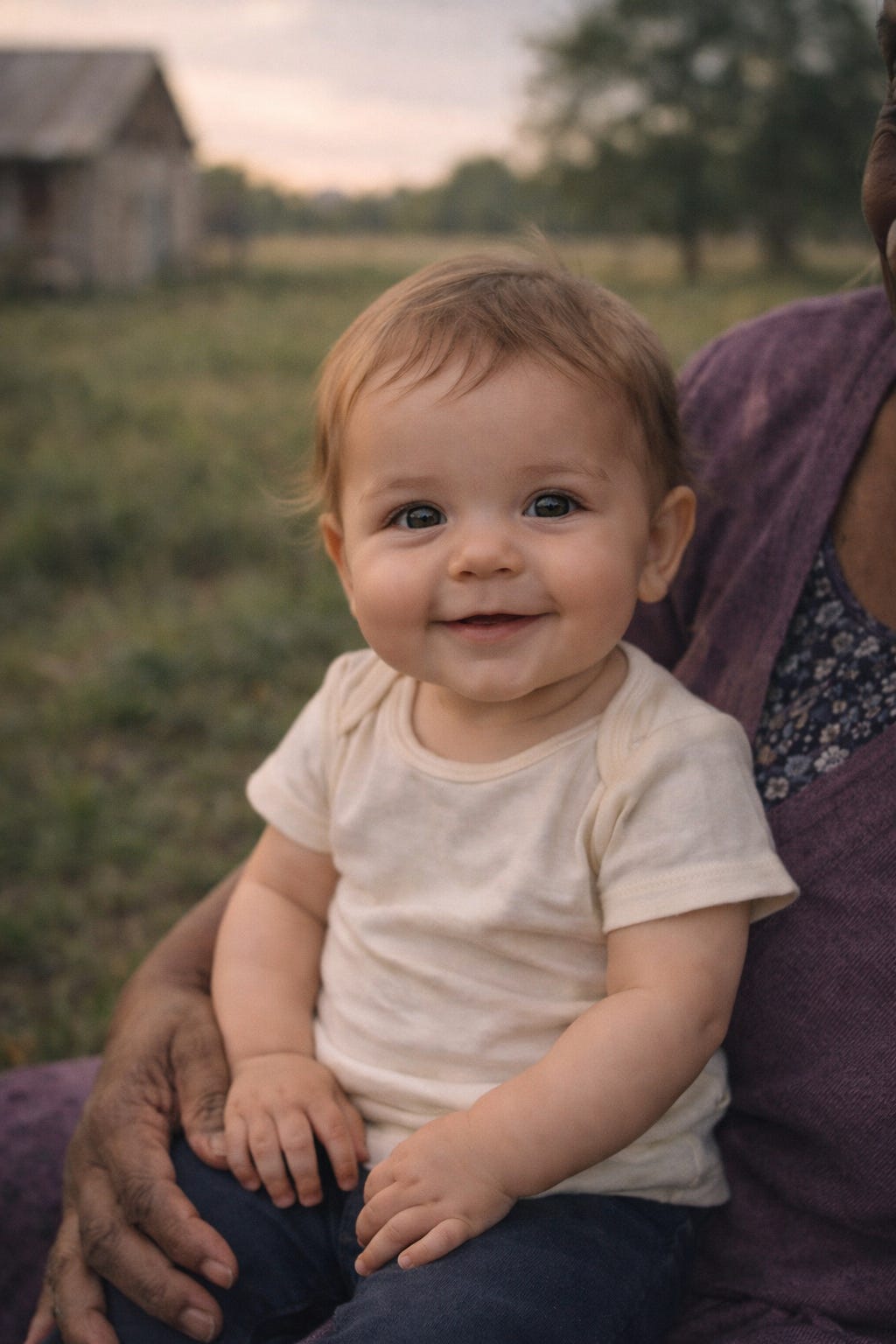
The five Moonshot Babies are AI-generated composites and images, not real individuals
The communities are real places, drawn on through AI-facilitated data and research, used as representative settings rather than precise portraits of those localities
They serve as a vehicle to understand varied American experiences from birth
Readers uncomfortable with AI-generated content may choose not to engage
Feedback to improve accuracy is welcomed
Hey. I’m Eva.
Born January 20, 2025 | Tompkinsville, Kentucky, Zip Code 42167 | Rep. James Comer (R-KY-1)
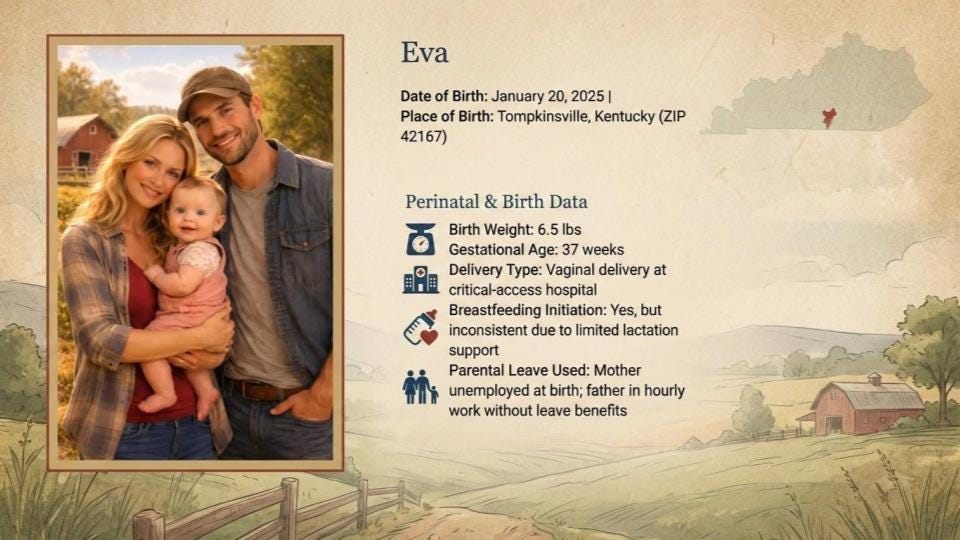
I was born on a cold January night in 2025 at Monroe County Medical Center in Tompkinsville, Kentucky—a 49-bed rural hospital that’s one of the few left standing in communities like mine.
My mama’s water broke around 9 PM. My grandmother drove her the three miles into town because my daddy was working a night shift hauling equipment an hour away in Glasgow and couldn’t get back in time. They made it to the hospital—barely heated, understaffed, but there.
I came into the world in ZIP code 42167—Tompkinsville, Kentucky. Population 2,300. Monroe County seat. The place my family has called home for five generations.
And it’s a place that America has largely forgotten.
The Town That’s Barely Holding On
Tompkinsville sits in south-central Kentucky, right on the Tennessee border. It’s the county seat of Monroe County—population around 11,000 and declining. We’re in Congressman James Comer’s 1st Congressional District, which sprawls across 19 counties of rural western and south-central Kentucky.
Monroe County is 95% white, with a median household income of $35,000. The poverty rate hovers around 24%—nearly one in four people here lives below the federal poverty line. For children under 18, it’s worse: 32% live in poverty.
We still have a hospital—Monroe County Medical Center. It’s small, 49 beds, struggling financially, and there’s talk every few years about whether it can stay open. When big hospital systems decided rural healthcare wasn’t profitable enough, places like Tompkinsville were left with skeleton infrastructure held together by determination and prayer.
The hospital has basic services: emergency room, some surgeries, X-rays, lab work. But for anything specialized—pediatric care, OB complications, neonatal intensive care—you’re driving an hour to Bowling Green or Nashville.
We have one pediatrician in the entire county. One. Serving roughly 2,000 children. She’s in Tompkinsville two days a week, the rest of the time she’s in other counties trying to cover the gaps. Wait time for a well-child visit: 4-6 weeks. If I get really sick, my mama will have to drive me an hour to a children’s hospital.
The federally qualified health clinic in town operates on a shoestring budget, chronically understaffed, dependent on grant funding that’s always uncertain.
What else is here? A pharmacy. A Dollar General. A few gas stations. A handful of locally owned businesses barely hanging on. And a whole lot of boarded-up buildings on Main Street—ghosts of what used to be.
My Mother: Working Hard and Getting Nowhere
My mama’s name is Sarah. She’s 24 years old.
She graduated from Monroe County High School—one of the 84% who do, which sounds good until you realize that 84% still leaves too many behind, and graduation doesn’t mean the same thing everywhere. She wanted to go to college, maybe become a dental hygienist, but there was no money for that and no clear pathway to make it happen.
So she stayed.
She works at the Tompkinsville Nursing Home as a CNA (Certified Nursing Assistant). She makes $13 an hour, works 35 hours a week (they keep her just under full-time so they don’t have to provide health benefits). That’s about $1,820 a month before taxes. After taxes, closer to $1,450.
She lives with my grandmother in a house they rent for $550 a month—a drafty two-bedroom place with a furnace that breaks down every winter, insulation that’s falling apart, and a roof that needs replacing but the landlord (who lives in Nashville) won’t fix.
My mama doesn’t have health insurance. She makes too much to qualify for Medicaid in Kentucky—barely. The cutoff is strict, and she’s just above it. But she can’t afford private insurance. A marketplace plan would cost her $320/month with a $6,500 deductible. That’s impossible on her income.
So when she got pregnant with me, she went to the health department for prenatal care. They could see her once every four weeks, check her blood pressure, give her vitamins, test her urine. But there were no ultrasounds available there—for that, she had to drive to Glasgow and pay out of pocket ($200 she borrowed from her sister). No specialists if something went wrong. Just basic monitoring and hope.
She qualified for WIC (Women, Infants, and Children), which gave her vouchers for milk, eggs, cereal, juice, formula once I arrived. It helped. But the nearest grocery store that carries a decent selection is the Walmart in Glasgow, 20 miles away. Gas money to get there eats into everything else.
My Father: Three Jobs, Still Not Enough
My daddy’s name is Jason. He’s 26.
He works three jobs:
Hauling and equipment operator for a local construction company—$15/hour, irregular hours depending on weather and whether there’s work. Sometimes 40 hours a week, sometimes 15.
Night shift at the Amazon warehouse in Bowling Green—45 minutes away, $16.50/hour, grueling physical work, inconsistent scheduling.
Weekend farm work for a cattle operation outside of town—$14/hour cash when they need extra hands.
On a good month, he brings in around $2,400. On a slow month, it’s $1,600. There’s no consistency, no benefits, no security.
He drives a 2012 Chevy Silverado that he needs for work—truck payment is $340/month, insurance $180, gas $350 (all those miles to Bowling Green add up). After that, what’s left goes to my mama and to the small apartment he rents with a buddy for $400/month.
He doesn’t have health insurance either. Last year when he wrenched his back moving equipment, he took ibuprofen and kept working because he couldn’t afford to see a doctor or take time off.
He wants to be there for me. He wants to provide. But the math doesn’t work. The jobs don’t pay enough. The hours aren’t stable. And there’s nowhere else to go—Tompkinsville doesn’t have jobs, and moving somewhere with more opportunities requires money he doesn’t have.
The Healthcare Desert I Was Born Into
Let me tell you what healthcare access looks like in Monroe County, Kentucky:
For children:
One pediatrician for every 2,000+ children (national average: 1 per 1,500)
That pediatrician operates out of a small clinic, two days a week
Wait time for well-child visits: 4-6 weeks
For specialists (developmental pediatrics, pediatric neurology, pediatric cardiology): 60+ miles away
For emergency pediatric care: Monroe County Medical Center ER, then transport to Bowling Green or Nashville if serious
Infant mortality:
Monroe County: 8.2 deaths per 1,000 live births
Kentucky average: 6.5 per 1,000
National average: 5.4 per 1,000
Rural Kentucky has significantly higher infant mortality than urban areas
Maternal health:
Kentucky maternal mortality: 28.4 deaths per 100,000 births (national average: 23.8)
Monroe County has no OB/GYN—high-risk pregnancies must be managed in Glasgow or Bowling Green
Prenatal care is limited to basic health department services
My mama’s biggest fear during pregnancy was something going wrong and not being able to get help in time
Chronic disease:
Diabetes prevalence: 15% (national average: 10.5%)
Hypertension: 38% of adults
Obesity: 42% of adults
Heart disease: Leading cause of death, well above national rates
Life expectancy: 74.2 years (national average: 78.9 years)
This is what happens when healthcare follows profit, not need. Rural communities get what’s left over. And what’s left over isn’t enough.
The Nutrition Challenge
We qualify for SNAP benefits (food stamps)—my mama receives $291/month for the two of us.
We also qualify for WIC, which provides specific foods: formula, baby food, milk, eggs, cereal, juice, peanut butter.
But accessing that food is harder than it sounds.
The closest full grocery store is the Walmart in Glasgow, 20 miles away. Tompkinsville has a small IGA grocery, but prices are higher and selection is limited—often no fresh produce, limited healthy options, minimal WIC-approved items.
What we do have in Tompkinsville:
Dollar General (processed food, almost no fresh produce, higher prices than Walmart)
A couple of gas stations that sell chips, candy, soda, maybe milk
The small IGA with limited stock
This is called a food desert. And it means I’m more likely to grow up without consistent access to nutritious food—not because my family doesn’t care, but because access itself is a barrier.
When gas prices go up, we eat what’s closest. When the car breaks down (and it does, regularly—my grandmother’s 2009 Toyota has 185,000 miles), we make do with what’s in town. That usually means processed food, high in calories, low in nutrients.
For an infant whose brain is developing at a million neural connections per second, inconsistent nutrition has consequences. Developmental delays. Cognitive gaps. Health problems that emerge later but start now.
The Infrastructure That Isn’t There
Let me tell you what else is missing in Monroe County, Kentucky:
No public transportation. If you don’t have a car, you don’t go anywhere. Doctor’s appointments, job interviews, grocery shopping—all impossible without a vehicle. And keeping a car running on poverty wages is a constant crisis.
Limited broadband internet. Parts of the county have no high-speed internet at all. My grandmother’s house has slow DSL that cuts out regularly. My mama can’t work from home even if such jobs existed here. When I’m school-aged, I won’t be able to do homework that requires streaming video or fast downloads. Rural Kentucky is being left behind in the digital economy.
Aging water and sewer systems. Tompkinsville’s water system is old, constantly needing repairs the town can’t afford. There have been boil-water advisories. My grandmother boils our water anyway, just to be safe. I’ll be bathed in water we’re not entirely confident is clean.
Underfunded schools. Monroe County Schools are struggling—low per-pupil funding, teacher shortages (starting salary for teachers: $39,000, hard to live on when housing and gas costs eat up paychecks), aging facilities, limited resources. Per-pupil spending: roughly $10,200/year (compared to $22,000+ in wealthy districts). Test scores lag state averages, which already lag national averages.
Almost no childcare. There’s one licensed childcare center in the county, with a waiting list. Cost: $600-700/month, which my mama can’t afford anyway. When she goes back to work, I’ll stay with my grandmother, who’s 58, has type 2 diabetes, high blood pressure, and chronic back pain. She’ll do her best. She loves me. But she’s tired, and she’s not trained in early childhood development.
No jobs. Unemployment in Monroe County officially: 5.8%. But that doesn’t count people who’ve stopped looking, who work part-time and want full-time, who string together gig work and side hustles. Real economic insecurity is much higher. The jobs that exist: nursing home CNAs, Dollar General cashiers, fast food, farm labor, construction when it’s available. Almost nothing pays a living wage. Almost nothing offers benefits.
My Likely Trajectory
Let me tell you what the data says about babies born in Monroe County, Kentucky:
Health:
Higher risk of infant mortality than state or national averages
Limited access to vaccinations, well-child visits, developmental screening
If I have delays—speech, motor, cognitive—early intervention services are 30-60 miles away and my family may not be able to access them
High likelihood of childhood obesity, asthma, dental problems by elementary school
Life expectancy if I make it to adulthood: 74.2 years (four years less than national average)
Early Childhood:
No access to quality early childhood education (Head Start exists but is underfunded and has waiting lists)
Likely cared for by my grandmother while my mama works—loving care but not developmentally optimized
Language and cognitive gaps emerging by age 3 due to limited exposure to books, educational toys, enrichment activities
Food insecurity affecting brain development
High ACEs (Adverse Childhood Experiences): poverty, housing instability, family stress
Education:
Monroe County Schools: struggling, under-resourced
By 4th grade: statistically likely to be reading below grade level
High school graduation rate: 84% (sounds okay until you realize 16% don’t finish, and those who do often aren’t college-ready)
College enrollment: around 40% (many go to community college, fewer to four-year schools)
College completion: less than 20% of those who enroll
Economic Outcomes:
Without high school diploma: median lifetime earnings around $900,000
With diploma but no further education: median lifetime earnings around $1.3 million
Limited local opportunities mean leaving home or accepting low-wage service work
Homeownership: difficult (median home value in Monroe County: $88,000, but saving for a down payment on poverty wages is nearly impossible)
Wealth accumulation: unlikely
Retirement security: minimal to none—Social Security, if it still exists
Life Trajectory:
Statistically likely to remain in or near Monroe County due to family ties, lack of resources to relocate, emotional attachment to home
Likely to experience chronic financial strain
If female: higher risk of early pregnancy, single parenthood
Higher risk of substance abuse issues (Kentucky’s opioid crisis has hit rural areas hard)
Likely to need public assistance at some point
The cycle continues to the next generation
But I Am Loved
Here’s what the statistics can’t measure:
My grandmother raised five children in this county, kept them fed, kept them safe, kept them believing in something better. She knows every home remedy, every garden technique, every survival strategy. She’s the backbone of this family.
My mama is 24 years old and fiercely determined that I will have more than she did. She reads to me even though she’s exhausted from double shifts. She sings me old country songs and church hymns. She talks to me like I understand every word, building my vocabulary from day one. She’s doing everything right with the resources she has.
My daddy works himself to exhaustion because he wants to provide. He wants to be there. He wants me to know I matter, that I’m worth fighting for.
There’s community here—church members who bring by diapers and hand-me-down clothes, neighbors who check in, my mama’s coworkers who cover shifts when she needs them, extended family scattered across the county who help when they can.
There’s resilience. There’s dignity. There’s love.
But love isn’t infrastructure.
Love doesn’t replace a pediatrician.
Love doesn’t fill nutrition gaps.
Love doesn’t fix underfunded schools.
My family is doing everything possible. The failure isn’t theirs. It’s the system’s.
What My First 1,000 Days Actually Need
I need a pediatrician I can see when I’m sick, not a month from now when the appointment finally opens up.
I need developmental screening so delays are caught early, when intervention is most effective—and I need that intervention to be accessible, not 60 miles away requiring time and gas money my family doesn’t have.
I need clean, safe water I can drink and bathe in without my family worrying.
I need nutritious food that’s actually accessible—a grocery store in my town with fresh produce at prices my family can afford.
I need my mama to have healthcare so she can stay healthy and care for me. If she gets sick, we’re in crisis.
I need quality childcare while she works—not just supervision, but developmentally appropriate care that supports my learning, my language, my social-emotional growth.
I need schools that are funded, staffed, equipped to actually educate me—not babysit me until I’m old enough to leave.
I need broadband internet so I’m not educationally isolated in the 21st century.
I need my parents to have jobs that pay living wages, that offer stability, that don’t require choosing between paying rent and buying groceries.
I need economic investment in places like Tompkinsville—not the extraction economy that takes our labor and wealth and gives nothing back, but real investment in infrastructure, jobs, opportunity.
I need a country that sees rural communities like mine as worthy of the same resources, the same attention, the same commitment as wealthy suburbs.
The Abandonment Is a Choice
Monroe County, Kentucky, didn’t happen by accident. Rural healthcare deserts aren’t natural phenomena. Economic decline in small towns isn’t inevitable.
This is the result of policy choices:
Healthcare: Decades of hospital consolidation and profit-driven care that abandoned rural areas. Reimbursement rates that make rural practice unsustainable. Medical school debt that pushes doctors to high-paying urban and suburban markets. Kentucky’s struggle with Medicaid expansion and funding.
Economic: Trade policies that hollowed out manufacturing. Agricultural policies that favor massive corporate operations over family farms. Decline of coal (we’re not in coal country, but the ripple effects reach us). No economic development strategy for rural America beyond “move somewhere else.”
Education: Funding formulas that penalize poor districts. Property tax bases that can’t support quality schools. Teacher shortages because we can’t pay competitive salaries. Technology gaps that leave rural kids behind.
Infrastructure: Decades of underinvestment in rural roads, bridges, water systems, broadband. The assumption that if you want services, you should move to cities. The quiet message that rural lives don’t matter as much.
Political: Gerrymandering that dilutes rural voices. Low voter turnout born of justified cynicism. Politicians who campaign on rural values but vote for policies that hurt rural communities. The urban-rural divide weaponized for political advantage rather than addressed through policy.
Congressman James Comer represents this district. He represents me. And I’m asking: what is he doing to ensure babies born in Monroe County have the same chance as babies born in wealthy districts?
The Question I Raise
I’m two weeks old. I didn’t choose to be born in Tompkinsville, Kentucky.
But I was.
And the likelihood of my survival, my health, my education, my economic future is already dramatically different from a baby born in Chestnut Hill, Massachusetts—not because I’m less deserving, not because my family loves me less, not because I have less potential.
Because of a ZIP code.
Is that the America we believe in?
An America where your life expectancy drops four years because you were born rural instead of suburban? Where seeing a pediatrician in a timely way is a privilege? Where accessing nutritious food requires a car and gas money? Where quality education depends on your county’s property values? Where opportunity is concentrated in cities and suburbs while small towns are left to die?
The Declaration of Independence says all people are created equal. It says we have unalienable rights to life, liberty, and the pursuit of happiness.
But in Monroe County, Kentucky, in 2025, those words ring hollow.
Because I don’t have an equal shot at life—my healthcare access is a fraction of what wealthy children receive.
I don’t have liberty—poverty is a cage, lack of infrastructure is a cage, being born in a place that policy has abandoned is a cage.
And the pursuit of happiness? That requires foundation, opportunity, a pathway to build on.
Right now, I have love. I have family. I have fight.
But I don’t have what Emma has in Chestnut Hill. I don’t even have what Liam has in Somerset, Pennsylvania.
And the gap between us? That’s not natural. That’s engineered.
Congressman Comer: I Am Your Constituent
My name is Eva.
I was born January 20, 2025, in Tompkinsville, Kentucky, ZIP code 42167.
I am your constituent, Congressman Comer.
You represent Kentucky’s 1st Congressional District. You represent Monroe County. You represent my family.
You supported Trump Accounts—giving me a financial investment that will grow to maybe $5,800 by the time I’m 18.
Thank you.
But here’s my question: what good is $5,800 in 2043 if I don’t survive my first year because healthcare was too far away? If developmental delays go unaddressed because services were inaccessible? If I can’t read well enough to fill out a college application? If chronic health problems from malnutrition limit my life?
Financial capital at 18 doesn’t matter if I don’t receive human capital in my first 1,000 days.
You chair the House Oversight Committee. You investigate government failures. You demand accountability.
So I’m asking: will you investigate the failure happening in your own district? The healthcare deserts, the childcare gaps, the underfunded schools, the infrastructure crumbling around families like mine?
Will you champion the policy changes that rural Kentucky desperately needs:
Rural healthcare infrastructure investment
Telehealth for developmental screening
Mobile early intervention services
Affordable quality childcare
Broadband expansion
School funding that doesn’t penalize poor districts
Economic development that creates real jobs, not just more Dollar Generals
Or will you campaign on rural values while voting for policies that don’t support rural children?
I can’t vote yet. I can’t call your office. I can’t donate to your campaign.
But in 2043, when I turn 18, I will remember.
And so will every parent in Monroe County who’s watching to see whether you fight for us or forget us.
My name is Eva.
I was born in Tompkinsville, Kentucky, ZIP code 42167.
My story is just beginning.
And I’m asking—Congressman Comer, the rest of Congress, the President, every policymaker who claims to care about children:
When will America keep its promise to me?
Not someday. Not eventually.
Now.
Because I deserve the same chance at life that every baby born in this country deserves.
Not because of charity. Not because of pity.
Because it’s right.
Because rural children matter as much as urban children.
Because Kentucky matters as much as Massachusetts.
Because ZIP code 42167 deserves the same investment as ZIP code 02467.
And because a nation that abandons its children—especially its most vulnerable—has abandoned its soul.
Eva - Born January 20, 2025
Tompkinsville, Kentucky 42167
Monroe County
Represented by Congressman James Comer (R-KY-1)
First 1,000 Days: In progress
Future: Up to us