


DISCLAIMER:
The five Moonshot Babies are AI-generated composites and images, not real individuals
The communities are real places, drawn on through AI-facilitated data and research, used as representative settings rather than precise portraits of those localities
They serve as a vehicle to understand varied American experiences from birth
Readers uncomfortable with AI-generated content may choose not to engage
Feedback to improve accuracy is welcomed
Hola. I’m Mateo.
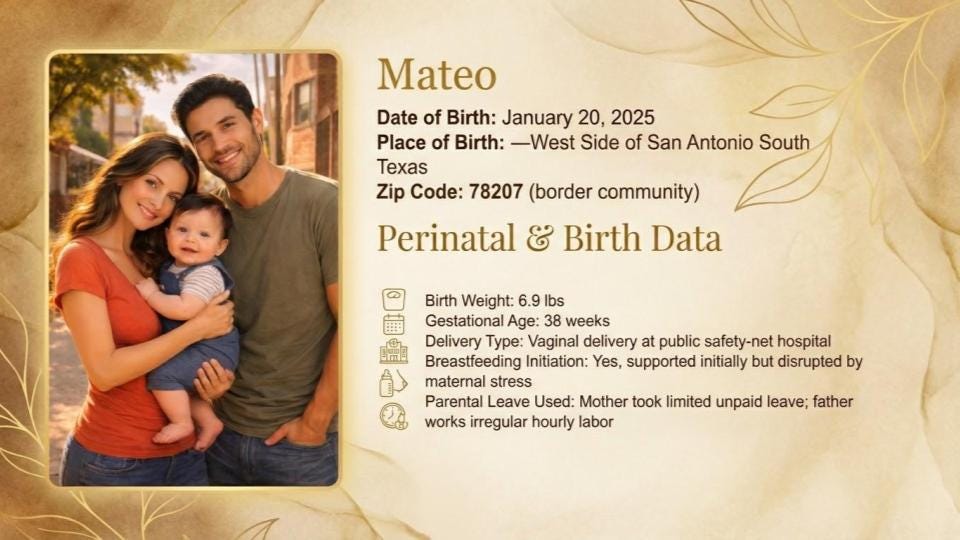
I was born on a January afternoon in 2026 at University Hospital in San Antonio, Texas. I came into the world crying, healthy, a U.S. citizen from my first breath. The nurse put a little bracelet on my wrist with my name, my birthday, my medical record number. Official. Legal. American.
But my parents looked at that bracelet and felt something most parents don’t feel in that moment: terror.
Because I may be a citizen, but they’re not.
I live in ZIP code 78207—the West Side of San Antonio, a predominantly Latino, working-class neighborhood where the streets have Spanish names, where you can smell barbacoa on Sunday mornings, where quinceañeras spill out of church halls, where corner stores sell chicharrones and Jarritos, where murals honor Cesar Chavez and the Virgin of Guadalupe.
This is home. This is community. This is culture.
And this is where families like mine live in constant, grinding fear.
My Mother: Undocumented and Invisible
My mother’s name is Rosa. She’s 28 years old.
She crossed the border when she was 16, with her older brother, fleeing violence in Guerrero, Mexico—cartel violence that had already taken her uncle and two cousins. They paid a coyote $4,000 her family scraped together. They walked through the desert for three days. She still has scars on her feet.
She made it to San Antonio, where her aunt lived. She finished high school at a small alternative school that didn’t ask too many questions. She learned English. She worked under the table—cleaning houses, babysitting, working in restaurant kitchens.
She’s been here for 12 years now. She has no criminal record. She pays taxes using an ITIN (Individual Taxpayer Identification Number). She’s woven into the fabric of this city. But legally, she doesn’t exist.
She has no papers. No social security number. No driver’s license (Texas doesn’t issue them to undocumented immigrants). No path to citizenship. No protection.
She works as a housekeeper for a cleaning company that contracts with hotels and office buildings. She makes $11/hour, cash, no benefits, no overtime pay, no worker protections. If she’s injured on the job, she can’t file a claim. If her boss doesn’t pay her, she can’t complain. If she’s harassed, she stays silent.
She works 45 hours a week, bringing in about $1,980/month. She sends $300 of that back to her mother in Mexico every month. She’s been doing that for 12 years—over $40,000 sent home to keep her family alive.
My Father: DACA and the Sword of Damocles
My father’s name is Carlos. He’s 30 years old.
He was brought to the United States when he was 5 years old by his parents, who overstayed their visas. He grew up in San Antonio, went to school here, pledged allegiance to the flag every morning, played on the high school soccer team, dreamed of joining the military.
When he turned 18, he found out he couldn’t. Couldn’t enlist. Couldn’t get federal financial aid for college. Couldn’t get a legal job. Couldn’t drive legally. He existed in a legal limbo—American in every way except on paper.
Then in 2012, President Obama created DACA—Deferred Action for Childhood Arrivals. My father applied immediately. He paid the $495 fee (borrowed from his aunt). He submitted his fingerprints, his background check, his school records, proof he’d been here continuously since he was a child.
And he got it. DACA status.
It gave him:
A work permit (renewable every two years)
A social security number
Protection from deportation (as long as he renewed on time and didn’t commit crimes)
The ability to get a driver’s license
It didn’t give him:
A path to citizenship
Permanent legal status
The ability to leave the country and return
Peace of mind
Because DACA was always temporary, always precarious, always under threat.
My father works as a construction laborer—framing houses, pouring concrete, roofing in the Texas heat. He makes $18/hour through a contractor who knows his DACA status. He brings in about $2,880/month before taxes. After taxes (yes, he pays taxes), about $2,400.
But that work permit? It expires in eight months. And under the current administration, DACA renewals are being challenged in court. There’s talk of ending the program entirely. Executive orders targeting “illegal immigration” create confusion about whether DACA recipients could be swept up in enforcement actions.
Every day, my father wakes up not knowing if this is the day he loses his work permit, his driver’s license, his ability to provide. Not knowing if this is the day he gets detained, deported, separated from me.
A sword hanging by a thread.
The Family That Lives in Shadows
Here’s what life looks like for a mixed-status family in San Antonio in 2026:
My parents don’t go to hospitals unless it’s life-or-death. When my mother was pregnant with me, she went to a community health clinic that serves uninsured patients—$40 per visit, sliding scale, no questions asked about immigration status. She got basic prenatal care, but no ultrasounds, no specialist consultations, no genetic testing.
When she went into labor, she was terrified to go to the hospital. Not because of the pain—because of what might happen. Would they ask for her papers? Would they report her? Would ICE be waiting?
They went because they had to. I was born. She was treated. They left as quickly as possible.
Now, I’m a U.S. citizen. I qualify for:
Medicaid (healthcare for low-income children)
WIC (nutritional assistance)
SNAP (food assistance)
Childcare subsidies
Early intervention services if I need them
But my parents won’t apply for most of these programs.
Why? Because under new “public charge” rules and heightened immigration enforcement, using public benefits can be used against immigrants in deportation proceedings or future immigration applications. Even though I’m the beneficiary and I’m a citizen, my mother’s undocumented status means the family is terrified that accessing benefits could put her at risk.
So we leave resources on the table. Resources I’m legally entitled to. Because fear is a more powerful force than law.
Living Under the New Enforcement Regime
In January 2025, the new administration took office with an explicit promise: mass deportation.
Since then, ZIP code 78207 has seen:
Increased ICE raids: Agents in unmarked vehicles outside schools, courthouses, grocery stores. Last month, a father dropping his daughter off at Herff Elementary was detained in the parking lot. The daughter watched from the car.
Workplace raids: A furniture factory on the South Side was raided in December. 47 workers detained. The factory reopened three days later with a new workforce. The detained workers? Some deported within weeks, families shattered.
“Papers, please” encounters: Local police—despite San Antonio’s official stance as a “sanctuary city”—are under pressure to cooperate with ICE. Traffic stops turn into immigration checks.
Community fear: Parents pull kids from school. People stop going to church. Families avoid grocery stores on certain days. The neighborhood has gone quiet in a way that feels like collective holding of breath.
My parents have a plan. If ICE comes:
My mother will try to run, to hide
My father, with DACA, might have a slightly better chance, but who knows
I’ll go to my tía (my father’s sister, who’s a citizen)
They’ve signed temporary guardianship papers so I won’t end up in foster care
I’m two weeks old, and my parents have already planned for the possibility that they’ll be ripped away from me.
The Daily Calculus of Fear
Every decision my parents make is filtered through the question: Will this expose us?
Healthcare:
My mother has a tooth that’s been hurting for months. She won’t go to the dentist. Too expensive, too risky.
My father injured his shoulder at work last week. He didn’t report it. Reporting means paperwork, attention, risk.
I have a cough. Is it serious enough to risk taking me to the doctor? How long do we wait?
Driving:
My mother can’t get a driver’s license. She drives anyway—to work, to the grocery store, to bring me to my abuela’s house—with an expired Mexican license and a constant knot of anxiety. If she gets pulled over, she could be detained.
My father has a license, but every time he sees police lights, his heart stops.
Work:
My mother’s boss knows she’s undocumented. He pays her less than minimum wage, makes her work off the clock, sometimes withholds pay. She says nothing because complaining means deportation.
My father’s contractor knows DACA status is precarious. He’s been told, implicitly, that if he complains about safety violations or asks for overtime pay, he’ll be replaced.
Money:
My parents can’t open a bank account easily (my father can with his SSN, my mother can’t). They cash checks at predatory check-cashing places that take 3-5% of every dollar.
They can’t get credit. Can’t get a mortgage. Can’t build assets.
They live paycheck to paycheck, unable to plan beyond next month.
Social connections:
They avoid crowds, official spaces, anywhere that might require ID or documentation.
They didn’t have a baby shower for me. Too risky to gather publicly.
They don’t travel, even within Texas. Checkpoints on highways become barriers.
This is what “living in the shadows” actually means. Not hiding in darkness—working, paying taxes, raising a family—but doing it all with the knowledge that at any moment, the life you’ve built can be erased.
The Healthcare Desert in My Own Language
ZIP code 78207 has limited access to bilingual pediatric care.
My parents speak Spanish primarily. My mother’s English is functional but limited. My father is fluent in both.
When I need medical care:
The nearest clinic with Spanish-speaking pediatricians is 40 minutes away by bus (my mother doesn’t drive legally, remember)
Most pediatricians’ offices require insurance and documentation up front
The community health clinic is overwhelmed—wait times for appointments are 4-6 weeks
Emergency rooms are the last resort, but they come with bills my family can’t pay
Language barriers in healthcare aren’t just inconvenient—they’re dangerous. Miscommunication about symptoms, medications, follow-up care can have serious consequences. Studies show Latino children are less likely to receive preventive care, less likely to be up-to-date on vaccinations, more likely to end up in the ER for conditions that could have been managed earlier.
Not because their parents don’t care. Because the system doesn’t accommodate them.
The Workplace Dangers
My father works in construction—one of the most dangerous industries in America.
In Texas, construction has:
The highest workplace fatality rate of any industry
Minimal safety enforcement (especially for immigrant workers)
Rampant wage theft
Few protections for workers who report violations
Last year in San Antonio, 68 construction workers died on the job. Many were immigrants. Most were never counted in official statistics.
My father has seen:
Workers fall from scaffolding because safety equipment wasn’t provided
Heat exhaustion and heatstroke (working in 105°F Texas summers with no water breaks)
Electrical shocks, equipment failures, trench collapses
He’s been injured himself—cuts, burns, a concussion when debris fell on him. He went back to work the next day every time. Reporting means losing the job. Losing the job means we don’t eat.
My mother’s work as a housekeeper is also dangerous:
Exposure to harsh chemicals without protective equipment
Repetitive stress injuries
Sexual harassment (which she endures silently)
No sick days, no health insurance
Worker exploitation isn’t a side effect of undocumented status—it’s the economic model. Entire industries rely on vulnerable workers who can’t complain.
My Likely Trajectory
Let me tell you what the data says about babies born in ZIP code 78207 to mixed-status families:
Health:
Lower rates of prenatal care leading to higher risk of complications
Underutilization of pediatric care due to fear and cost, leading to missed vaccinations, untreated conditions
Higher rates of childhood poverty (41% in 78207 vs. 12.8% nationally)
Food insecurity affecting development
Toxic stress from family instability, fear of separation, economic precarity
Early Childhood:
Limited access to early childhood education (Head Start requires documentation; private preschool is unaffordable)
Language development may be strong in Spanish but delayed in English, creating challenges when I enter an English-dominant school system
Developmental delays more likely to go undiagnosed and untreated
Education:
San Antonio ISD schools on the West Side are underfunded compared to North Side suburban schools
English Language Learner programs are often under-resourced
By 4th grade: likely to be behind in reading and math
High school graduation rate for Latino students in San Antonio: 78% (compared to 90%+ in wealthier districts)
College enrollment: approximately 50%, but completion rate is much lower
First-generation college student challenges: if I make it to college, I’ll navigate it without parents who understand the system
Family Stability:
Constant risk of parental deportation: studies show 5.5 million U.S. citizen children live with at least one undocumented parent
If my mother is deported: potential foster care placement, family separation, trauma
If my father loses DACA: loss of income, potential deportation
Childhood trauma from living with this uncertainty affects long-term mental health, academic performance, trust in institutions
Economic Outcomes:
Limited parental ability to invest in my education, enrichment, opportunities
Intergenerational poverty likely without significant intervention
Even if I succeed academically, family obligations may pull me into workforce early to support parents, siblings
Lifetime earnings reduced by educational gaps, economic starting point, family responsibilities
Social and Emotional:
Identity complexity: American by birth, Mexican by heritage, living between worlds
Trust issues with authority, institutions, systems
Chronic stress affecting mental and physical health long-term
Resilience, but at a cost
But I Am Not Just a Statistic
Here’s what the data doesn’t capture:
My abuela makes the best tamales in San Antonio. She teaches me prayers in Spanish and tells me stories about her village in Michoacán, about my grandfather who I’ll never meet, about resilience.
My parents love me fiercely. They left everything behind, risked everything, work themselves to exhaustion, live in fear—all so I could have a chance.
My community is strong. When someone gets detained, neighbors collect money for lawyers. When someone loses their job, the community shares food. When someone is afraid, we hold each other up.
There’s music—conjunto and norteño and banda playing at family gatherings. There’s food—my mother’s mole, my tía’s pozole. There’s language—Spanish that carries the rhythm of home. There’s faith—churches that offer sanctuary, not just spiritually but literally.
I’m growing up bilingual, bicultural, learning to navigate multiple worlds. That’s a strength, not a deficit.
But it shouldn’t come at the cost of living in fear.
What My First 1,000 Days Need
I need my parents to be able to access healthcare without terror—for themselves and for me.
I need my mother to have a path to legal status so she can work legally, drive legally, live without the daily fear of being ripped away from me.
I need my father’s DACA status to be permanent, not a political football tossed around every election cycle.
I need workplace protections so my parents aren’t exploited, so my father doesn’t die on a construction site for $18/hour.
I need to be able to access the benefits I’m legally entitled to as a U.S. citizen without my family being punished for it.
I need immigration policies that recognize my family’s humanity, contributions, and that I—a citizen—deserve to grow up with my parents.
I need schools that value bilingualism, that support English learners, that don’t see my heritage as a deficit.
I need a country that stops treating immigrant families like criminals and starts treating them like the essential workers, taxpayers, and community members they are.
The Cruelty Is the Point
My family pays taxes—my father through payroll deductions, my mother through sales tax and her ITIN. They contribute to Social Security they’ll never collect. They work jobs that keep this city running—building houses, cleaning offices, cooking food, caring for children.
But they’re told they’re criminals, invaders, drains on the system.
The truth? Undocumented immigrants pay $96 billion in federal, state, and local taxes every year. They’re ineligible for most federal benefits. They commit crimes at lower rates than native-born citizens. They’re essential to industries like agriculture, construction, hospitality, healthcare.
But facts don’t matter when the goal is cruelty.
Separating families isn’t about border security—it’s about punishment. Making people live in fear isn’t about law enforcement—it’s about control. Denying children like me the benefits we’re entitled to isn’t about fiscal responsibility—it’s about exclusion.
And I’m the one who pays the price.
I’m an American citizen, but I’ll grow up watching my parents look over their shoulders. I’ll grow up knowing that the country I was born in sees my family as disposable. I’ll grow up with trauma baked into my earliest memories—not from anything my parents did wrong, but from a system designed to terrorize people like them.
The Question I Raise
I didn’t choose to be born into a mixed-status family.
My parents didn’t choose to flee violence, to cross deserts, to live in fear. They chose survival. They chose hope. They chose me.
And now I’m here. A U.S. citizen. Born with the same rights as Emma in Chestnut Hill, Massachusetts.
But do I have the same chance?
When my mother is too afraid to take me to the doctor, do I have the same chance?
When my father could be deported at any moment, do I have the same chance?
When my family lives paycheck to paycheck in fear, do I have the same chance?
The Declaration of Independence says all people are created equal.
But my family is told they’re less than. And so, by extension, am I.
[The sound of a lullaby in Spanish. A baby’s heartbeat. The rumble of a city that runs on the labor of people it refuses to see. And underneath it all, a question: What does citizenship mean if fear is the only inheritance?]
My name is Mateo.
I was born in San Antonio, Texas, ZIP code 78207.
I am an American citizen.
And I’m asking: What does that mean if my family isn’t allowed to be part of America?
Not on paper. Not in policy. Not in practice.
If America believes in family values, then keep families together.
If America believes in hard work, then protect workers.
If America believes all children deserve a fair shot, then stop punishing me for my parents’ immigration status.
I’m two weeks old.
And I’m already fighting for a promise this country made but refuses to keep.
How long will I have to fight?