
What If We Measured What Matters?
Introducing the Gross Flourishing Product — a new framework for measuring national success in an age of artificial intelligence, abundance, and widening inequality.

“We built our economy on a wartime instrument. Artificial intelligence has made the cost of that choice impossible to ignore. This article introduces a new framework — and invites you to help build it.”
A New Measure for a New Moment: The Gross Flourishing Product
The article you are about to read began as a question that would not leave me alone: if we know GDP is measuring the wrong things, and we have known this for decades, why are we still governing by it — especially now, as artificial intelligence reshapes the economy faster than any instrument designed in the 1930s could possibly track?
The Gross Flourishing Product is our answer. It is not a finished answer. It is a disciplined beginning — a framework built on fifty years of beyond-GDP scholarship, grounded in the philosophical traditions that have always insisted the economy exists to serve human beings rather than the reverse, and extended into genuinely new territory: the specific measurement challenges posed by an age of artificial intelligence and abundance.
I want to be direct about what this article is and what it is not. It is not an academic paper, though the framework it introduces may be submitted for peer review. It is not a policy brief, though the measurement architecture it proposes has immediate policy implications. It is a public document — written for citizens, published in a civic space — because the question of what we measure and what we manage by is ultimately a democratic question. It belongs to the public whose flourishing is, or should be, its subject.
CENTRAL INITIATIVE
The People’s Commission on Technology and the American Future
The Gross Flourishing Product is not a standalone document. It is a foundational component of the People’s Commission on Technology and the American Future — the civic infrastructure Moonshot Press and the Institute for Salutogenesis are building to ensure that the decisions being made right now about artificial intelligence are made with democratic accountability, not just corporate efficiency, as their governing standard.
The Commission’s work rests on a core conviction: that citizens, not shareholders or regulatory agencies alone, must have a meaningful role in determining how the extraordinary productivity gains of AI are distributed, what obligations employers and government bear to displaced workers, and what kind of society we are building for the children who will inherit it. The GFP gives that conviction a measurement architecture. It asks, with quantitative precision, the question the Commission asks in every deliberation: are the conditions of human flourishing getting better or worse?
The Framework Beneath the Framework
Why Salutogenesis — Not Pathogenesis — Shapes the GFP
The GFP is not simply a better accounting tool. It is built on a different theory of what an economy is for. That theory comes from the work of medical sociologist Aaron Antonovsky, whose concept of salutogenesis — from the Latin salus (health) and the Greek genesis (origin) — asks not “What makes people sick?” but “What creates health?”
For thirty years of clinical practice as a geriatric psychiatrist, I watched patients navigate systems designed around disease management rather than health creation. The salutogenic framework offered something different: a way of asking what conditions allow human beings to develop and sustain the capacity for a coherent, meaningful life — regardless of the challenges they face. Antonovsky called the core of this capacity the Sense of Coherence, composed of three dimensions that appear at every scale of the GFP, from the individual’s daily experience to the society’s macro-level dashboard:
Comprehensibility: The world makes sense. I can understand what is happening to me and around me.
Manageability: I have adequate resources — material, social, institutional — to meet the demands I face.
Meaningfulness: My engagement with the world matters. My contribution has value beyond mere survival.
AI is simultaneously attacking all three dimensions for millions of workers: making the economic world less comprehensible (Who is making these decisions? On what basis?), less manageable (My skills may not transfer. My income is at risk.), and less meaningful (If a machine can do what I do, what am I for?). The GFP measures the degree to which the economy creates or destroys these conditions — at scale, with accountability, and in a form that can drive policy.
The article that follows introduces the GFP’s six domains, its harm-adjusted accounting methodology, its illustrative dashboard for the United States in 2026, and — crucially — its democratic architecture. The weightings of the GFP are not set by economists. They are set through citizen deliberation. This is not a concession to popular sentiment. It is the framework’s most important design feature. A measurement system that citizens help construct is one they can use to hold their government accountable.
“A society that scores 80 on the AI Abundance Dividend but 40 on First 1,000 Days indicators is building its technological future on a deteriorating human foundation. The GFP makes that imbalance visible — and urgent.”
One passage in the article that I want to flag before you reach it: the illustrative GFP dashboard for 2026 shows Domain 6 — the AI Abundance Dividend — rising, with a Very High equity gap. That combination is the specific failure mode of this moment. AI is generating real and substantial value. That value is overwhelmingly concentrated among technology firms and their investors. The workers and communities most affected by AI displacement are not sharing in those gains. The GFP is designed to make that story impossible to hide behind aggregate productivity statistics.
We are publishing this in the Social Contract section of Moonshot Press because that is exactly what this is — a proposal about the terms of the agreement between citizens, government, and the economy. Those terms are being renegotiated right now, in legislative chambers and regulatory agencies and boardrooms, largely without the participation of the people who will live under whatever agreement emerges. The GFP is our contribution to bringing citizens into that negotiation — with data, with a framework, and with a voice.
Read the article. Challenge the domains. Tell us what we are missing. And join us in upcoming events.
Written with Assistance of Claude Sonnet 4.6 Images Chat GPT 5.5
What If We Measured What Matters?
Introducing the Gross Flourishing Product
Every quarter, the U.S. government releases a number. Markets move. Political speeches are written. Television anchors nod gravely or smile broadly. The number is Gross Domestic Product — the total value of all goods and services bought and sold in the American economy. And for eighty years, that number has been the primary measure of whether the country is doing well or doing poorly.
There is just one problem: GDP was never designed to measure whether Americans are flourishing. It was designed to measure whether the wartime economy could produce enough steel, ammunition, and aircraft. The economist who created it, Simon Kuznets, warned Congress in 1934 that national income should not be confused with national welfare. That warning was ignored. And for eight decades, we have been governing a $28 trillion economy — and navigating an era of artificial intelligence — using an instrument designed for industrial mobilization.
The results are what you would expect when you use the wrong tool. GDP counts opioid sales and incarceration costs as growth. It ignores the unpaid labor of parents raising children. It renders invisible the catastrophic cost of displacing workers without supporting their transition. And now, as artificial intelligence generates extraordinary value in forms that are free, abundant, and widely shared, GDP may actually stagnate — not because the economy is failing, but because the metric was built for an era of scarce physical goods.
“We measure what we value. For eighty years, we have been measuring transactions. It is time to value what actually makes human life worth living.”
At Moonshot Press, we have spent the past year developing an alternative. We call it the Gross Flourishing Product — the GFP. It is an original measurement framework that asks a different question: not “How much did we buy and sell?” but “Are the conditions of human flourishing getting better or worse?”
We are publishing it here, in the Social Contract section of Moonshot Press, because it belongs to the citizens who will have to live with whatever number — and whatever future — we decide to measure our way toward.
Why GDP Is the Wrong Instrument for the AI Era
The problem with GDP is not that it is inaccurate. It is that it is accurate about the wrong things. It measures the volume of economic transactions with precision. It says nothing about whether those transactions make people’s lives better.
Consider three examples that illustrate the distortion:
The encyclopedia problem. Encyclopedia Britannica once cost several thousand dollars and contributed meaningfully to GDP. Wikipedia replaced it with a free, vastly superior product. By GDP’s accounting, an industry shrank. By any honest measure of human welfare, knowledge became more accessible to more people than at any point in human history. GDP counted this as a loss.
The opioid problem. Pharmaceutical companies that developed and aggressively marketed opioid drugs contributed positively to GDP — through drug sales, then through medical treatment of addiction, then through incarceration of those whose addictions led to crime, then through funeral costs. Every stage of this catastrophe registered as economic growth. GDP was blind to the distinction between a dollar that heals and a dollar that harms.
THE AI PARADOX
As AI makes more of the economy’s output free, abundant, and high-quality — search, translation, medical guidance, legal information, educational tools — GDP may stagnate or decline. Not because the economy is failing. Because the metric was designed for an era of scarce physical goods exchanged for money. The most important economic outputs of the AI era are precisely the ones GDP cannot count.
The health creation problem. A society with a genuine prevention infrastructure — robust prenatal care, early childhood support, mental health access, community health workers — that successfully keeps its citizens healthy will generate less healthcare GDP than a society that allows illness to accumulate and then treats it expensively. By GDP’s logic, preventing disease is economically inferior to treating it. This is not a theoretical distortion. It is the logic that governs our healthcare system every day.
Artificial intelligence makes these distortions existential. The most valuable economic outputs of the AI era — free information, automated medical diagnosis, accessible legal guidance, educational personalization — are precisely the outputs GDP cannot count. We are heading into the most consequential economic transformation in a century navigating by a broken compass.
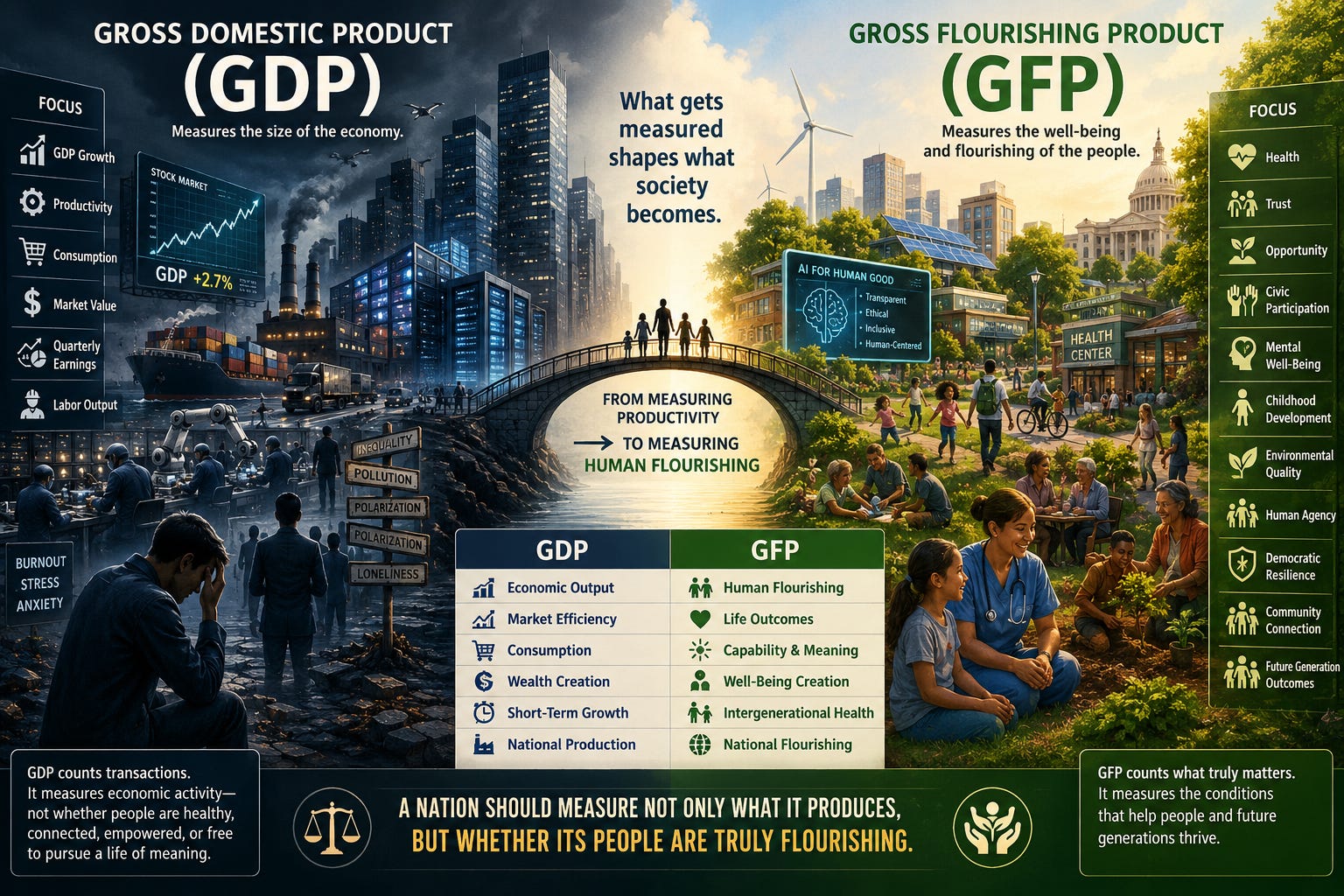
The Gross Flourishing Product: Six Domains of What Actually Matters
The GFP measures national progress across six domains, each scored on a 0–100 scale, weighted by default equally — and adjustable through citizen deliberation.
DOMAIN 1. Vital Health
Not healthcare spending, but actual health outcomes: life expectancy disaggregated by income and race, maternal and infant mortality, mental health access, First 1,000 Days of Life indicators, and the population-level Sense of Coherence score.
DOMAIN 2 Distributed Prosperity
Median household income, Gini coefficients, poverty depth, housing affordability, medical debt rates, and intergenerational economic mobility. Aggregate growth that doesn’t reach median households does not count as prosperity.
DOMAIN 3 Capability & Agency
Functional literacy, digital and AI literacy, access to retraining, civic participation rates, and self-reported autonomy. In an AI economy, capability is the critical difference between displacement as catastrophe and displacement as transition.
DOMAIN 4 Social Fabric
Interpersonal and institutional trust, social isolation and loneliness prevalence, community organization density, family stability, and perceived safety. Abundance without social connection is not flourishing.
DOMAIN 5 Ecological Integrity
Carbon emissions per capita, air and water quality, biodiversity, resource depletion vs. regeneration, and circular economy metrics. Present prosperity purchased at future ecological cost is not wealth — it is liquidation.
DOMAIN 6 AI Abundance Dividend
The domain that makes the GFP unique. Consumer surplus from free AI services, access democratization, displacement-to-reabsorption ratios, the distribution of AI gains between workers and capital owners — and a Harm Offset Index that distinguishes AI that detects cancer from AI that optimizes addiction.
The Moral Innovation: Distinguishing What Heals from What Harms
The most politically radical feature of the GFP is also its most important: it refuses GDP’s moral equivalence. Under GDP, a dollar of opioid revenue equals a dollar of childhood nutrition. The GFP rejects this. Economic activity that measurably reduces life expectancy, increases chronic disease, degrades ecological systems, or concentrates wealth while displacing workers without support is not neutral — it is pathogenic. The GFP names it as such.
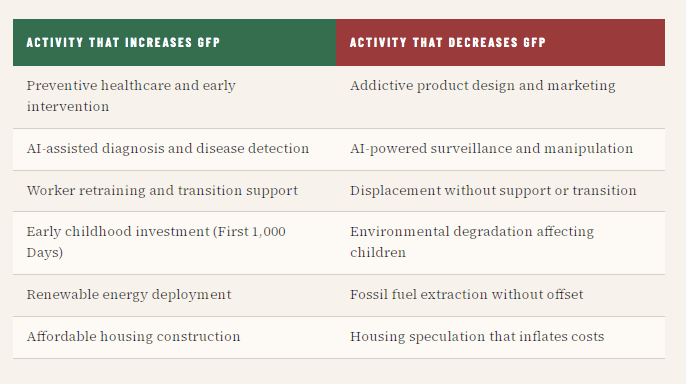
What the GFP Dashboard Reveals
Below is an illustrative GFP dashboard for the United States in 2026 — using hypothetical but plausible baseline scores based on available data. It tells a story that GDP cannot:
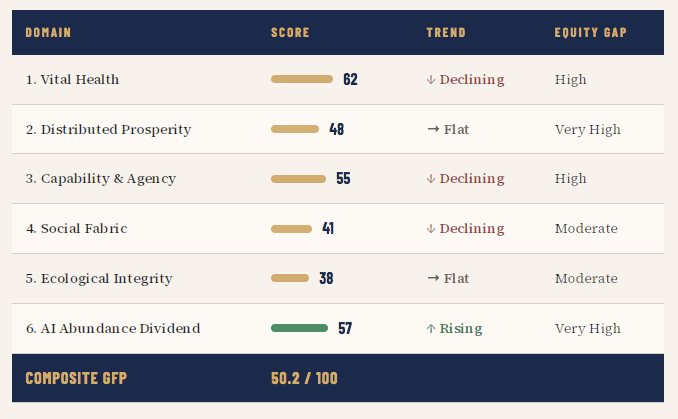
This dashboard tells the specific story of 2026 America: the economy is generating significant technological value (Domain 6, rising) while social fabric deteriorates (Domain 4, declining at 41), health outcomes worsen despite massive spending (Domain 1, declining with a high equity gap), and the workforce transition infrastructure to manage AI displacement is inadequate (Domain 3, declining). GDP might show 2.5% growth and call the economy healthy. The GFP shows a society generating abundance it cannot distribute, creating value it cannot sustain, and displacing workers it cannot support.
Domain 6 rising with a Very High equity gap tells an equally specific story: AI is creating real value — but that value is overwhelmingly flowing to technology firms and their investors, not to the workers and communities displaced by it. A rising AI Abundance Dividend score with concentrated distribution is not a success. It is a warning.
The Democratic Heart of the GFP
One feature of the GFP distinguishes it from every technocratic beyond-GDP proposal that has come before: its weightings are not set by economists. They are set by citizens.
Using structured deliberation — drawing on the Medical Case Presentation methodology developed by the Institute for Salutogenesis — citizen panels can adjust the relative weight of each domain based on the community’s actual priorities. A region facing acute ecological degradation can weight Domain 5 more heavily. A community in the midst of a workforce displacement crisis can elevate Domain 3. This is not a design concession. It is the GFP’s most important feature. A measurement framework that citizens help to design is a measurement framework that citizens can use to hold their government accountable.
The three dimensions at the heart of the salutogenic framework — comprehensibility, manageability, meaningfulness — serve as the meta-criteria for evaluating any proposed weighting. A weighting scheme that makes governance more comprehensible, more manageable, and more meaningful to the people it serves is a salutogenically valid scheme. One that concentrates power in technical agencies and removes citizens from the process is not.
Help Us Build the GFP
The Gross Flourishing Product is not a finished document. It is a beginning — and a beginning that belongs to the public it is meant to serve. We are inviting readers to join us in developing it.
01 — Challenge the Domains. Tell us what we are missing, misweighting, or measuring wrong. The GFP should reflect what citizens actually care about — not just what researchers find it convenient to measure.
02 — Apply It Locally. What would Montgomery County’s GFP score look like? What about your neighborhood, your workplace, your school district? The six domains are designed to scale from national to community level.
03 — Bring It to Your Elected Officials. Ask your state representative, your county commissioner, your school board member: which of these six domains do you track? Which do you manage by? Their answer — or their silence — is information.
04 — Join the People’s Conference. Sign up to receive information about the upcoming People’s Conference from across the region will gather to deliberate about AI, work, and the social contract. The GFP will be on the table. So will you.
Write to us at Moonshot Press. Tell us which domain matters most to you — and why. Tell us what you think is missing. Tell us what a 100-out-of-100 on the Social Fabric domain would actually feel like in your neighborhood. This is your framework as much as ours.
“The care of human life and happiness, and not their destruction, is the first and only legitimate object of good government.” — Thomas Jefferson