
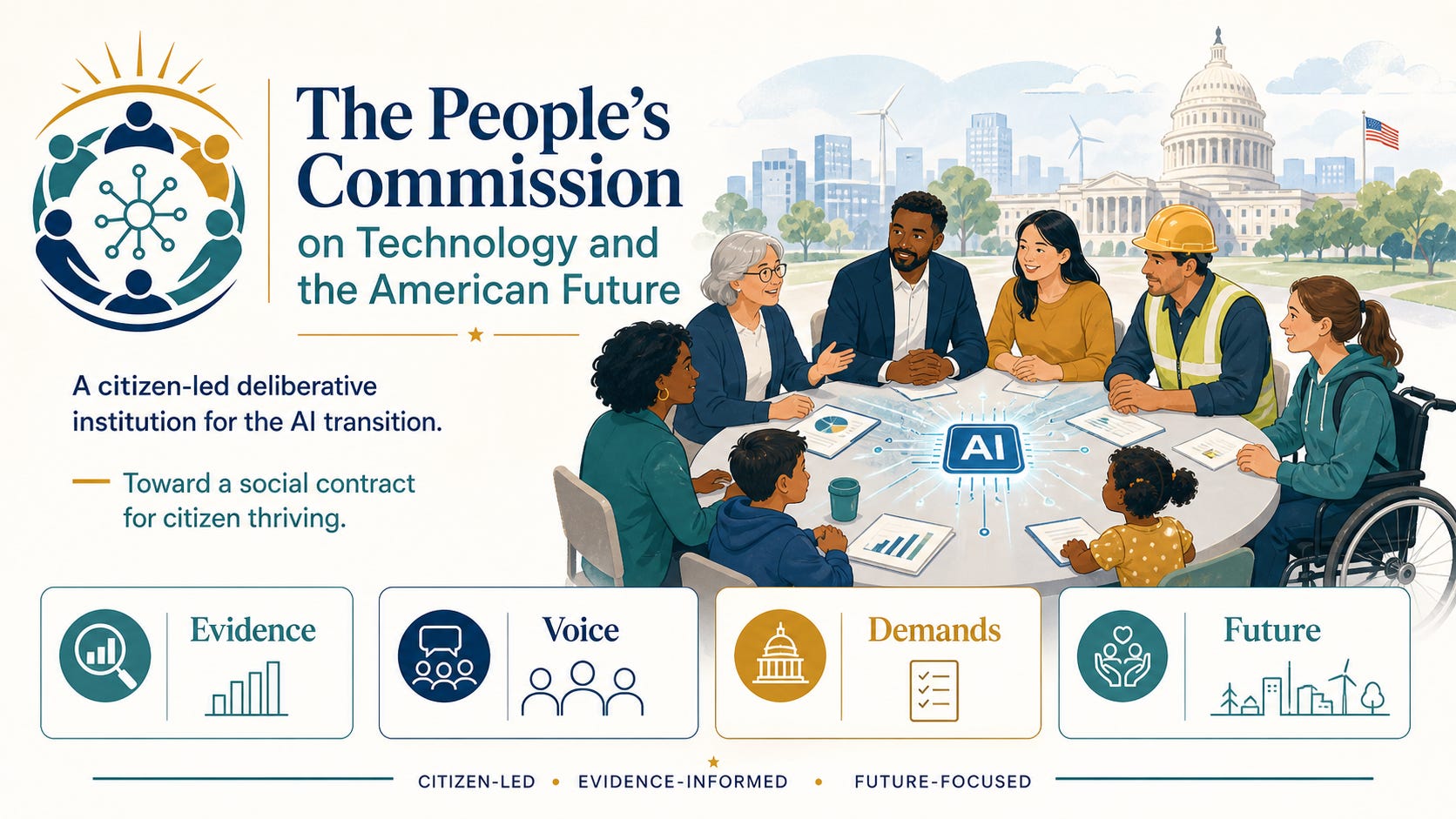
The People’s Commission on Technology and the American Future
Steering Artificial Intelligence Toward Human Flourishing

Editor’s Note
I started The People’s Commission on Technology and the American Future because artificial intelligence is the most consequential technology of our lifetimes — and the people whose lives it is reshaping have almost no organized voice in how it unfolds.
AI is already doing remarkable things. It is also disrupting work faster than any institution in our democracy is prepared to handle. The question is not whether AI is good or bad. The question is what kind of AI age we are going to build, and whose hands will shape it.
That is what the People’s Commission is for: a citizen-led body where workers, families, educators, and local leaders deliberate seriously about how to harness AI for the common good — and turn that deliberation into accountability, policy, and action.
What follows is the short version and the longer version. Both are working drafts. This is not a final document. It is an invitation.
— Shimon Waldfogel, MD
Brief Introduction
The care of human life and happiness, and not their destruction, is the first and only legitimate object of good government.”
— Thomas Jefferson
Something big is happening to American work, and most of us feel it even if we can’t quite name it. Artificial intelligence is reshaping careers, communities, and the meaning of citizenship faster than any institution in our democracy is equipped to handle. It is also opening genuine possibilities — in medicine, science, education, accessibility, and the ordinary productivity of small enterprises — that previous generations could only have imagined.
The people building this technology are organized. The people living inside the transition are not.
The People’s Commission on Technology and the American Future is a citizen-led effort to change that. It was started by one person who believes this moment calls for it — and is being built into something genuinely participatory, because that’s the only kind of institution that can do what this moment requires.
We are not anti-technology. We are pro-democracy and pro-flourishing. We are not a think tank, an advocacy group, or a government body. We are a civic institution in the tradition of American self-governance: citizens who believe that when the existing structures aren’t adequate to a challenge, you build ones that are.
What we think is at stake
AI can lift human capability or hollow it out. It can compress the time it takes to find a cure or compress the time it takes to lose a livelihood. It can democratize expertise or concentrate it in a handful of companies. Which of those futures we get is not a matter of fate. It is a matter of choice — a thousand choices, made in legislatures and boardrooms and union halls and school districts and family kitchens, over the next several years.
Work is not only how we make a living. It is also how we know who we are — a source of structure, purpose, and belonging. When that is disrupted at scale, the damage goes deeper than a paycheck. America learned this in the 1970s and 80s, when deindustrialization produced not just unemployment statistics but “deaths of despair” — the surge in suicide, addiction, and early death that shortened working-class life expectancy. We will not let the AI transition repeat that pattern. We will also not let fear of repeating it blind us to what AI can do for human beings when its development is shaped by the people it is meant to serve.
What we’re building
The Commission is being constructed right now, in Montgomery County, Pennsylvania, with tools and formats designed to spread anywhere:
Plain-language guides to what AI actually is, what it can do well, where it falls short, and how it is reshaping work and community
Policy briefs written for citizens, not specialists — covering both protection from harm and the promotion of beneficial applications
A public scorecard holding candidates and employers accountable for both sides of the equation: how they’re managing displacement, and how they’re extending AI’s benefits
Deliberative forums where workers, families, educators, and elected officials sit in the same room with real authority over the agenda
A framework for measuring success not by GDP alone, but by whether people’s lives are actually getting better
Two pillars of the work
The Democracy Stack is the Commission’s analytical framework — a citizen’s map of where power lives in self-government, and where AI is now entering every layer of it. The framework names both the risks (mass surveillance, algorithmic decision-making without due process, the erosion of local journalism) and the opportunities (more informed citizens, more accessible public services, better tools for civic deliberation itself).
The American Humanity Trust is the Commission’s flagship policy proposal — a framework for directing a meaningful share of the unprecedented wealth being generated by AI back to the public from which it emerged: to worker transition, to the First 1,000 Days of human development, to AI tools built for the public interest, and to the community foundations that make a free society possible.
Both are published as working drafts. Both are open to public deliberation.
The honest version
This Commission started as one person’s conviction that citizens deserve a seat at the table where AI’s future is being decided. It is being built transparently, with AI tools disclosed (we use them ourselves, openly), with funding sources reported, and with a clear understanding that its legitimacy must be earned through process — not claimed through rhetoric. We don’t speak for the people. We’re building the structures through which people can speak for themselves.
Who this is for
If you are a worker worried about your job — or excited about what AI lets you build. A parent thinking about your child’s future. A teacher trying to figure out what to teach and what AI tools to use. A local official who keeps getting asked about AI and doesn’t have good answers. A founder or technologist who wants this transition to go well for more than the people closest to the technology. A citizen who believes democracy should have something to say about the most powerful technology of our time. You belong here.
The next step is simple: Tell us where you live, what work you do, and what you want to understand or shape. That’s how this starts.
The Full Version
For those who want to go deeper — the case, the framework, the structure, and the work ahead.
Introduction
Artificial intelligence is transforming American life faster than democratic institutions are learning how to respond. It is the most consequential general-purpose technology since electrification, and like electrification it will reshape almost everything — work, health, science, education, the texture of daily life. Whether that reshaping is broadly beneficial or narrowly extractive is not a question physics will answer. It is a question of governance, values, and democratic choice.
Right now, the decisions are being made largely by technology companies, investors, and expert advisory bodies. The workers, families, and communities whose lives hang in the balance have had little say in the terms of that transformation. That is the problem the People’s Commission exists to address.
We are a citizen-led deliberative institution. We are not a government agency, a think tank, an advocacy organization, or another expert panel. We are a civic body — one in which displaced workers, healthcare practitioners, educators, labor economists, parents, technologists, and elected officials sit in the same room, and in which citizens hold authority over the agenda rather than merely offering input to conversations others control.
Our conviction is simple. Technological progress and human flourishing are not inherently opposed, and they are not automatically aligned. Aligning them is the work of democratic governance. When existing institutions fail to make space for that work, citizens must build the institutions the moment requires.
We are not anti-technology. We are pro-democracy and pro-flourishing.
Mission
Our mission is to provide a framework and tools for citizen engagement in the democratic life of the AI transformation — to maximize its benefits and mitigate its harms — anchored in the principles of the Declaration of Independence and the quest for human flourishing.
Three questions guide everything we do:
What is human flourishing, and what is the role of government in helping people achieve it?
What are the AI and digital tools reshaping our lives, and how can they be directed toward a health-promoting society?
What is the role of the citizen in our democracy — and how do we strengthen it?
Vision
We envision an America in which the most powerful technology of our age strengthens, rather than erodes, the conditions for human flourishing — and in which citizens are co-authors of the society AI is helping to build, not passive recipients of its effects.
That vision rests on a distinction worth naming carefully. The AI age has produced an enormous public conversation about the AI stack: chips, energy, data centers, foundation models, applications, agents. Trillions of dollars will flow through that stack, and out of it will come breakthroughs in medicine, science, education, and the productivity of ordinary people. But there is another stack on which the future depends: the democracy stack. At its foundation is the citizen — not the consumer, not the user, not the data point, but a person capable of understanding, judging, deliberating, organizing, and sharing responsibility for the common world. Above the citizen sit the institutions that make democratic life possible: families, schools, local communities, unions, congregations, civic associations, public health systems, courts, a free press, and a culture of trust.
When the democracy stack is strong, technological change can be absorbed, argued over, governed, and directed toward public purposes. When it is weak, technology becomes something done to people rather than something shaped by them — and even technologies with enormous beneficial potential drift toward the interests of the few rather than the flourishing of the many.
Our vision is to ensure that as artificial intelligence becomes infrastructure, citizen intelligence becomes infrastructure too — so that the gains AI makes possible are widely shared, and the harms it threatens are widely contained.
Our Values
A citizens’ commission that holds institutions accountable must hold itself accountable as well. We commit to:
Open and transparent deliberation wherever possible.
Public reporting on activities, membership, funding sources, and progress.
Clear disclosure of AI assistance in research, writing, analysis, and public engagement.
Honest acknowledgment of uncertainty, disagreement, and the limits of evidence — including honest acknowledgment of what AI can do well that earlier generations could not.
Active outreach to the communities most affected by AI disruption — and to the communities that stand to benefit most from AI’s applications in health, education, and civic life.
Our legitimacy does not depend on claiming to speak for the people. It depends on building processes through which people can speak, deliberate, decide, and act.
Why This Commission, Why Now
The federal government has created high-level advisory structures to advance American leadership in artificial intelligence. Those bodies offer important technical and strategic counsel. They do not solve the democratic problem at the center of the AI transition: the people most affected by technological change are often the least represented in the rooms where its terms are shaped — whether those terms concern the harms to manage or the benefits to be distributed.
The builders of AI systems, the investors who finance them, and the companies that deploy them have organized effectively to represent their interests. Workers, families, local communities, and the public-health consequences of technological disruption have not been given equivalent civic architecture. Neither have the patients who would benefit from AI-assisted diagnosis, the students who would benefit from AI tutoring, the small business owners who would benefit from AI-augmented productivity, or the disabled Americans whose access to the world AI can dramatically expand. All of them deserve representation in the conversations that will determine whether AI’s gains reach them and whether its costs spare them.
That is not a communications failure. It is a governance failure.
The People’s Commission is the citizens’ answer to that gap.
The Scale of What Is Happening
Two stories about AI are unfolding at the same time, and any honest account of this moment has to hold both.
What AI is already making possible
AI systems are accelerating drug discovery, with several drug candidates now in clinical trials that were identified by machine-learning models in months rather than years. AI-assisted radiology and pathology are catching cancers and other conditions earlier and more accurately, particularly in rural hospitals and underresourced clinics that cannot afford specialist coverage. AI-powered tutors are demonstrating measurable learning gains for students who previously had no access to individualized instruction. Speech-to-text and computer-vision tools are giving people with hearing loss, vision loss, and motor impairments a degree of independence their grandparents could not have imagined. Climate scientists are using AI to model weather and ecological systems at resolutions that improve disaster preparedness. Small business owners are using AI to do the marketing, accounting, customer service, and document work that used to require a team. These are not promises. They are happening now, in 2026, in American hospitals, schools, homes, and businesses.
What AI is doing to American work
At the same time, the disruption to the labor market is real and unprecedented in its speed. Goldman Sachs projects 300 million jobs globally affected by AI. Anthropic CEO Dario Amodei has warned publicly that his own technology could eliminate 50 percent of entry-level white-collar jobs within five years — and that most lawmakers are unaware this is about to happen. By the end of 2026, 37 percent of business leaders plan to replace workers with AI. Among companies already using large language models, nearly half report they have already done so.
AI use in the American workplace jumped from 8 percent to 35 percent between 2023 and 2024 alone — a fourfold increase in a single year. Yet more than half of workers report they do not feel prepared to use it in their jobs. The gap between the speed of the technology and the readiness of workers, institutions, and policy is not closing. It is widening.
The sectors most exposed are not the ones the conventional narrative predicted. Healthcare and social assistance, professional and technical services, finance and insurance, pharmaceutical research, and software development are among the most acutely affected occupational categories. These are the workers who were told that education and professional credentialing were their protection. They are also, often, the workers whose productivity AI most amplifies — so the question is not simply whether their work survives but in what form, on whose terms, and with what share of the gains.
What makes this moment different from prior disruptions is not the scale alone. It is the speed. The Industrial Revolution unfolded across generations. AI is advancing in months.
The Industrial Revolution unfolded across generations. Families moved, retrained, recalibrated over decades. The adaptive mechanisms that once cushioned technological change — unions, community colleges, extended family networks, municipal institutions — are not calibrated for the velocity of the AI transition. Catching up is possible. Doing it without democratic input is not.
Who Bears the Burden — and Who Shares the Gains
Both halves of the AI transition are landing unevenly. The patterns are structural, not incidental.
On the burden side: Black workers are being displaced at twice the rate of white workers, concentrated in the administrative and clerical roles AI is eliminating earliest and fastest. Women in those same occupations face the highest near-term exposure — and those roles have been among the most reliable pathways to economic stability for workers without four-year degrees. Workers in rural and smaller metropolitan areas face the same displacement pressures as urban counterparts but with far fewer institutions capable of supporting them. Older workers face what labor economists are calling the terminal displacement problem: jobs automated in the final decade of a career that cannot be recovered.
On the gains side, the inequality is just as stark. The productivity dividends, the access to advanced tools, the wealth from AI company growth — these flow overwhelmingly to capital owners, technology companies, and workers whose skills allow them to direct AI rather than be replaced by it. AI-assisted healthcare reaches well-resourced hospitals before underserved ones. AI tutors reach families who can pay for premium subscriptions before public schools. AI-augmented small business tools reach the entrepreneurs who know they exist before the ones who don’t.
Neither distribution is a market failure. Both are market outcomes — the predictable result of a technological transition managed without democratic deliberation about how gains should be shared and costs should be borne.
The Commission’s working assumption is that this is fixable. The same technology that is concentrating advantage can, with deliberate policy and institutional design, distribute it. That requires citizens who understand what is at stake and institutions through which they can act.
What AI Displacement Actually Destroys — and What an Adequate Response Requires
The standard political response to the labor disruption is a single word: retraining. Invest in education. Learn AI skills. Adapt.
These responses are not false. They are insufficient in ways that matter enormously — and their insufficiency is not just a practical objection about program scale or funding levels. It is a deeper analytical failure that misdiagnoses what AI displacement actually costs.
Work provides income. But it also provides something harder to replace: identity, structure, belonging, and the sense that what you do matters to others. The sociologist Richard Sennett wrote that work is not primarily what we do — it is who we are. Sigmund Freud, asked what a psychologically healthy person required, answered simply: to love and to work.
When AI automation eliminates an occupation, it does not merely reduce income. It attacks three things at once:
Comprehensibility. The billing specialist who spent years mastering the logic of her field finds that logic has been automated. The professional map she built — knowing how her world works, what effort produces what results — has been dissolved.
Manageability. Work provides not just a paycheck but a whole ecosystem of resources: professional networks, institutional affiliations, credentials, the simple structure of a workday. AI displacement strips all of these simultaneously, at the moment a person needs them most.
Meaningfulness. America already knows what happens when meaning is stripped from communities at scale. The deindustrialization of the 1970s and 80s produced deaths of despair — the surge in suicide, drug overdose, and alcoholic liver disease that shortened the life expectancy of working-class Americans. Cognitive automation threatens something broader: the erasure of economic purpose across the white-collar and professional occupations that tens of millions of Americans built their identities around.
A policy that replaces lost wages without rebuilding identity, community, and civic capacity has solved the wrong problem with the right resources. By the same logic, a policy that delivers AI’s gains as income without expanding the conditions for human meaning — better health, better learning, better creative capacity, stronger communities — has not actually delivered prosperity. It has delivered numbers.
The Salutogenic Standard
The Commission evaluates the AI transition through a salutogenic framework — the science of what creates health, resilience, and human flourishing, not only what causes harm.
The framework draws on the work of Aaron Antonovsky, an Israeli-American medical sociologist who spent his career asking not what makes people sick, but what keeps them healthy under stress. His central finding: human beings remain resilient when life feels comprehensible, manageable, and meaningful. He called this the Sense of Coherence, and he established across decades of research that it is among the most robust predictors of physical and mental health across a lifetime.
Work is one of the most reliable daily sources of all three dimensions for adults in modern societies. AI threatens all three simultaneously when it eliminates work without replacement — but it can also strengthen all three when it expands what people can understand, control, and contribute. A doctor freed by AI from documentation drudgery and given more time with patients gains all three dimensions. A small business owner whose AI tools let her serve customers she could not otherwise reach gains all three. A student whose AI tutor finally explains a concept that confused her gains all three. These are not edge cases. They are what the AI transition can deliver if it is shaped by the right hands.
We therefore ask three symmetric questions of every policy proposal, every candidate commitment, every corporate practice, and every public institution:
Does it make the AI transition more comprehensible for the people living inside it — and does it expand their understanding rather than narrowing it?
Does it make the transition more manageable — strengthening the resources people have to navigate it, and reaching the people who need those resources most?
Does it make life and work more meaningful — expanding what people can contribute, learn, build, and care for?
This is the Salutogenic Standard. It is not a utopian demand. It is the minimum requirement for a policy response that actually addresses what AI displacement destroys — and the minimum standard for evaluating whether AI’s potential is being realized in the lives of ordinary Americans. It is the test we apply to every elected official, every AI company, every proposed policy — including our own.
The Thriving Social Contract
The old social contract rested on assumptions that are no longer secure: stable employment, employer-based benefits, predictable career ladders, local tax bases tied to physical industries, and education systems designed for slower technological change. The AI transition exposes the fragility of that arrangement.
The Thriving Social Contract is our effort to define what citizens should be able to expect from democratic society in an age of accelerating technological transformation — a contract that protects against the worst of the transition while opening pathways to the best of it. It rests on seven commitments:
Dignity of Work. Every person who wishes to work deserves access to work that is fairly compensated, safe, socially valued, and compatible with family life. AI should be deployed to enhance the dignity of work, not to strip it.
Shared Prosperity. The productivity gains generated by AI should not flow only to owners, investors, and platform companies. Workers and communities whose labor, data, public infrastructure, and educational systems helped create this prosperity deserve a meaningful share.
Adaptive Security. Security in a rapidly changing economy cannot depend on one employer, one occupation, or one credential earned early in life. Portable benefits, wage insurance, lifelong learning, childcare support, and healthcare access are essential features of a modern social contract.
Geographic Justice. AI’s benefits and burdens will not be distributed evenly without deliberate effort. The professional worker in Lower Merion, the billing specialist in Norristown, the logistics worker in Pottstown, and the bilingual family in Lansdale face different risks and different opportunities. Policy must be designed with that geographic reality in mind.
Equity as a Design Constraint. Technological disruption does not land on a level field, and technological benefit is not distributed on one either. Race, gender, education, disability, immigration status, age, and wealth shape who is most exposed and who has the resources to capture the upside.
Democratic Participation. Economic precarity diminishes civic power. A workforce that is anxious, dislocated, and unsupported becomes a citizenry less able to deliberate, organize, vote, and hold institutions accountable. AI policy is not only economic policy. It is democratic infrastructure.
Intergenerational Responsibility. The children being born today will enter adulthood in an economy shaped by decisions made in this decade. We hold every AI policy question against a generational horizon: what kind of society are we building for the children who cannot yet speak in the rooms where their future is being decided?
The Commission’s Civic Infrastructure
The Commission is being built as practical civic infrastructure — not as a statement of concern but as a working institution with tools designed to translate democratic deliberation into democratic action. Six instruments anchor the work:
The Civic Curriculum. Plain-language public essays and learning materials that help citizens understand the AI transition — what large language models actually are, what they can do well, where they fail, how they are reshaping labor, and how democratic response can be organized. Published by Moonshot Press, the Commission’s communications arm.
Citizen Policy Briefs. Structured, evidence-based briefs written for citizens rather than specialists. Each brief explains a major policy option — from worker protection to public AI infrastructure to procurement reform — presents the strongest arguments for and against it, weighs the evidence, and supplies the specific questions citizens should be asking elected officials.
The AI Workforce and Opportunity Scorecard. A public tool for evaluating candidates, elected officials, major employers, and institutions on their commitments — both to managing AI’s harms and to extending AI’s benefits. Designed to make silence visible: a candidate or institution that refuses to answer basic questions has given citizens information that matters.
The 2026 Democratic Accountability Project. A nonpartisan initiative issuing a Candidate AI Accountability Questionnaire to federal, state, and local candidates — documenting and scoring their plans for managing AI’s impact on employment, education, public services, and community stability. We are asking candidates, publicly and on the record, what they will do.
The People’s Conferences. Public convenings that bring workers, civic organizations, labor economists, educators, healthcare practitioners, technologists, elected officials, and community members into citizen-centered deliberative forums. These are not endpoints. They are launches.
Gross Domestic Flourishing (GDF). A success metric designed to complement, and ultimately to discipline, the traditional GDP standard. GDF shifts the focus of economic evaluation from raw market consumption to the active optimization of human health, agency, and community thriving. We use GDF to evaluate whether AI is delivering broad societal benefit or concentrating wealth while hollowing out the conditions for ordinary flourishing.
On our use of AI. We use AI ourselves — through a method we call the Useful Generative Intelligence Process — to make this work possible at the scale and speed the moment requires. We disclose this openly, as we disclose all AI assistance in our research and publishing. We think this transparency is itself a civic obligation, and we think the work we are able to do with these tools is itself a demonstration of what AI in service of citizens looks like.
The Democracy Stack
Trillions of dollars are flowing into what its builders call the AI stack — chips, data centers, cloud platforms, foundation models, applications, agents. There is another stack on which all of it depends, and almost no one is talking about it.
We call it the Democracy Stack. It is the Commission’s analytical framework — a citizen’s map of the architecture of self-government and a diagnostic tool for understanding both where AI threatens that architecture and where it can strengthen it.
Democracy is not a single thing. It is a layered structure. At its foundation is the citizen — a person capable of judgment, conscience, and action with others. Above that foundation sit the layers that make self-government possible: rights, constitutional structure, law and administration, civic participation, the public sphere, the economic foundation, and the institutions of renewal across generations.
Artificial intelligence is now operating at every layer, and at every layer it can go in either direction. AI is being used to surveil and profile citizens, and to give citizens unprecedented tools to understand the public information environment. It is being inserted into sentencing, hiring, credit, and benefits decisions — often without due process protections adequate to its scale, but also with the potential, properly governed, to reduce bias rather than embed it. It is being used to micro-target voters and to flood the public sphere with synthetic content, and it is being used to translate public meetings into the dozens of languages spoken in any modern American community. It is reshaping education — dangerously, when it substitutes for thinking; powerfully, when it personalizes learning for students who would otherwise be left behind. The Democracy Stack framework supplies the questions citizens should be asking of any AI application in public life: whose rights are protected, whose narrowed, who is deciding, who benefits, who bears the cost, and whether democratic time is being respected or overrun.
Running across every layer is the question of pace. Democratic institutions were built to handle change at the speed of deliberation. That slowness is not a defect to be optimized away. It is a feature that protects against the impulsive concentration of power. AI is currently testing democratic time harder than any force in living memory — and the Commission’s answer is not to slow AI but to strengthen the institutions that can keep up with it.
The Democracy Stack is published as a working draft. It is incomplete. It will be wrong in places. We expect the people who use it — workers, parents, organizers, teachers, technologists, local officials, citizens of every kind — to push back, to find what doesn’t fit their experience, and to propose what is missing.
The American Humanity Trust
The American Humanity Trust is the Commission’s flagship policy proposal — the institutional answer to the hardest version of the question the Salutogenic Standard and the Thriving Social Contract pose: what would an adequate response to this moment actually require, in dollars, in governance, and in operational reality?
It begins with a property-rights argument, not a redistribution argument. The science, the public infrastructure, the data, the legal protections, the educational systems, and the consumer base that made the current AI economy possible were funded, built, and sustained by the American public. The wealth those investments are now generating is unprecedented in scale. The mechanisms for translating it into broadly shared benefit do not yet exist. The public’s stake in the resulting wealth is not charity received but ownership recognized.
The timing is not incidental. The next eighteen months will see what is likely to be the largest concentration of new private wealth in American history. OpenAI is preparing for a public offering at a valuation that could exceed one trillion dollars. Anthropic, xAI, and the foundational AI infrastructure companies are positioned for IPOs or secondary transactions that will generate hundreds of billions of dollars for a relatively small group of founders, early employees, and investors. The window to design public-benefit obligations into those events is open now. After the IPOs close and the wealth is privately distributed, it closes.
What the Trust would fund
The Trust would fund four categories of work that no existing institution is adequately resourcing — each designed to capture AI’s upside for the public while protecting against its downside:
Worker transition and economic resilience (approximately 40 percent of distributions). Wage insurance, portable benefits, automatic safety-net stabilizers, and retraining at the scale of the GI Bill — the infrastructure that converts displacement into dignified transition rather than catastrophe.
Public-interest AI and democratic infrastructure (approximately 20 percent). Independent journalism, civic education, public-interest AI tools (for libraries, schools, small businesses, local government, and community organizations), and deliberative civic institutions including the People’s Commission and bodies like it across the country. The Trust would explicitly fund civic institutions that may, at times, criticize the AI industry or the Trust’s own decisions. Independence from the institutions it scrutinizes is a feature, not a vulnerability.
Human development across the lifespan (approximately 25 percent). First 1,000 Days investments that build the capabilities the AI economy of 2043 will reward. Education that prepares citizens to direct AI rather than be directed by it. Care-economy investment that recognizes the work AI cannot perform as the foundation it is.
The salutogenic foundations of community life (approximately 15 percent). The local institutions — libraries, community centers, faith communities, public spaces, civic associations — that produce the comprehensibility, manageability, and meaningfulness that no income transfer alone can provide.
How the Trust would be funded
The Trust is designed to be funded through three complementary mechanisms:
A public benefit charge on AI IPO and major secondary transactions. A modest percentage — five to ten percent — of the proceeds from major AI company public offerings, directed to the Trust. The legal precedent for such a charge is well established; public benefit charges and transfer taxes have been used in industries from telecommunications to oil and gas to pharmaceuticals.
An automation productivity dividend. A scaled fee on enterprise AI deployment, calibrated to documented productivity gains in firms’ own SEC filings, deductible against documented investment in worker transition. This is the mechanism that Acemoglu, Autor, and others have proposed under various labels, structured here for democratic legitimacy and economic efficiency.
Charitable trust restoration. Where AI companies were founded as charitable trusts or operate under public benefit corporation status and the original public-benefit mission has been compromised, the Trust offers a vehicle for ensuring that recovered assets serve their original purpose.
How the Trust would be governed
The Trust’s governance is the single most important question in its design. A poorly governed Trust would simply reproduce, at greater scale, the structural failures of the OpenAI Foundation — where $190 billion in nominal assets generates roughly $50 million in actual public benefit because the governance structure ensures that the for-profit’s interests dominate the foundation’s mission.
The Trust is designed to make those failures structurally impossible. Its board must include no member with current financial interests in AI companies subject to the public benefit charge, with a defined cooling-off period for former executives, board members, or significant investors. Its composition must include, by binding charter provision, representation from organized labor, civil rights organizations, public health institutions, educational systems, faith communities, and broader civil society alongside the technical and economic expertise the work requires. Its assets must be diversified by charter — explicitly prohibited from concentration in the equity of any single company. It must be subject to annual public reporting against the Salutogenic Standard. It must operate under a binding minimum payout rate of seven percent of assets annually.
The Trust is not anti-AI. It is not anti-innovation. It is not anti-corporate. It does not seek to slow the development of AI or to prevent the wealth creation that successful innovation produces. What it does is establish, at the moment of AI’s largest wealth events, that the public has a structural stake in the value created by technologies built on public foundations — and that the public’s stake must be recognized through institutional mechanisms rather than left to the voluntary discretion of the wealth’s recipients. This is the relationship the United States has had with other transformational industries throughout its history. The AI industry’s exceptional treatment is the historical anomaly, not the Trust’s framework.
The National Cohort: Five Children, Five Americas
Policy discussions about AI move quickly toward the abstract: projections, percentages, displacement curves, retraining pipelines. The Commission resists this abstraction — not because data doesn’t matter, but because abstraction is how catastrophic failures of imagination become normalized, and how the children who stand to benefit most from AI’s potential become invisible in conversations about its risks.
The National Cohort Framework is our policy evaluation methodology. It tracks how technological changes will affect five composite newborns, each born in the winter of 2026 in a different American community. They are fictional composites, but their communities are real. Each child will turn eighteen between 2043 and 2044. Each will enter a labor market that every credible projection says will have been fundamentally restructured by artificial intelligence. The capabilities that economy will reward — and the AI tools that economy will make available to them — are being built, or left unbuilt, right now.
Liam (Somerset, Pennsylvania). Born into post-industrial America, tracking how the decline of traditional manufacturing and the rapid automation of service, clerical, and logistics roles impacts families in the Rust Belt — and how AI-enabled small enterprises, telemedicine, and remote learning could reshape rural opportunity if the infrastructure reaches him.
Amare (Chicago, Illinois). Growing up on the South Side, examining how algorithmic bias in predictive policing, automated hiring platforms, and digital welfare systems affects urban youth in marginalized communities — and how AI tools for tutoring, healthcare, and small business creation could open doors his neighborhood has historically been denied.
Emma (Chestnut Hill, Massachusetts). Born into privilege, observing how early access to elite proprietary model subscriptions and hyper-personalized tutors compounds wealth and credentialism across generations — and what public policy must do to prevent AI from becoming a moat around opportunity.
Eva (Tompkinsville, Kentucky). Born in a deeply rural county, analyzing how data-center resource extraction strains power grids and water tables, how rural digital divide barriers shape isolation — and how AI-enabled rural healthcare, agricultural technology, and remote work could rebuild what previous waves of economic change took from her community.
Mateo (San Antonio, Texas). A citizen child in a mixed-status family, tracking the deployment of automated surveillance and biometric identity systems that threaten civil rights — and the potential for AI-enabled language access, civic translation, and public services that could serve mixed-status communities better than the systems they have.
When we evaluate any policy proposal, any candidate’s position, any AI governance commitment, we ask five questions — one for each child. Does this reach Liam in Somerset? Does it address algorithmic bias as it falls on Amare in Chicago? Does it constrain the wealth-compounding dynamics that make Emma’s advantages structural rather than incidental? Does it account for Eva’s infrastructure deficits in rural Kentucky? Does it protect Mateo’s civil rights in a mixed-status household in Texas — and does it open AI’s benefits to him on equal terms?
These are not rhetorical questions. They are the operational expression of what the Declaration of Independence means when it says all people are created equal. They are the test we apply, in public, to ourselves and to everyone who asks for the public’s trust.
Moonshot Press
Moonshot Press is the publishing and communications arm of the Commission. It is not a conventional media outlet covering us from the outside. It is part of the civic infrastructure through which the Commission speaks in the public square.
Its editorial task is to close the distance between evidence and citizens, between policy debate and local life, and between democratic concern and democratic action. Its work is held to a single standard — not what is economically convenient, not what is politically safe, but the salutogenic standard: whether the conditions for human flourishing are being created or destroyed, preserved or squandered, for the citizens of this country and for the children who will inherit the world we are building right now.
An Honest Word About How This Started
The People’s Commission began as one person’s conviction — a citizen who recognized that at moments of profound change, ideas matter and everyone can participate in strengthening our social fabric. It is ambitious, complex, doable in the age of AI (and in fact made possible at this scale only by AI), and rooted in concern for what American democracy is built to protect and for what it can yet become.
It is being built transparently: with funding sources reported, AI assistance disclosed, and governance designed to give participants genuine authority over the agenda. The Commission’s legitimacy cannot be claimed. It must be earned through process, over time, by actually doing what it says.
The Road Ahead
The Commission begins in Montgomery County because democracy becomes real in particular places. The AI transition may be global, but its effects are local — in workplaces, schools, libraries, clinics, family budgets, and community institutions.
Our long-term purpose is to help build a new social contract adequate to the age of artificial intelligence — one that protects dignity, shares prosperity, strengthens adaptive security, corrects inequity, sustains democratic participation, and honors the next generation. One that ensures the extraordinary gifts AI is already producing reach ordinary Americans, and that the costs of the transition are borne fairly rather than dumped on the people least able to absorb them.
The question is no longer whether AI will transform American life. It already is. The question is whether citizens will have the institutions, the tools, and the confidence to shape that transformation democratically — to claim the benefits and contain the harms.
The People’s Commission on Technology and the American Future is one answer.
Show up. Deliberate. Demand. Build. Vote. Repeat.
APPENDICES
Appendix A: The Civic Curriculum
Appendix B: The Citizen Briefs
Appendix C: The AI Workforce Accountability Scorecard
Appendix D: The People’s Conference Agenda
Appendix E: Candidate Questionnaire
Appendix F: Replication Guide for Local Communities
Appendix G: Moonshot Press Role and Publishing Calendar
Appendix H: Evidence Dossier and Source Notes