


There is a sentence in the Declaration of Independence that Americans have been arguing about for 250 years.
We hold these truths to be self-evident, that all men are created equal, that they are endowed by their Creator with certain unalienable Rights, that among these are Life, Liberty and the pursuit of Happiness.
Created equal. Not born into equal circumstances. Not guaranteed equal outcomes. Created equal — in dignity, in worth, in the moral claim each person holds on their community and their country.
It is a radical sentence. It was radical when Jefferson wrote it. It remains radical today, because the systems we have built — the healthcare system, the education system, the economic system, the social safety net — do not yet fully reflect it. They reflect something else: the accident of birth. The zip code. The income of the parents. The language spoken at home.
And nowhere is the gap between promise and reality more consequential, more measurable, and more fixable than in the first 1,000 days of a child’s life.
This is where we begin. Not with the problem — with the possibility.
The Most Consequential Window in Human Development
From conception through a child’s second birthday — roughly 1,000 days — more happens in the human brain than at any other period in existence. More than one million new neural connections form every second. The architecture of cognition, emotion, language, and resilience is being built in real time.
What happens in this window doesn’t just affect childhood. It echoes across an entire lifetime — shaping health trajectories, educational outcomes, economic participation, and the capacity to engage as a citizen in a democracy that depends on capable, informed, connected people.
The science has been settled for decades. Every dollar invested effectively in the first 1,000 days yields seven to thirteen dollars in return over a lifetime — through reduced healthcare costs, stronger educational outcomes, greater workforce participation, and deeper civic engagement. The Nobel laureate economist James Heckman has called early childhood investment the highest-return investment available to any society.
This is not a story about what is broken. It is a story about what is possible — and about what communities across America are proving when they take the first 1,000 days seriously.
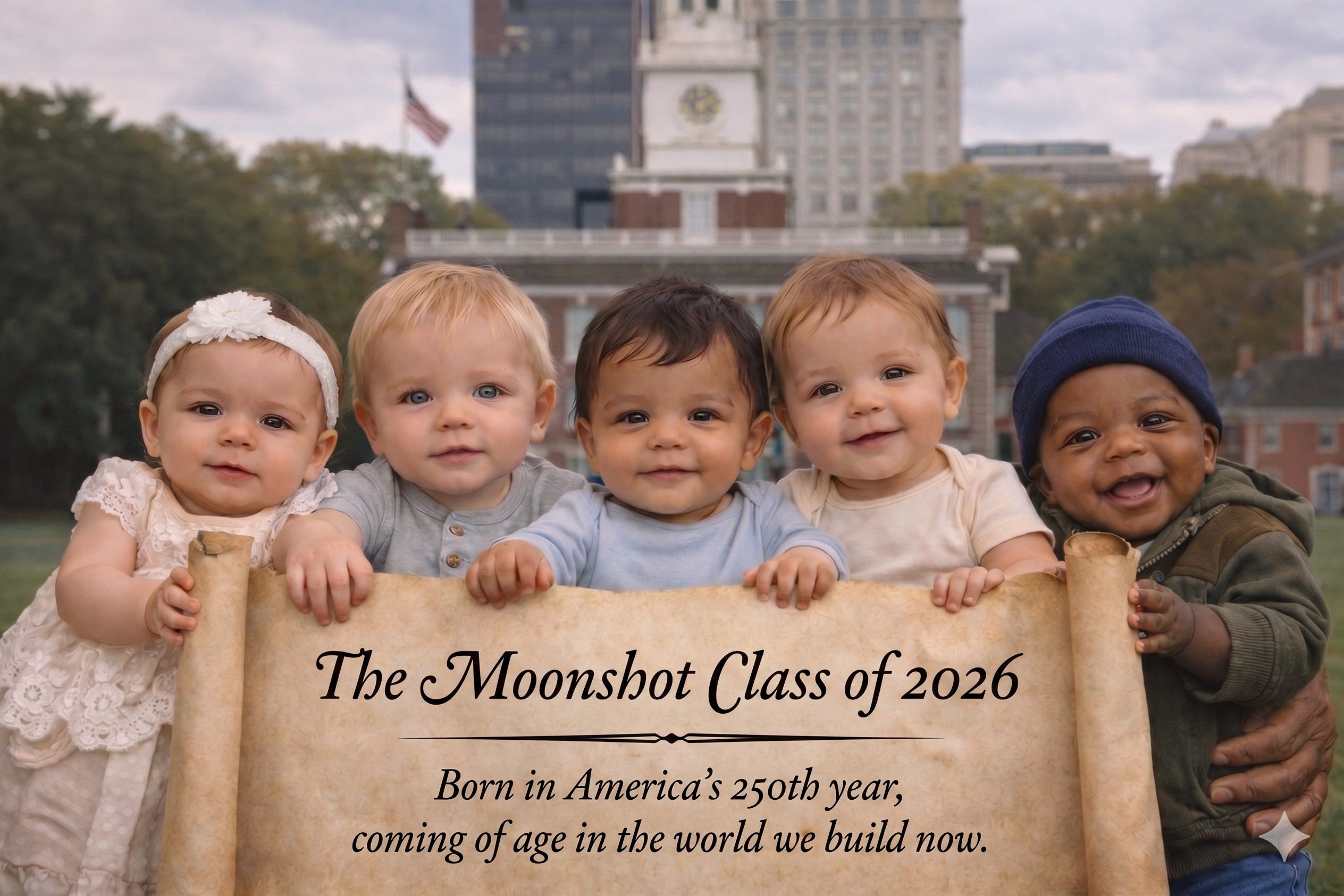
Five Children, Five Americas, One Promise
In the year America celebrates the 250th anniversary of its founding promise — that all are created equal, endowed with unalienable rights to life, liberty, and the pursuit of happiness — five American children drew their first breaths.
Emma arrived in Chestnut Hill, Massachusetts, to parents with paid leave, comprehensive insurance, and a neighborhood where the developmental supports for a flourishing childhood are simply part of the landscape — so embedded in daily life that no one thinks to call them supports at all. By age two, Emma will have been exposed to approximately 45 million words in language-rich interactions that build the neural pathways for language, reasoning, and emotional regulation. Her developmental trajectory is not guaranteed — no child’s is — but the structural supports are firmly in place.
Liam arrived in Somerset, Pennsylvania, to parents who love him completely and worry constantly — his mother returning to work at six weeks not by choice but by economic necessity, navigating a childcare system that costs more than the rent and a labor market that offers no guarantees. His parents are devoted and resourceful. What they need is not advice but infrastructure.
Amare arrived on Chicago’s South Side to parents rich in faith, community, and commitment — and into a neighborhood that has absorbed decades of disinvestment. His parents do everything right. They seek pediatric care, engage in early literacy, create routines despite unstable work schedules. What surrounds them is not a reflection of their effort. It is a canvas waiting for the investment it deserves.
Eva arrived in Tompkinsville, Kentucky, in a county with one pediatrician for every 3,000 children, where high-quality childcare is not inadequate but absent, and where the nearest early intervention services are sixty miles away. Her community has deep social ties and mutual aid networks. It has the people. It needs the infrastructure.
Mateo arrived in San Antonio, Texas, to parents who whisper dreams in his ear every night. He is a citizen, born on American soil, eligible for every service his country provides. His parents are devoted and hardworking. They need a system that sees their family’s strengths and meets them where they are.
Five children. Five Americas. One promise. And across every one of these circumstances — in Chestnut Hill and Somerset and Chicago and rural Kentucky and San Antonio — the developmental science points to the same window of opportunity: the first 1,000 days, when investment in a child’s life produces its greatest return.
Emma shows us what is possible when the full ecosystem of support is in place. Liam and Amare and Eva and Mateo show us where to build it next.
→ Read their full stories: Five Babies, Five Life Trajectories
A Different Way of Asking the Question
Most American health and social policy asks: what is wrong with this family?
It screens for deficits, diagnoses pathologies, intervenes in crises, and measures the absence of disease. It is organized around failure — waiting for something to go wrong before the system engages, treating families as problems to be managed rather than as people building futures.
The First 1,000 Days of Life Initiative asks a different question, drawn from a different tradition.
In 1979, the medical sociologist Aaron Antonovsky published research that began with something no one had quite asked before. Studying women who had survived Nazi concentration camps, he noticed that some maintained remarkably good health despite experiencing the most extreme adversity imaginable. Rather than asking why the others were sick, he asked why these women were well.
His answer shaped a field. Health — not just the absence of disease, but genuine, sustained wellbeing — is actively created through what he called a Sense of Coherence: the degree to which a person experiences their world as comprehensible, manageable, and meaningful. And that Sense of Coherence is built through relationships, through resources, through communities that support and recognize the people within them.
He called this paradigm salutogenesis — from the Latin salus, health, and the Greek genesis, origin. The study of the origins of health rather than the origins of disease.
Applied to the first 1,000 days, the salutogenic lens transforms how we work. We don’t ask what’s wrong with Liam’s family or Eva’s family or Amare’s family. We ask: does this family have what it needs to flourish? Stable housing? Adequate nutrition? A pediatrician who speaks their language? A community that sees and supports them? Someone to call at 2 a.m.?
And then we build the bridges to get them there.
Emma’s family has always lived in a salutogenic environment. The Initiative exists to build one for every family — in every zip code, in every state, at every income level.
The Seven-Component System
The First 1,000 Days of Life Initiative is the foundational cornerstone of the Institute for Salutogenesis’s Democracy, Opportunity and Citizenship Moonshot — a national framework built on the conviction that democratic vitality begins with the wellbeing of the youngest members of a democracy.
It operates through seven interconnected components. They are not parallel programs. They are a reinforcing system — each one feeding and strengthening the others.
Research and Evidence Base. Six decades of developmental neuroscience, nutrition science, attachment theory, environmental health research, and policy analysis inform every decision. That evidence is translated into plain language and made available to every stakeholder — from community health workers to parents to policymakers — because knowledge that lives only in journals doesn’t reach the families who need it.
The People’s Commission to Make Our Children Healthy. A citizen-led deliberative body that puts the power of inquiry and recommendation directly into the hands of community members — not officials acting on behalf of families, but parents, healthcare workers, faith leaders, educators, and neighbors acting as the architects of their own community’s response. Its founding principle: the people closest to the challenges are closest to the solutions. A neonatal nurse knows things a policy paper cannot capture. A grandmother raising grandchildren knows what families actually need in ways no needs assessment fully represents. The Commission exists to bring that knowledge into the room where recommendations are made.
The Composite Children Framework. Nationally, five children — Emma, Liam, Amare, Eva, and Mateo, born on Inauguration Day 2025 — keep every policy discussion anchored in the irreducible reality of individual lives. In each pilot community, six local children serve the same function, drawn from the specific demographics and circumstances of that place. They are the accountability test: does this recommendation actually change the trajectory for Liam? For Eva? If the honest answer is no, the recommendation is not good enough.
AI-Powered Tools. The Whole Person Health and Wellbeing Assistant provides personalized guidance across the full salutogenic ecosystem — nutrition, developmental milestones, mental health, local resources, and the social and environmental factors that shape early development — tailored to each family’s specific circumstances, location, and language. For Mateo’s family, that means full Spanish-language access and immigration-safe support with no reporting requirements. For Eva’s family, it means 24/7 access to developmental guidance that does not require a sixty-mile drive.
Equitable Interventions. Programs explicitly designed for families like Mateo’s and Amare’s and Eva’s — not as a special accommodation but as the baseline design standard. In the right language. Through the institutions families actually trust. Building on the strengths families already possess rather than treating cultural difference or economic hardship as deficits to be corrected.
Supportive Ecosystem. Cross-sector coordination across healthcare, education, social services, faith communities, employers, and policy — mapped, visualized, and continuously updated so that families are surrounded by support rather than left to navigate a maze of disconnected services that were never designed to work together. The system has parts. This component builds the plumbing.
Moonshot Press. The civic media platform that makes the work visible, participatory, and accountable to the communities it serves. Translating research into stories. Amplifying community voices. Publishing findings as they develop. Without Moonshot Press, the other six components exist in institutional isolation. With it, the Initiative becomes what it is designed to be: a community effort that belongs to the community.
Remove any one component and the system weakens. Keep all seven connected and you have something American communities have rarely had: integrated, citizen-driven, evidence-grounded infrastructure for the first 1,000 days.
Where It Gets Built: The Montco Pilot
National frameworks are proved or disproved in specific places. The First 1,000 Days of Life Initiative is being built, tested, and documented in Montgomery County, Pennsylvania — a county of 850,000 people adjacent to Philadelphia that is, in miniature, America.
Affluent suburbs and struggling post-industrial towns. World-class hospitals and communities where a prenatal appointment requires two buses and a day off work no one can afford. A demographic range wide enough to test whether the model works across genuinely different circumstances. An institutional infrastructure developed enough to support a serious pilot. Documented disparities that mirror national patterns in a geography small enough to act on.
In Montgomery County, the pilot has developed its own six composite children — the Moonshot Class of 2026, born in the year of the Initiative’s launch. They are the local face of the national story Emma and Liam and Amare and Eva and Mateo tell at continental scale. Same divergence. Same causes. Same fixable gap between what Grace in Lower Merion receives and what Jaylen in Norristown, Sofia in Lansdale, Aiden in Pottstown, Amara in Cheltenham, and Riley in Abington navigate.
The People’s Commission to Make Our Children Healthy is now convening in Montgomery County. The Whole Person Health and Wellbeing Assistant is being deployed and refined. The ecosystem is being mapped. The Citizen Briefs are being written. And every lesson learned — every tool tested, every partnership built, every gap identified, every failure documented alongside every success — is being recorded in an Integration Playbook designed for one purpose: so that what works in Montgomery County can travel.
This is how national change actually happens. Not through grand federal legislation alone, but through the unglamorous, essential, community-rooted work of connecting one family to one resource, one institution to the data that shows where it is falling short, one community health worker to one mother who needs someone in her corner — and then documenting it rigorously enough that what works travels.
Montco is not the answer. Montco is how we build the answer.
→ Follow the Montco pilot week by week: Thrive in Montco PA
→ Meet the Moonshot Class of 2026: the six Montco newborns and what their stories reveal
The Positive Case
We want to be clear about what this Initiative is and is not.
It is not a lament. It is not an indictment. It is not organized around the failures of American institutions or the deficits of American families.
It is a moonshot — in the original sense of the word. A specific, achievable goal, pursued with the full force of available knowledge and civic energy, by a community that has decided the gap between what it knows and what it does is no longer acceptable.
We know what Emma receives. We know it produces flourishing. We know the science that explains why. We know the policy levers, the community tools, the AI-assisted supports, and the cross-sector partnerships that can extend what Emma receives to Liam and Amare and Eva and Mateo. We know how to build the plumbing. We know how to measure whether it is working. We know how to document what we learn so that other communities do not start from scratch.
What has been missing is not knowledge. It has been will — organized, citizen-driven, evidence-grounded, democratically accountable will to close the gap between what we know and what we do.
The First 1,000 Days of Life Initiative is that will, given structure.
The Civic Argument
This Initiative is built on three convictions that cross every political boundary and have commanded agreement across every American administration from Kennedy to Reagan to Obama to Trump.
Investing in the first 1,000 days is the highest-return investment a society can make. Seven to thirteen dollars returned for every dollar invested. Reduced healthcare costs. Stronger educational outcomes. Greater workforce participation. Lower incarceration rates. Deeper civic engagement. These are not contested findings. They are among the most robust results in social science. Every dollar we do not invest in the first 1,000 days costs us multiples later — in remediation, in healthcare, in lost productivity, in the civic disengagement that erodes democratic institutions from within.
The people closest to the challenges are closest to the solutions. The grandmother in Norristown, the WIC counselor in San Antonio, the pediatric nurse in rural Kentucky — they possess knowledge that expert-designed programs consistently fail to incorporate. The Commission exists to bring that knowledge into the deliberation and produce recommendations that communities own rather than receive.
The founding promise is either kept in the first 1,000 days — or the work of keeping it becomes exponentially harder. The Declaration promised equality of dignity and worth. The developmental science shows that the conditions surrounding a child in their first 1,000 days shape their capacity to exercise that dignity and worth across an entire lifetime. This is not a new insight. It is the founding promise, read through the lens of what we now know about human development.
We hold these truths to be self-evident. Including the truth that what we owe every newborn child is the conditions for a flourishing life — and that we have the knowledge, the tools, and the civic capacity to provide them.
Join the Movement
Follow the national Initiative here on Moonshot Press. Subscribe for research, community stories, Commission findings, and the unfolding evidence of what works and what needs to change.
Follow the Montco pilot in real time at Thrive in Montco PA. Every hearing, every Citizen Brief, every newborn profile, every tool deployment — documented as it happens.
Starting July 4th, the Moonshot Class of 2026 campaign launches on social media. One Montco newborn introduced per day, with their Whole Person Assessment, through July 9th. One specific action to take in response to each story. Follow on Instagram, TikTok, Facebook, and LinkedIn with #MontcoClass2026.
If your community is ready to build its own First 1,000 Days Initiative, the Integration Playbook being built in Montco is intended for you. Reach out through Thrive in Montco PA.
If you work in philanthropy, policy, healthcare, or research and want to support or partner with the Initiative, contact the Institute for Salutogenesis. The operational plan — workstream details, evaluation framework, budget structure, and replication model — is available on request.
A Closing Thought
There is a sentence in the Declaration of Independence that Americans have been arguing about for 250 years.
We have been arguing about what it means. About who it includes. About whether it describes a reality or an aspiration. About whether the promise it makes is one we intend to keep.
The First 1,000 Days of Life Initiative takes a position on that argument.
The promise is one we intend to keep. We intend to keep it for Emma — who was always going to flourish, and whose flourishing shows us what is possible. And we intend to keep it for Liam and Amare and Eva and Mateo — whose circumstances are not a verdict on their potential but a challenge to our collective will.
We intend to keep it starting at the beginning — in the window when the brain is most plastic, when investment yields its greatest return, when the gap between what a child receives and what they need is still closeable.
We intend to keep it here, in Montgomery County, where six children born within days of each other in six different zip codes are the living argument for why this work matters and the living test of whether it works.
And we intend to document every step — every success, every failure, every lesson — so that communities across America can build on what we learn rather than starting from scratch.
The founding promise is 250 years old. Its most important clause has always been the one we act on tomorrow morning.
Subscribe. Share. Show up. The first 1,000 days will not wait.
The First 1,000 Days of Life Initiative is a project of the Institute for Salutogenesis and the flagship initiative of the Democracy, Opportunity and Citizenship Moonshot. The national Initiative is published here on Moonshot Press. The Montco pilot is documented in real time at Thrive in Montco PA. Read the full profiles of the national five: Five Babies, Five Life Trajectories. Meet the Moonshot Class of 2026: Thrive in Montco PA.