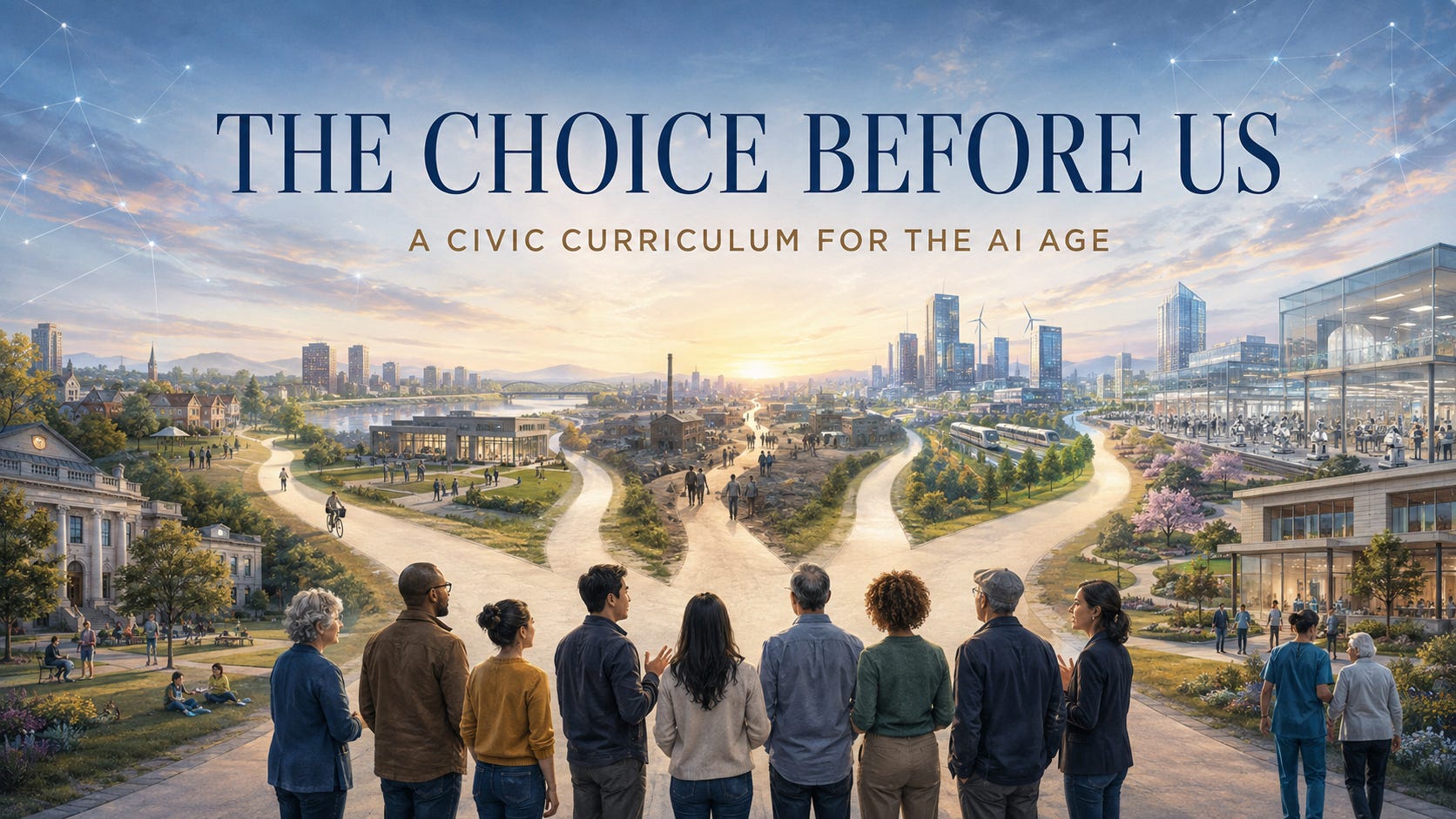
The Choice Before Us
Technology changes what is possible. It does not decide what is just.

An Editor’s Note from Moonshot Press
Moonshot Press is a human-led, AI-augmented publication. This article was written and edited by Shimon Waldfogel, MD, with artificial intelligence used to support research, questioning, synthesis, and editorial development. Shimon retains responsibility for the final judgments and published text.
AI collaborators used in developing this article: ChatGPT 5.6 Sol Claude Opus 5 High
Learn more about how Moonshot Press uses artificial intelligence.
An orientation to the Civic Curriculum for the AI Age
Consider a high school senior trying to decide what to study.
She is good at writing and good at math, and people who mean well—but cannot possibly know whether they are right—have told her to avoid anything a machine may soon be able to do. She asks what that leaves. Her guidance counselor does not have a reliable answer. Neither do the labor economists, the executives selling the systems, or the researchers building them.
She is being asked to make a consequential decision under genuine uncertainty, and the honest response—nobody knows—is not much comfort when the application deadline is in November.
Millions of people are in some version of her position. Not only students choosing a field, but a paralegal watching first-year work quietly disappear, a school board deciding what to buy, a county weighing a data center against its water supply, a physician deciding how much clinical judgment can safely be delegated to software. These decisions are being made right now, in laboratories and boardrooms and agencies and school districts and living rooms. They will shape how people work, how children learn, how healthcare is delivered, how information travels, and how power is distributed.
And most of us are being invited into that future as consumers, users, patients, and employees—not as citizens with any say in what the technology is for.
The Civic Curriculum begins from a different premise: citizens should help shape the technological future they will be asked to inhabit.
We do not know what is going to happen
Public conversation about AI rewards confidence. One camp anticipates extraordinary abundance—productivity growth, scientific breakthroughs, personalized education, liberation from tedious work. Another warns of mass unemployment, surveillance, manipulation, concentrated power, and the loss of meaningful human control. Both accounts deserve serious examination. Neither should be mistaken for a forecast.
Here is what we actually know. AI capabilities have advanced rapidly. Enormous sums are being invested. Machines can now assist with, and sometimes perform, work involving writing, coding, analysis, design, research, and clinical decision support that recently required trained human beings.
Here is what we do not know. We do not know how quickly technical capability converts into dependable economic value. We do not know how many occupations will vanish, how many will change, or how many new ones will appear. We do not know whether productivity gains will reach ordinary households or stay with those who own the systems. We do not know whether organizations will find these tools more expensive and unreliable than promised. And we do not know whether our institutions will adapt faster than the technology or considerably slower.
We do not know. That may be the most important fact with which to begin.
This is not a hedge, and it is not a reason for passivity. A society that waits until the consequences are unmistakable has waited too long. A society that reorganizes itself around predictions that turn out to be wrong does real damage of a different kind. The task is not to pick the most dramatic forecast and build around it. The task is to prepare for several plausible futures, watch the evidence as it comes in, and build institutions capable of changing course.
Five futures worth preparing for
Chapter 4 examines these in depth. For now, the map:
The AI Slowdown. AI proves useful but far less transformative than promised. The disruption comes from the expectations themselves—abandoned projects, failed companies, communities left holding stranded investments in infrastructure built for growth that never arrived.
The Assistive Economy. AI expands human capability without broadly replacing people. Doctors, teachers, tradespeople, and small-business owners become more capable. The central question becomes who receives the tools—because a technology that reaches only the well-resourced raises productivity while widening the gap.
Uneven Transformation. AI creates real value but reorganizes work faster than people and institutions can absorb. Entry-level pathways disappear in professions where machines now perform the work through which beginners once learned the craft. The aggregate economy looks healthy while particular people, occupations, and regions are hollowed out.
Extraction Without Abundance. The technology works, the gains are real, and they are captured. Output rises, wages do not, ownership concentrates, and the promised broad prosperity never materializes for most people.
Abundance Without Employment. The most radical scenario, and the one to hold most loosely. Machines become capable enough that human labor is much less necessary for production. Society grows wealthy while needing fewer people to produce that wealth—at which point income turns out to be the easier problem, and the harder one is what work was doing besides paying us.
These are scenarios, not predictions. Reality may combine them, or move between them, or land somewhere none of them anticipated. Their purpose is to widen the field of vision and to ask what citizens and institutions would need to do if each began to emerge.
The question underneath
I spent my career as a psychiatrist, and it shapes how I read all five of these.
Prolonged unemployment, social disconnection, and loss of purpose have been associated with serious consequences for mental and physical health—including depression, substance use, cardiovascular illness, and premature death. We watched a version of this move through deindustrializing towns a generation ago and eventually gave it a name.
Whether that pattern follows AI into offices, hospitals, classrooms, and law firms is not established. I think the risk is serious enough to examine before the evidence is conclusive rather than after. Almost nothing in the current policy conversation is built to catch it, because that conversation is organized around replacing income rather than restoring meaning.
There is a useful way to think about this, and it runs through the whole Curriculum. The medical sociologist Aaron Antonovsky asked an unusual question. Not what makes people sick—the question medicine had been asking—but what keeps people well, given that stress and hardship are universal? His answer centered on whether life is comprehensible, manageable, and meaningful: whether I can make sense of what is happening, whether I have the resources to meet it, and whether my effort is worth making.
Turn that question toward technology and the policy conversation reframes itself. Not how do we cushion the harms, but does this system generate the conditions in which people can be healthy? We usually ask whether an AI system is accurate, efficient, safe, and profitable. Those are the right questions and they are not sufficient. Alongside them: Can people understand what it is doing to them and contest an error? Does it strengthen human capability or create hidden dependence? Who receives the benefits, and who carries the burdens?
That standard is developed in Chapter 9. It is worth naming now, because it explains why this Curriculum is organized the way it is.
What this is, and how it will work
This is not a technical course, and it will not teach readers how to build AI systems. It is a shared framework for understanding what AI may change, deliberating about the choices before us, and identifying meaningful ways to act.
A few commitments:
I will not assume transformation is inevitable. Claims about what AI will do are claims to examine, not facts to inherit.
I will present the strongest competing arguments, evaluated on their evidence, assumptions, and consequences—including the ones I find least congenial.
I will distinguish evidence from inference from prediction. What is technically possible is not necessarily economically practical, institutionally adopted, or socially desirable.
I will preserve distinctions that matter. A task is not a job. A job is not an occupation. Employment is not the only form of contribution. Productivity is not human worth.
I will revise in public. This is a living inquiry, and I will get things wrong.
The Curriculum is the learning half. The People’s Commission on Technology and the American Future is the other half—a method for moving from understanding to deliberation to action. It is not a panel of experts speaking for everyone else. It is a structure for citizens to examine evidence, contribute what they know from their own lives, and make their conclusions visible to the people who hold power.
One helps us understand the choices. The other helps us exercise citizenship within them.
What is coming
This Orientation begins a twelve-part public-learning journey: ten chapters followed by an epilogue, published weekly through late October.
We begin with the human question—what work has been doing for us besides paying us. Then the technology itself: what these systems actually are, what they can and cannot do. Then history, and where it stops being a reliable guide. Then the five futures in depth. Then power: who gains, who loses, who decides, and who governs any of this. Then choices—the real policy options and the honest arguments against each. Then information and democratic power, the salutogenic standard, and finally what Americans should be able to expect from one another in an age of intelligent machines.
Each chapter includes questions for reflection and for group deliberation. They are meant to be argued with.
The choice before us
Whatever future arrives, one principle runs through all five scenarios: technology changes what is possible; it does not decide what is just.
Those decisions—who gets access, who bears risk, who captures gains, whose rights are protected—will be made by people. Some in laboratories and boardrooms, others by legislatures, courts, agencies, schools, hospitals, states, cities, and citizens. They are not merely technical choices, and they are not merely economic ones. They are choices about the kind of society we intend to become.
The future of artificial intelligence will not be determined by citizens alone. But it should not be determined without us.
The Curriculum begins with learning, but its destination is participation.
Chapter 1 arrives Monday, August 17: What Is Work For? It begins with a woman who has spent fifteen years becoming very good at a job that a new system can now mostly do—and asks what exactly is lost when that happens, beyond the paycheck.
If you want to be part of the deliberation rather than only the readership, join the Moonshot and tell me what this transition makes you hopeful about, worried about, or curious about. Your answers will shape what I investigate.
I am glad you are here.
Shimon Waldfogel, MD Founder and Publisher, Moonshot Press