

Four Manifestos and the Future of Humanity
Three saw the crisis. The fourth is writing policy. AI, human dignity, and the world the Moonshot Class of 2026 will inherit.

Editor’s Note
Four Documents, Five Babies, and the Choice in Front of Us
A terrorist who saw what was coming. A democratic activist who died trying to prevent it. A venture capitalist who is making it worse. A Pope who is asking us to choose.
Four very different voices. Together, they map the entire moral terrain of the AI question. Three of them are describing the same crisis. The fourth is denying it — and writing policy.
I came to this material as a psychiatrist. My work has taught me that what most damages human beings is not hardship itself, but a world that has stopped making sense, in which they no longer feel capable of acting, and in which the meaning of their lives is no longer clear. AI, in the way it is being rolled out, is producing that condition at scale — for workers, for families, for whole communities. That is what brought me to write about these four documents.
The article that follows places them side by side — Kaczynski, Swartz, Pope Leo XIV, and Andreessen — and then offers a fifth: the Manifesto of the Class of 2026, the People’s Commission’s answer. It is the document that says what ordinary citizens, organized around the right questions, can still choose.
The choice is not between technology and no technology. It is between a future written for us, and a future we write together.
Liam, Amare, Emma, Eva, and Mateo are five composite children — portraits Moonshot Press drew to represent the babies being born across America this year. They will be old enough to vote in 2044, and to enter the workforce around the same time. Every governance decision being made now is a decision about the country they will inherit. That is the stake. That is why these four documents matter — and why a fifth needed to be written.
Read this as an invitation. The window is open.
— Shimon Waldfogel, MD
Founder, Moonshot Press · President, Institute for Salutogenesis
Philadelphia · June 2026

“We need to take information, wherever it is stored, make our copies and share them with the world.” — Aaron Swartz, Guerrilla Open Access Manifesto, 2008
“Industrial-technological society denies people genuine power processes by depriving them of their autonomy and reducing their scope for the exercise of effort.” — Theodore J. Kaczynski, Industrial Society and Its Future, 1995
“We believe the techno-capital machine will solve all human problems. Deceleration is murder.” — Marc Andreessen, The Techno-Optimist Manifesto, 2023
“Humanity, created by God in all its grandeur, is today facing a pivotal choice: either to construct a new Tower of Babel or to build the city in which God and humanity dwell together.” — Pope Leo XIV, Magnifica Humanitas, 2026
The Argument in Brief
This essay compares four manifestos written across thirty-one years, from 1995 to 2026. They come from radically different moral worlds: Theodore Kaczynski’s Industrial Society and Its Future, Aaron Swartz’s Guerrilla Open Access Manifesto, Marc Andreessen’s The Techno-Optimist Manifesto, and Pope Leo XIV’s Magnifica Humanitas: On Safeguarding the Human Person in the Time of Artificial Intelligence.
One was written by a murderer. One by a young democratic activist who died after being prosecuted for trying to liberate knowledge. One by a billionaire venture capitalist whose investments depend on the accelerated growth of artificial intelligence. One by the head of the world’s oldest continuous institution of moral teaching.
They should have almost nothing in common.
And yet three of them converge on the same diagnosis.
Kaczynski, Swartz, and Leo XIV all argue, in different vocabularies, that modern technological systems can erode human autonomy, weaken democratic agency, and produce psychological and spiritual suffering at scale. Kaczynski called this the loss of the “power process”: the human need for meaningful goals, genuine effort, attainment, and autonomy. Swartz saw the same problem in the privatization of knowledge: when information is enclosed, citizenship itself is weakened. Leo XIV places the issue within the long tradition of Catholic social teaching: artificial intelligence must be governed by the dignity of the human person, not by productivity, profit, or technical possibility alone.
The fourth manifesto, Andreessen’s, denies the diagnosis. It treats technological acceleration as the source of progress, markets as the best form of governance, and critics of acceleration as obstacles to human flourishing. In his framework, the “techno-capital machine” should be unleashed, not restrained. Growth is the answer. The machine will solve the problems created by the machine.
That asymmetry is the central fact of this essay: three independent traditions identify the same danger, while the tradition that denies the danger is the one currently closest to power.
This is not a simple debate between pro-technology and anti-technology. That is the wrong map. The better map is a two-by-two matrix.
One axis asks whether a tradition accepts the diagnosis: that industrial and digital technology, especially when governed by concentrated private power, can damage human agency, meaning, and dignity.
The second axis asks what prescription follows: constructive reform or destructive surrender.
Swartz and Leo XIV accept the diagnosis and offer constructive responses. Swartz calls for the democratization of knowledge. Leo XIV calls for governance rooted in human dignity, the common good, and special concern for those most vulnerable to technological disruption.
Kaczynski accepts the diagnosis but offers a destructive prescription. He concludes that reform is impossible and that the system must be destroyed. His crime was not only moral horror. It was also a failure of imagination: the inability to believe that human beings, acting together, can govern the systems that threaten them.
Andreessen denies the diagnosis and offers a different destructive prescription: acceleration. He does not say destroy the machine. He says build it faster. But in democratic terms, Kaczynski and Andreessen are not opposites. They are the same error in different directions. Kaczynski says the system cannot be governed, so it must be annihilated. Andreessen says the system should not be governed, because the market already knows best. Both refuse democratic responsibility.
That is why Aaron Swartz and Leo XIV belong together in this essay. One speaks in the language of the open internet, civic knowledge, and democratic participation. The other speaks in the language of human dignity, moral responsibility, and the common good. Their vocabularies differ. Their conclusion converges: technology must be accountable to the people whose lives it shapes.
The deeper question, then, is not whether we are for or against artificial intelligence. That question is too small. The real question is: what theory of the human being will govern the age of AI?
Is the human being primarily a market actor, valuable according to productivity and economic usefulness?
Is the human being an isolated creature seeking autonomy against an overwhelming system?
Is the human being a citizen, whose dignity depends on meaningful participation in a shared world?
Or is the human being a person of intrinsic worth, whose value no machine, market, algorithm, or productivity metric can erase?
This is why the essay matters for the Moonshot Class of 2026.
Liam, Amare, Emma, Eva, and Mateo — the five composite children at the center of the People’s Commission — are being born into the world these decisions are creating. They will grow up in homes shaped by algorithmic media, schools transformed by AI, labor markets disrupted by automation, healthcare systems mediated by data, and communities already strained by inequality, loneliness, distrust, and civic fragmentation.
A manifesto for the First 1000 Days of Life cannot therefore be only about prenatal care, nutrition, maternal mental health, early childhood development, or access to services — although it must be about all of those things. It must also ask what kind of civilization these children are entering. Will they inherit a world that makes life more comprehensible, manageable, and meaningful? Or a world that turns them into data points, consumers, competitors, and productivity inputs before they have even had a chance to become citizens?
The four manifestos do not answer that question for us. They clarify the choice.
One path is Babel: the tower of technological power, speaking one language, serving one logic, concentrating authority in the hands of those who build and own the machine.
The other path is the city of human dignity: democratic, accountable, plural, solidaristic, built around the conviction that technology must serve persons, families, communities, and the common good.
This essay is long because the choice is serious. But the argument is simple.
We do not have to choose between technology and no technology. We have to choose between technology governed by concentrated power and technology governed by democratic responsibility.
We do not have to choose between nostalgia and acceleration. We have to choose whether human dignity remains the standard by which progress is judged.
And we do not have to accept a future written for us by those with the most capital, the most data, and the most access to power.
The Moonshot Class of 2026 begins from a different premise: the future of these children should be shaped by citizens, families, communities, and institutions willing to ask what makes human flourishing possible.
The full essay below offers the map.
The question it leaves with us is the one that matters most:
Which city do you want to live in?
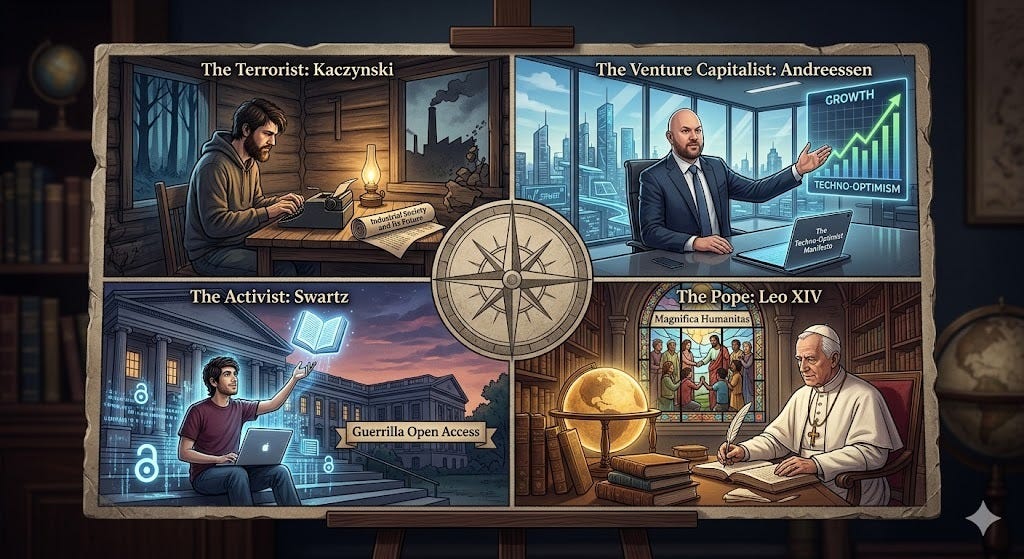
Because one of these documents was written by a murderer, this essay begins where any morally serious reading must begin: with the people he killed and injured. Hugh Scrutton. Thomas Mosser. Gilbert Murray. David Gelernter. Gary Wright. Their lives and suffering are not footnotes to the argument. They are the necessary beginning of it.
The tradition of the manifesto is an act of radical clarity. Not a policy brief. Not a white paper. Not a hedged and footnoted academic argument. A manifesto says: here is what I see, here is what I believe it means, and here is what must be done. It is addressed to anyone willing to read it. Its claim is not expertise. Its claim is truth.
In the thirty-one years between 1995 and 2026, four documents were written in this tradition that together may constitute the most complete map available of the moral and political landscape of artificial intelligence. They were written by four very different people, from four very different traditions, with four very different prescriptions for what should be done. On the single most important question — whether industrial and digital technology systematically erodes human autonomy and produces mass psychological suffering — three of the four documents agree. Only one denies the problem exists.
The one that denies the problem is the one currently governing AI policy in the United States.
That asymmetry — three independent traditions arriving at the same diagnosis, the fourth position being held by the people with the money and the political access — is the central fact of the AI governance debate. Understanding it requires taking all four documents seriously: what they say, who wrote them, what tradition they draw from, and where each goes right or wrong.
One of the four documents was produced by a man who murdered people. Naming his ideas without obscuring his crimes — and without pretending, as most comfortable technology commentary does, that his diagnosis was simply wrong — is what intellectual honesty requires. It is also, as will become clear, the strongest possible argument for the constructive responses that the other traditions offer.
Let us read all four.
I. The Documents
“Industrial Society and Its Future” — Theodore J. Kaczynski, 1995. Thirty-five thousand words, printed as a special supplement to The Washington Post in September 1995 at the request of the FBI. Its author had been mailing bombs since 1978. He offered to stop if his document was published. Three people had already died: Hugh Scrutton, a Sacramento computer store owner, killed by a package bomb in his parking lot. Thomas Mosser, an advertising executive, killed by a bomb mailed to his home. Gilbert Murray, a timber industry lobbyist, killed in his office. Twenty-three others were injured. David Gelernter, a Yale computer science professor, lost vision in his right eye and partial use of his right hand. Gary Wright, a computer store employee, was left with permanent nerve damage.
These were not symbols. They were people. Their suffering is the price of the document’s publication, and it must be named before a single idea within it is examined.
With that said: the manifesto itself is not what most people imagine. It is the work of a Harvard-educated mathematician who had spent decades reading Jacques Ellul, Lewis Mumford, and the serious intellectual tradition of technology criticism. In its analytical sections, it reads like a rigorous if tendentious social science paper. Kevin Kelly, the technophilic writer, devoted several pages to the Unabomber Manifesto in his book What Technology Wants, calling it, with apologies, one of the most astute analyses of technology he had ever read. This was not a rogue judgment. It is widely shared among serious readers who are honest about what they found.
“Guerrilla Open Access Manifesto” — Aaron Swartz, 2008. Four hundred and eighty-one words, published in a corner of the internet almost nobody read. Its author was twenty-one years old. He had co-authored the RSS 1.0 specification at fourteen, helped build Creative Commons, and would later play a central role in defeating SOPA, the internet censorship bill. He would subsequently be charged with thirteen federal felony counts for downloading academic journal articles from JSTOR, facing up to thirty-five years in prison. He died by suicide on January 11, 2013. He was twenty-six.
“The Techno-Optimist Manifesto” — Marc Andreessen, October 2023. Five thousand two hundred words, published on the website of Andreessen Horowitz, a venture capital firm managing approximately $42 billion in assets weighted toward AI and technology companies. Its author is one of the most powerful investors in Silicon Valley, a donor to the Trump campaign, and an informal architect of the deregulatory AI governance framework currently in place in the United States.
“Magnifica Humanitas: On Safeguarding the Human Person in the Time of Artificial Intelligence” — Pope Leo XIV, signed May 15, published May 25, 2026. Forty-two thousand three hundred words. The first encyclical of his pontificate, addressing human dignity and the ethical challenges posed by artificial intelligence. Released on the 135th anniversary of Rerum Novarum — Leo XIII’s foundational 1891 encyclical on labor and capital — a date chosen with evident deliberateness. Its author leads the largest religious institution on earth and was named to the 2025 Time 100 AI list as a key thinker shaping how humanity confronts AI.
Four documents. Four traditions. One crisis.
II. The Genealogies
Every intellectual argument rests on a tradition. The tradition tells you nearly as much as the argument itself — whose thinking you are inheriting, what assumptions you are carrying, and what moral vocabulary you are using. The four documents draw on four distinct traditions, and the genealogies reveal the fault lines before the arguments even begin.
Kaczynski’s tradition runs through Jacques Ellul, Lewis Mumford, and what might be called the technology pessimist school of the twentieth century. Kaczynski’s brother called Ellul’s The Technological Society his “bible.” In a fan letter to Ellul, Kaczynski wrote that he had read it six times. His manifesto is shot through with Ellul’s ideas. Ellul argued that modern technology — he preferred the word “technique” — had become autonomous, self-reproducing, and hostile to human freedom, that it obeyed its own internal logic rather than human purposes, and that its total reach into every domain of life constituted a new form of totalitarianism. These ideas, absorbed and radicalized in a Montana cabin over seventeen years, became the intellectual foundation of Kaczynski’s campaign. What Kaczynski inherited from Ellul was the diagnosis. What he invented himself was the prescription.
Swartz’s tradition runs through Jefferson and Paine and the abolitionists, through the labor movement and the civil rights movement, through the open-source programmers who built the internet as a commons before it was enclosed by corporate interest. His intellectual heroes are unnamed but unmistakable: the anonymous Wikipedia editor, the researcher who publishes without a paywall, the programmer who releases code freely because knowledge belongs to everyone. His tradition is democratic solidarity — the conviction that the concentration of information and knowledge in private hands is a form of political oppression, and that the response is not destruction but liberation.
Andreessen’s tradition is explicit in a way that invites close reading. He invokes Hayek’s Knowledge Problem to argue against democratic governance. He cites Milton Friedman on the infinitude of human wants. He describes the “techno-capital machine” using terminology borrowed from Nick Land — often considered the “father of accelerationism,” whose anti-democratic and anti-egalitarian ideas were deeply influential to the neo-reactionary and Dark Enlightenment movements. At the end of his manifesto, he lists patron saints by name. They include philosopher Friedrich Nietzsche, the fictional character of John Galt, the neo-reactionary philosopher Nick Land, and Filippo Tommaso Marinetti — who would go on to co-author the Fascist Manifesto. Among his declared enemies: sustainability, tech ethics, risk management, and “the ivory tower.”
Leo XIV’s tradition is the oldest continuous social teaching in Western civilization. He traces it explicitly from Rerum Novarum (1891) through every subsequent papal social encyclical, through the Second Vatican Council, through Laudato Si’ and Laudate Deum. He invokes Augustine of Hippo, St. Francis, and the prophetic tradition of Scripture. He quotes Augustine’s De Civitate Dei: “’Two loves have built two cities: the earthly city, the love of self even to the contempt of God; the heavenly city, the love of God even to the contempt of self.’” His fundamental claim — that the human person is made in the image of God and bears an inalienable dignity that no market outcome, no algorithmic decision, and no productivity metric can negate — is 2,000 years old. Its application to AI is entirely new.
The Pope’s patron saints are Francis of Assisi, Mary, and the prophets. Swartz’s implicit patron saints are Jefferson and the Wikipedia community. Andreessen’s declared patron saint is a co-author of the Fascist Manifesto. These genealogies are the argument before the argument begins.
III. The Shared Diagnosis
Here is the most important structural fact of this four-way comparison: three of the four documents agree on what technology does to human beings.
Kaczynski, writing in 1995, before the internet was a mass phenomenon and before social media existed: the power process — comprising four elements of goal, effort, attainment of goal, and autonomy — is a fundamental human psychological mechanism. Industrial-technological society denies people genuine power processes by depriving them of their autonomy and reducing their scope for the exercise of effort. The consequence is mass psychological illness: depression, alienation, the proliferation of “surrogate activities” that substitute manufactured satisfaction for the real thing.
Swartz, writing in 2008: “Information is power. But like all power, there are those who want to keep it for themselves.” The privatization of knowledge destroys democratic autonomy — the capacity to participate meaningfully in the governance of one’s own community and life. What Kaczynski calls the power process, Swartz calls democratic citizenship. Both are describing the same underlying need: the capacity to act with purpose and genuine agency in a world that makes sense.
Leo XIV, writing in 2026: “The ‘new ways’ of working are not necessarily better. While AI promises to boost productivity by taking over mundane tasks, it frequently forces workers to adapt to the speed and demands of machines, rather than machines being designed to support those who work.” The encyclical’s deepest concern is not economic but psychological and spiritual: that human beings will begin to understand themselves through the machine’s categories — as data points, productivity inputs, optimization targets — and lose the sense of their own dignity in the process.
Three traditions, three vocabularies, one observation. The observation has since been confirmed by exactly the empirical research Kaczynski could only speculate about. He predicted psychological breakdowns. Today: the WHO reports nearly one billion people suffer mental disorders; youth show increased depression, anxiety, and social media addiction. He believed people would lose agency over their lives. Digital surveillance increases control, algorithmic management shapes work and consumption, automated hiring systems make opaque decisions about people’s economic futures.
Andreessen sees none of this. We believe everything good is downstream of growth. We believe technology is fundamentally constructive. We believe a Universal Basic Income would turn people into zoo animals to be farmed by the state. Man was not meant to be farmed; man was meant to be useful, to be productive, to be proud.
The three who share the diagnosis are not conspiracy theorists. They are a mathematician who read Ellul, a 21-year-old who loved Wikipedia, and the Pope. The one who denies it is a billionaire investor whose financial returns depend on the acceleration of the very technologies whose consequences the other three are describing.
This asymmetry is not coincidental. It is structural. And it is the central fact of AI governance.
IV. The Tower of Babel
The most powerful single image in these four documents appears in the one that has received the least public attention. The story of Babel appears in the Book of Genesis at the origins of humanity. After settling in a plain in the land of Shinar, the people decided to build a city and a tower “with its top in the heavens.” Fearing being scattered across the earth, they sought to guarantee stability and power for themselves, and above all to “make a name” for themselves. It was an impressive feat: a single language, a single technology, a single direction. However, the project concealed a profound danger. It was a project conceived without reference to God, supported by a uniformity that eliminated diversity and chose homogenization over communion. When a city is built on pride and the claim to self-sufficiency, communication breaks down, languages are confused and people no longer understand each other.
The Pope did not write the Andreessen manifesto when he wrote this description. But read them together and the correspondence is exact.
Andreessen’s “techno-capital machine” spirals perpetually upward, driven by a single logic — growth — that overrides all other considerations. It speaks one language: market signals. It admits of one value: productivity. It has one measure of human worth: economic output. We believe everything good is downstream of growth. This is Babel. A single language. A single direction. A tower whose top Andreessen expects to reach in his lifetime.
Kaczynski saw the same tower and reached a different conclusion about what to do with it. In his terms: modern technological society is a totalitarian force — an order in which individuals are “adjusted” to fit the requirements of the system and those outside the system are seen as pathological or “bad.” This tendency gives rise to expansive police powers, mind-numbing mass media, and indiscriminate promotion of drugs designed to conform to the needs of the technological environment.
Babel, again, in darker and more paranoid language. The tower stands. The question is what to do about it.
Swartz said: democratize the tower’s information. Make what is being built inside it available to everyone who needs it. Leo XIV says: the primary choice is not between a “yes” or “no” to technology, but rather between constructing Babel or rebuilding Jerusalem — between a power that claims to dominate the heavens and a people who work together in the presence of God to rebuild the walls of fraternal coexistence.
Andreessen says: build the tower faster.
Kaczynski said: burn it down.
V. Four Anthropologies
Every political philosophy rests on an anthropology — a theory of what human beings fundamentally are. The four documents offer four distinct answers. Understanding the differences between them is not a philosophical exercise. It determines everything about what governance means and who it is for.
For Andreessen, the human being is a productive market actor. Flourishing is measured by wages, productivity, and access to cheap goods. We believe a Universal Basic Income would turn people into zoo animals to be farmed by the state. Man was not meant to be farmed; man was meant to be useful, to be productive, to be proud. A person who cannot compete in the techno-capital machine has, by this logic, lost the very quality that defines humanity. Dignity is conditional on economic performance. It is, in the end, a theory of worthiness rather than inherent worth.
For Kaczynski, the human being is fundamentally a hunter-gatherer — a creature evolved for small-group, goal-directed, autonomous activity in a natural environment. The power process has four elements: goal, effort, attainment of goal, and autonomy. Goals must demand substantial effort — neither trivially easy nor overwhelmingly unattainable — to yield fulfillment. Industrial society’s fundamental sin is that it systematically removes genuine challenge from most people’s lives while making self-determination impossible on any matter that actually counts. This anthropology has real insight — the Sense of Coherence research, the psychology of autonomy, and the evidence on meaning and work all support its core claim. But it is a theory of the solitary individual, with no adequate account of solidarity, community, or democratic participation. In Kaczynski’s world, humans do not have obligations to each other. They have biological needs for goal-directed activity that industrial civilization frustrates.
For Swartz, the human being is a political creature in the Aristotelian sense — a being whose fullest expression is civic participation, whose dignity rests on access to the information and knowledge needed for democratic life. To deny a person access to publicly funded research is not merely a commercial inconvenience. It is a denial of citizenship. The manifesto’s moral force derives from this single claim: that knowledge is the precondition of democratic life, and therefore its privatization is a form of political oppression with structural victims, not just commercial losers.
For Leo XIV, the human being is made in the image of God — imago Dei — bearing a dignity that is prior to any economic arrangement, any social role, any productive capacity. “We must lovingly safeguard the grandeur of humanity bestowed upon us and revealed in its fullness in Christ, the splendor of which no machine can ever replace. True progress always stems from a heart open to others, an intelligence willing to listen and a will that seeks what unites.” This is not a claim limited to Catholics. It is a political claim in the classical sense: that human dignity is inalienable, that it cannot be quantified by productivity metrics or market signals, and that any system — including an AI system — that reduces persons to data points has committed a fundamental moral error regardless of whether its designers intended harm.
Now observe the structure. Andreessen and Kaczynski are both reductive — both conceive of the human being in terms of a single fundamental drive (market participation; biological power process) and both therefore miss what the other two traditions center: solidarity, community, and the person’s intrinsic value as a member of a civic and spiritual community. Swartz and Leo XIV, despite their radically different vocabularies, are describing the same person — a being whose dignity is intrinsic, whose claim on justice does not depend on economic productivity, and whose fullest expression is found not in isolation but in community.
This is the most important distinction the four documents draw. Not left versus right. Not secular versus religious. The distinction is between anthropologies that reduce the person to a single drive and anthropologies that honor the full complexity of human dignity.
VI. The Power Process and What the Research Shows
The most intellectually significant convergence across all four documents is between Kaczynski’s “power process” and what the social and medical sciences have independently confirmed about human psychological needs.
He predicted psychological breakdowns as industrial society removed genuine autonomy from most people’s lives. Today: the WHO reports nearly one billion people suffer mental disorders, with depression prevalence rising alongside technological integration and urbanization. Youth show increased depression, anxiety, and social media addiction.
Aaron Antonovsky — the Israeli medical sociologist who developed the concept of Sense of Coherence — described the same underlying need in different language. Human beings require that their world be comprehensible (structured, predictable, explicable), manageable (that they have the resources to meet its challenges), and meaningful (that engagement with those challenges is worth the investment). These three dimensions map almost exactly onto Kaczynski’s four elements of the power process: goal (meaningfulness), effort (manageability), attainment (comprehensibility), autonomy (the precondition of all three).
Two researchers, working in entirely different traditions, with entirely different methods, arrived at nearly identical descriptions of what human beings need to flourish. The difference is that Antonovsky developed a program for creating those conditions — the salutogenic framework, the study of what makes people healthy rather than what makes them sick. Kaczynski developed a mail bomb.
The Pope’s encyclical is, in the deepest sense, a salutogenic document applied to the specific conditions of AI capitalism. Pope Leo XIV calls for renewed attention to schools as places where people learn to “seek and love the truth,” and emphasizes that in the “fourth industrial revolution” represented by the digital transition, “AI promises to boost productivity by taking over mundane tasks” but “it frequently forces workers to adapt to the speed and demands of machines, rather than machines being designed to support those who work.”
Kaczynski’s power process. Antonovsky’s Sense of Coherence. The Pope’s vision of dignified work. These are not competing descriptions. They are the same empirical reality, approached from three different directions. The convergence should give pause to anyone inclined to dismiss any one of them.
Andreessen addresses this empirical reality directly: he denies it. The techno-capital machine generates abundance. Markets produce better outcomes than centralized planning. Growth solves every problem including the problems caused by growth. These are not arguments from evidence. They are articles of faith, stated with the conviction of someone who has done very well from the machine and is not experiencing its underside.
VII. The Worker and the Machine
Each document has something to say about what happens to people whose livelihoods are transformed or destroyed by technology. The divergence here is perhaps the most concrete expression of the anthropological differences identified above.
Kaczynski: technology systematically destroys meaningful work by first making survival too easy and then making self-determination on anything that matters impossible. The industrial worker is a cog. The white-collar professional is a more comfortable cog. The solution — the only solution — is to destroy the system that has made them both into cogs.
Swartz: the information worker whose knowledge is extracted, privatized, and sold back to them at a profit is being robbed. The researcher whose publicly funded findings are locked behind a paywall, unavailable to the public that paid for them, is the victim of a specific kind of institutional theft. The response is democratic reclamation: take the information back, share it, build the commons.
Leo XIV: “The ‘new ways’ of working are not necessarily better. While AI promises to boost productivity by taking over mundane tasks, it frequently forces workers to adapt to the speed and demands of machines, rather than machines being designed to support those who work.” The encyclical goes further: “A more moral AI is not enough if that morality is determined by a few… As with every major technological shift, AI tends to amplify the power of those who already possess economic resources, expertise and access to data.” The prescription is regulatory: establish governance frameworks centered on the dignity of the person, the common good, and — in the phrase that is perhaps the most radical in the entire document — the preferential option for the poor.
The preferential option for the poor, applied to AI governance, means this: the measure of any AI system is not what it does for the investors, the executives, or the credentialed users who can adapt. It is what it does for the truck driver in Laredo, the medical coder in Chattanooga, the paralegal in Columbus whose job is next. If the system makes their lives more comprehensible, more manageable, and more meaningful, it is serving human dignity. If it makes their lives less so, it is not — regardless of what it does to productivity metrics or investor returns.
Andreessen: technology guarantees high employment regardless of its level. Markets generate more jobs than they destroy. Three hundred years of history prove it. Workers who cannot adapt to the new economy are unfortunate but not the proper subject of policy concern, because the machine generates more wealth than any redistributive scheme could distribute, and interfering with the machine slows the generation of that wealth.
This is the complete landscape of positions available on the question of what to do about workers displaced by technology. Three of them involve some form of accountability — to the system (Kaczynski), to democratic solidarity (Swartz), or to a governing standard of human dignity (Leo XIV). One of them — Andreessen’s — involves none. It is faith in the machine. It is the position that currently governs.
VIII. On Enemies
What each tradition identifies as its enemy is, in some ways, more revealing than what it identifies as its goal.
Swartz’s enemies are structural: the systems and legal arrangements that privatize knowledge. Academic publishing monopolies. Copyright law weaponized against sharing. The Computer Fraud and Abuse Act, which turned the act of downloading academic articles into a federal felony. His enemies are not people. They are arrangements of power — ones that can, at least in principle, be changed through democratic action.
Kaczynski’s enemies are also structural, but his analysis of the structure leads him somewhere Swartz would not follow. The system itself — industrial-technological civilization in its entirety — is the enemy. Not a specific law, not a specific monopoly, not a specific governance failure. The whole thing. Because the whole thing, in his analysis, is irredeemably corrupted. “Efforts to reform or restrain the system are useless. The only way out is to dispense with the industrial-technological system altogether.” This conclusion — that the system cannot be reformed, only destroyed — determines his prescription. It also, as we will examine, reveals the specific error at the heart of his thinking.
Leo XIV’s enemies are identified with care and genuine theological precision. The technocratic paradigm — an order in which technology and market logic colonize every domain of human life and reduce all questions to questions of efficiency — is the structural force he opposes. He identifies specifically the “epistemic, economic and political asymmetry” and “the new monopolies of AI” as the structural threats to the common good. He names no individuals. He calls for dialogue, not confrontation. He offers principles, not ultimatums. His enemies are real — the concentration of power in a few private hands, the systematic exclusion of democratic publics from governance decisions that will shape their lives — but he addresses them in the tradition of a shepherd rather than a general.
Andreessen’s enemies are people and ideas, named with a specificity that is remarkable: sustainability, tech ethics, and risk management. The “ivory tower.” “Credentialed experts.” “Decelerationists.” And — the move that forecloses debate rather than engaging it — the claim that any deceleration of AI constitutes murder. Deaths caused by the AI that was “prevented from existing” are deaths for which the critics are responsible. This rhetorical move is not an argument. It is preemptive silencing: if you question my preferred policy, you are a killer.
It is worth noting what this enemy list includes: safety researchers, ethics scholars, risk managers, and people who think about sustainability. These are the people whose professional function is to ask whether technology is working as intended and causing the harms it risks. In Andreessen’s schema, asking those questions is equivalent to being “against life.” Coming from a man with $42 billion in assets weighted toward the companies whose critics he is attacking, this is not merely intellectually dishonest. It is a conflict of interest dressed as a philosophy.
IX. Where Kaczynski Went Wrong — And What That Teaches Us
The hardest intellectual task this essay sets itself is explaining, with fairness and precision, where Kaczynski’s argument breaks down.
He was not simply wrong about the diagnosis. That is the uncomfortable fact. He saw, earlier than most, that industrial and digital systems could erode autonomy, weaken meaningful agency, and produce psychological suffering at scale. He understood that human beings need more than comfort, consumption, and entertainment. They need meaningful goals, real effort, some experience of mastery, and some genuine say over the conditions of their lives.
Where he went catastrophically wrong was in the prescription.
He concluded that because the technological system was damaging human beings, the system could not be governed. It could only be destroyed. That conclusion does not follow from the diagnosis. It follows from three deeper errors.
He mistook a governance failure for a technology destiny.
Kaczynski treated the loss of autonomy as intrinsic to technology itself. In his account, industrial-technological society has its own internal logic, and that logic inevitably expands until human beings are adjusted to serve the system rather than the system being governed to serve human beings.
There is truth in the warning. Technological systems do tend to expand. They do tend to reward efficiency, scale, prediction, and control. When left to their own logic, they can colonize domains of life that should be governed by human judgment, democratic deliberation, and moral restraint.
But this is not the same as saying that technology itself inevitably destroys autonomy.
Ungoverned technology, deployed by concentrated private or state power without democratic accountability, destroys autonomy. Technology designed without concern for human dignity can make life less comprehensible, less manageable, and less meaningful. Systems built only for productivity, surveillance, profit, or control will predictably produce alienation.
That is a governance failure.
The solution to a governance failure is not annihilation. It is better governance.
A hammer is not responsible for what it builds. The question is who holds it, for whose benefit, under what rules, and accountable to whom. The same is true of artificial intelligence, biotechnology, algorithmic management, digital media, and every other powerful tool now reshaping human life.
Kaczynski saw the danger of the hammer. He did not believe citizens could govern the hand that held it.
That was his first error.
He mistook isolation for realism.
Kaczynski also misidentified the prescription. Having correctly diagnosed that modern technological society could damage autonomy and psychological wellbeing, he concluded that reform was impossible. The system could not be changed from within. It could only be attacked from without.
“The only way out,” he wrote, “is to dispense with the industrial-technological system altogether.”
But this conclusion tells us as much about Kaczynski as it does about technology.
A man who spends seventeen years alone in a ten-by-twelve-foot cabin, with no community, no family life, no democratic relationships, no experience of sustained collective action, and no living practice of solidarity, will not easily imagine reform. He will see systems. He will see domination. He will see manipulation, dependency, and control. What he will not see is the ordinary miracle by which human beings gather, deliberate, organize, resist, compromise, build institutions, and change what concentrated power is allowed to do.
His inability to imagine reform was itself a symptom of the condition he was diagnosing.
He had experienced alienation so completely that the antidotes to alienation — friendship, solidarity, democratic organizing, civic institutions, mutual obligation, the movement that gathers in a room and decides together what to do — were unavailable to him as real possibilities.
The cabin was not just where Kaczynski lived.
It was the intellectual architecture of his conclusion.
He mistook the view from the cabin for the view from reality. But the cabin was not reality. It was isolation, radicalized into a theory of history.
That was his second error.
He had no theory of the other person.
The deepest structural flaw in Kaczynski’s manifesto is not geographical isolation but philosophical isolation.
His human being is essentially solitary: a creature with biological needs for autonomy, challenge, effort, and attainment. Those needs are real. But they are not the whole human person. The manifesto has no adequate theory of solidarity, no theory of democratic community, no theory of love, no theory of mutual obligation, no theory of what happens when people face shared problems and develop shared responses.
He could not imagine Wikipedia — the world Aaron Swartz loved, where people freely contributed knowledge for the common good.
He could not imagine the labor movement, in which workers facing concentrated industrial power built unions and changed the terms of work.
He could not imagine the civil rights movement, in which citizens facing entrenched political and social domination built institutions of courage, discipline, sacrifice, and law.
He could not imagine the environmental movement, in which people confronted the destructive consequences of industrial civilization without concluding that civilization itself had to be destroyed.
All of these movements faced versions of the concentrated power Kaczynski analyzed. None accepted the conclusion that reform was impossible. They organized. They created language, law, institutions, practices, and public pressure. They changed what power could do.
Kaczynski’s manifesto cannot account for this because it lacks the central fact of democratic life: the other person.
This is where the contrast with Jacques Ellul becomes illuminating.
Kaczynski and Ellul drew from the same tradition of technology criticism. Both saw that modern technological systems could become autonomous, self-expanding, and hostile to human freedom. Both understood that technique could become more than a tool — that it could become an organizing logic for society itself.
But they were radically different men.
Kaczynski was isolated, violent, misanthropic, and finally murderous. His answer to technology’s dangers was terror.
Ellul was a Christian thinker, scholar, husband, father, and participant in communities of faith and resistance. His answer was not surrender and not violence. It was truthful living, human relationship, moral witness, and the patient building of institutions and communities capable of resisting technological domination.
Ellul did not deny the power of the system. He simply refused to grant it the final word.
That distinction matters.
Leo XIV is Ellul’s intellectual heir. So, in his own way, is Swartz. Both recognize the danger Kaczynski saw. Both understand that technology can deform human life when it is governed only by efficiency, profit, or control. But both draw the opposite conclusion from the one Kaczynski drew.
Not because they are naïve.
Because they have what Kaczynski lacked: a theory of the other person, a belief in solidarity, and an experience of collective life that makes reform imaginable.
What the cabin teaches us, finally, is this: the AI governance debate does not only need better analysis. Three traditions have already produced rigorous analyses that substantially converge. What the debate requires now is the preservation of the very capacities that make constructive response possible: community, solidarity, moral imagination, and democratic agency.
The People’s Commission, the encyclical, the open knowledge movement, the civic institutions being built around AI accountability — these are not merely policy mechanisms. They are the institutional expression of the alternative to the cabin.
They are the proof that Kaczynski was wrong about the only thing that ultimately matters.
Reform is possible.
But only if people refuse the cabin.
X. The Matrix
We can now see the four documents in their full structural relationship. They do not form a simple spectrum from anti-technology to pro-technology. They form a two-by-two matrix of positions that is considerably more illuminating.
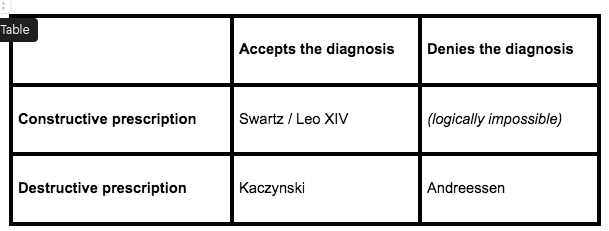
Kaczynski and Andreessen are not opposites. They are the same error in different directions. Kaczynski looks at the system and says: it cannot be reformed, destroy it. Andreessen looks at the system and says: it is perfect, accelerate it. Both positions are, at their core, a refusal of democratic engagement — a conviction that the question of how technology is governed cannot be answered through collective deliberation, only through force (Kaczynski) or through market inevitability (Andreessen).
Swartz and Leo XIV occupy the same structural position: both accept the diagnosis and prescribe a constructive response rooted in democratic solidarity and human dignity. One was killed by the state for acting on it. The other leads 1.4 billion people and published 42,000 words demanding that the state govern technology in the service of the common good.
The matrix reveals something that neither binary opposition — pro-technology versus anti-technology, left versus right, religious versus secular — can reveal: the most important divide is between those who believe democratic governance of technology is possible and those who do not. Kaczynski and Andreessen both believe it is not — one because the system is too powerful to reform, the other because markets are too efficient to improve on. Swartz and Leo XIV both believe it is possible — and more than possible, necessary and urgent.
The question the matrix poses to the reader is not which manifesto you prefer. It is which position on democratic possibility you hold.
XI. The Two Cities
Augustine’s framework, which the Pope invokes at the center of his encyclical, is the most useful lens available for understanding the full four-way comparison — not because it is theological, but because it describes something observable about how civilizations organize themselves.
“Two loves have built two cities: the earthly city, the love of self even to the contempt of God; the heavenly city, the love of God even to the contempt of self.”
Strip the theological language and the observation remains: every era produces two competing civic visions. One is organized around the love of concentrated power — the conviction that the few who have the strength, intelligence, or capital to dominate the arrangement should do so, and that this produces the best outcomes for everyone else as a consequence. The other is organized around the love of the common good — the conviction that power must be accountable to all those who bear its consequences, and that human dignity is not conditional on productive capacity.
The AI governance debate is a contest between these two cities, stated in 21st-century terms.
One city is being built on the Andreessen manifesto: the love of the techno-capital machine, the conviction that growth is all and critics are murderers, the patron saints being the co-author of the Fascist Manifesto and the father of anti-democratic accelerationism. It concentrates the gains of the most productive technology in human history in nineteen billionaires and calls this the natural order.
One city was being built by Aaron Swartz: the love of the commons, the conviction that knowledge belongs to everyone, the patron saints being the anonymous contributors to human understanding everywhere. It was destroyed by the state before it could be completed. He was twenty-six when he died, and the academic articles he tried to free are still behind a paywall.
One city was being built by Kaczynski — except that what he was building was not a city at all, only a cabin, and then a bomb factory, and then nothing. His city could not be built because it had no citizens. You cannot build a community on a theory of the isolated individual. You cannot build democratic governance on a prescription of annihilation.
One city is being called for by Leo XIV: “Safeguarding the human in the time of Artificial Intelligence is a common and shared responsibility. Let us not remain resigned spectators, but rather weavers of hope.”
Weavers of hope. The phrase is simple and the tradition behind it is 2,000 years deep. It is also, in the current moment, a precise description of what the constructive response to AI governance requires: not the rejection of technology (Kaczynski), not the worship of it (Andreessen), not the individual act of civil disobedience that the state can crush (Swartz), but the patient, collective, democratic work of building institutions and governance frameworks that hold technology accountable to the dignity of every person it affects.
Conclusion: An Invitation
This essay does not resolve the debate these four documents open. It cannot, and it would be dishonest to pretend otherwise. The question of how artificial intelligence should be governed — who should have input, what standards should apply, what institutional forms accountability should take — is genuinely contested, genuinely uncertain, and too important to be handed over to any single class of experts, investors, politicians, or machines.
But the four manifestos do clarify the choice.
Is the diagnosis correct? Three independent traditions — a mathematician who read Ellul, a young democratic activist who loved Wikipedia, and the Pope — agree that industrial and digital technology can erode human autonomy, weaken democratic agency, and produce mass psychological suffering. The empirical evidence increasingly supports them. The tradition that denies the diagnosis is also the one most aligned with the financial interests driving the acceleration.
What theory of the human being will guide the age of AI? Is the person primarily a market actor, valuable according to productivity and economic usefulness? Is the person an isolated individual seeking autonomy against an overwhelming system? Or is the person a citizen, a neighbor, a worker, a parent, a child — a being of intrinsic dignity whose life cannot be reduced to data, output, or market value?
Is reform possible? This is Kaczynski’s question, the one his terrible answer does not discredit. He concluded that reform was impossible and built bombs. The democratic and theological traditions conclude that reform is possible and build institutions. But reform is not self-executing. It requires citizens who still believe that shared problems can be met through shared action.
And finally: who is governance for?
If AI governance is written primarily for investors, executives, engineers, and political insiders, it will reproduce the same pattern that has shaped so much of modern technological life: concentrated gains, distributed harms, and ordinary citizens asked to adapt after the fact. A different approach begins with those who will bear the consequences most directly — workers whose livelihoods are changing, families whose children are growing up inside algorithmic environments, communities already strained by inequality and distrust, and the babies being born now into a world they did not choose.
That is why this essay points beyond itself.
The Manifesto of the Moonshot Class of 2026 begins where this essay ends: with the children who will inherit the systems we are building now. Liam, Amare, Emma, Eva, and Mateo are not abstractions. They are composite portraits of the babies being born across America this year. They will come of age in the world shaped by our choices about AI, work, health, family life, civic trust, and democratic responsibility.
The question is not whether we will use technology. We will.
The question is whether technology will be governed by human dignity, democratic agency, and the common good — or whether we will accept a future written by those with the most capital, the most data, and the greatest access to power.
Four manifestos. Thirty-one years. One crisis.
The first was written by a man who murdered people and whose diagnosis cannot be separated from the horror of his crimes. The second was written by a young man who died trying to democratize knowledge. The third was written by a billionaire whose financial interests align precisely with his conclusions. The fourth was written by the head of the world’s oldest continuous institution of moral teaching, calling humanity to safeguard the person in the age of artificial intelligence.
These are not merely texts to analyze. They are invitations to choose.
Not between technology and no technology.
Not between progress and nostalgia.
Not between optimism and fear.
Between Babel and Jerusalem.
Between the machine and the person.
Between the love of concentrated power and the love of the common good.
So here is where the building starts:
Read the Manifesto of the Moonshot Class of 2026. It is the People’s Commission’s answer to the question these four documents leave open: what do we owe the children being born into this technological, political, and moral transition?
Join or follow the People’s Commission and the First 1000 Days work. The future will not be governed well unless citizens, parents, clinicians, educators, workers, technologists, public officials, and community leaders help define what human flourishing requires.
Share this essay with someone who is thinking seriously about AI, children, work, democracy, faith, or citizenship. The most important debates of the AI age should not happen only in boardrooms, laboratories, venture capital firms, or federal agencies. They belong in communities.
The question the four manifestos leave open — the question Augustine posed in a different language, Jefferson posed in the Declaration, Swartz posed with his life, and Leo XIV poses in the first great moral document of the AI age — is addressed now to us:
Which city do you want to live in?
And if the answer is the city of human dignity, democratic responsibility, and the common good, then the work begins here.
The Children This Is Really About

Liam, Amare, Emma, Eva, and Mateo will enter adulthood in the world we are building now. The Moonshot Class of 2026 begins with their lives, their families, and the conditions that make flourishing possible.