
The future doesn’t arrive as a policy paper or an election result. It arrives as a child.
One newborn enters the world with safe housing, good food, attentive healthcare, and parents who have the time and resources to hold her. Another arrives into financial strain, unstable housing, and parents who had to go back to work before their bodies had healed. Neither baby chose their circumstances. Both are shaping their brains, right now, in response to them.
Most of the architecture of the human brain is built before age two. That’s not a private fact about individual families — it’s a public fact about the country we’re building. The first 1,000 days, from preconception through a child’s second birthday, aren’t just a medical window. They’re civic infrastructure.
So we’re asking a simple, demanding question: What do we owe the next generation?
Not as a slogan. As a real inquiry — into what every child should be able to count on, and how that responsibility should be shared among families, communities, institutions, and government.
Over the coming weeks, we’re publishing four connected pieces of this work:
The First 1,000 Days Initiative — the developmental case for why this window matters so much, and what “creating health” actually requires.
The People’s Commission to Make Our Children Healthy — the citizen body we’re convening to turn this question into public deliberation and action.
Ada, the Whole Person Health and Wellbeing Assistant — an AI-powered guide we’re building to help families navigate these first days with more clarity and less overwhelm.
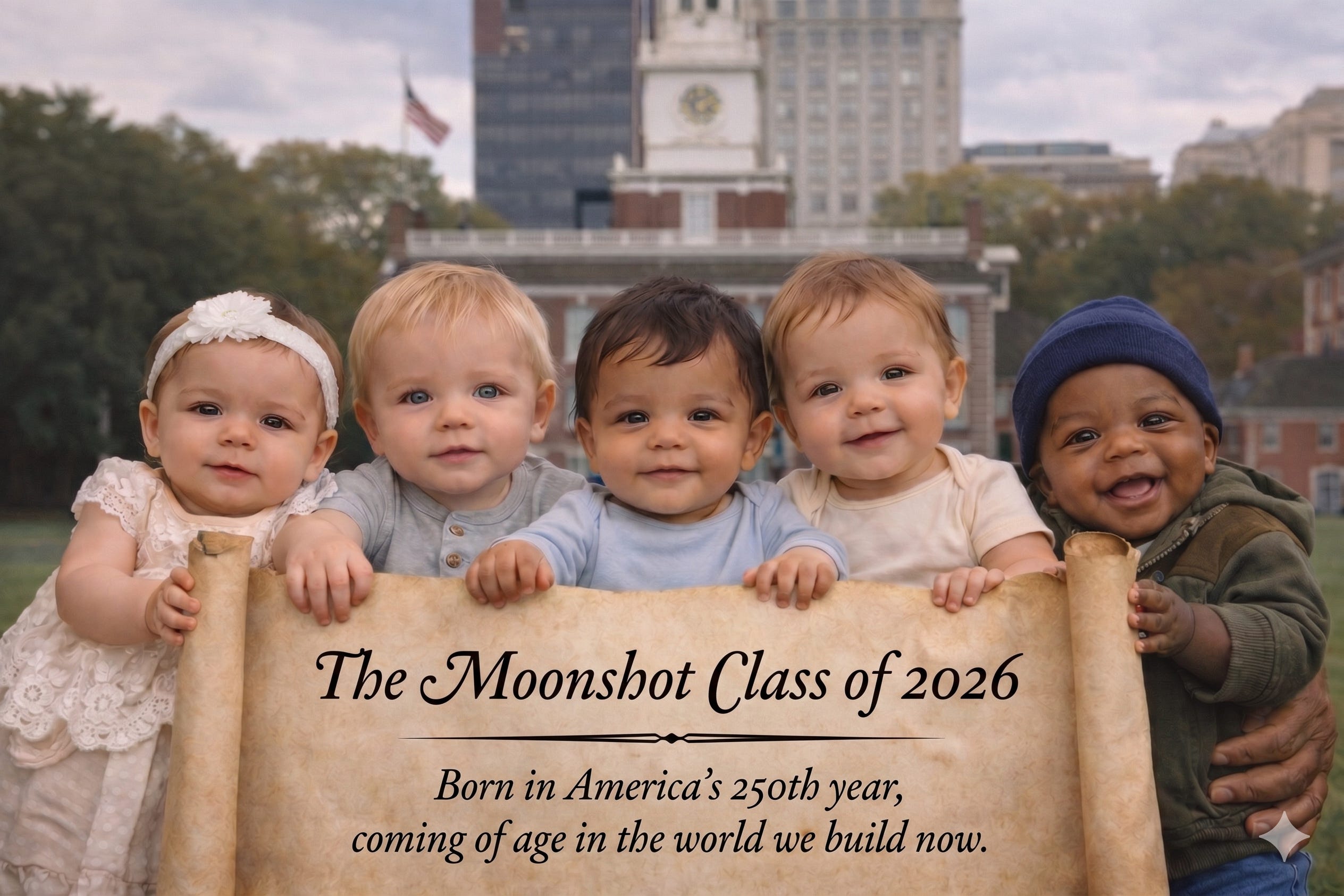
The Moonshot Class of 2026 — five composite children, born this year into five different American realities, whose stories make the stakes impossible to ignore.
None of these answer the question by themselves. Together, they’re how we intend to ask it seriously — and act on the answer.
This is where it starts. Subscribe to follow the whole series.
The First 1,000 Days: Where Flourishing Begins
If we wanted to build healthier kids, more capable adults, and a more resilient country, where would we start?
At the beginning. The first 1,000 days — preconception through age two — is when most of the brain’s architecture gets built. Attachment, emotional regulation, language, trust, the sense that your actions matter: the foundations for all of it are laid here, long before a child says her first word.
A baby doesn’t develop in isolation. She develops inside an ecosystem — her mother’s health, her family’s housing, whether someone had time to hold her, whether the air was clean, whether care was affordable and nearby. Public policy touches a child’s life not as an abstraction, but as food, time, distance, stress, and safety.
Most of healthcare asks: what’s wrong, and how do we treat it? That question matters. But it’s not enough. The First 1,000 Days Initiative starts from a different question — the salutogenic one: what creates health in the first place?
That reframe changes what we look for. Not just deficits, but strengths. Not just treatment, but the conditions that make good choices and secure relationships possible in the first place. Telling a new parent what she should do isn’t much help if she doesn’t have real choices available to her.
This Initiative is the developmental backbone of our larger question — what do we owe the next generation? It’s where the civic promise becomes concrete: What should every family be able to count on, from the earliest days of pregnancy through a child’s second birthday?
Next up: how we’re turning that question into public deliberation, through the People’s Commission.
The People’s Commission to Make Our Children Healthy
Some decisions are too important to leave to any single institution — and too complicated to leave to instinct alone.
Parents know what families are up against. Clinicians know care. Researchers know evidence. Community workers know which barriers are real. Each holds a piece of the answer, and usually they never sit at the same table.
The People’s Commission to Make Our Children Healthy is that table. It’s the deliberative counterpart to our First 1,000 Days work — a citizen body bringing parents, healthcare professionals, educators, researchers, and community members together to work through one central question:
What should every child and family be able to count on during the first 1,000 days — and how should that responsibility be shared?
The Commission isn’t a panel of experts handing down conclusions, and it isn’t a survey of public opinion collected without context. It’s a structured process — learn, listen, deliberate, design, act, review — where evidence and lived experience inform each other, and where the resulting recommendations are meant to be acted on, not filed away.
Its guiding principle: citizens lead, experts serve, AI amplifies, and humans stay accountable.
We’re launching a local learning demonstration in Montgomery County, Pennsylvania — not because the national question doesn’t matter everywhere, but because we believe the answer has to be built, tested, and learned locally before it can be trusted nationally.
You don’t need a credential to take part. You need a willingness to learn, listen, and take some responsibility for the future being built around the next generation’s beginning.
Next: meet Ada, the tool we’re building to help families navigate this window in real time.
Meet Ada: The Whole Person Health and Wellbeing Assistant
Most health tools start with the same question: what’s wrong?
Ada starts with a different one: what creates health here — and what’s one manageable next step?
Ada is an AI-supported demonstration we’re building for families navigating the first 1,000 days — from preconception through a child’s second birthday. It’s not a doctor, a therapist, or an emergency service, and it isn’t trying to be. It won’t diagnose, prescribe, or replace a clinician’s judgment. What it’s designed to do is help people show up to those relationships more prepared.
That means helping a parent organize her questions before a prenatal visit. Helping a caregiver see what’s already going right, not just what’s going wrong. Helping someone overwhelmed by eight different problems at once — housing, sleep, stress, money, feeding — see how those problems connect, and where one small step might ease several of them.
Ada is built on the same salutogenic idea driving the rest of this work: health isn’t just the absence of disease, it’s something you actively create. A good conversation with Ada should leave someone more oriented, not more confused. More capable, not more dependent. More connected to real human care and community resources, not less.
It’s also a listening tool for the bigger picture. When the same barriers show up again and again — no childcare nearby, confusing benefit systems, no prenatal appointments available for months — those patterns become questions for the People’s Commission to act on. A private struggle, multiplied, is often a public problem in disguise.
Ada is live today as a demonstration model, and it’s meant to be tested, challenged, and improved in public. It’s one practical answer to the question this whole series keeps asking: what do we owe the next generation, starting now?
Next: the five children whose stories make all of this real — the Moonshot Class of 2026.
Meet the Moonshot Class of 2026
Policy is easy to argue about in the abstract. It’s much harder to argue about when it has a name.
The Moonshot Class of 2026 is our editorial series following five composite children, each born this year into a different American reality — different ZIP codes, different family circumstances, different access to care, food, housing, and time. None of them is a real child; each is drawn from real data and real patterns, so that what we’re describing is true of thousands of families, not just one.
Through their first 1,000 days, we’ll follow how public policy actually enters a child’s life — not as a talking point, but as whether a parent could take paid leave, whether a prenatal appointment was thirty minutes away or three hours, whether the water was safe, whether someone had time to hold them.
This is the human face of everything else we’re publishing. The First 1,000 Days Initiative describes the science. The People’s Commission describes the deliberation. Ada describes a practical tool. The Moonshot Class describes what all of it is actually for — five specific beginnings, and everything riding on what we choose to build around them.
We think the question what do we owe the next generation gets easier to answer, not harder, when you stop asking it in the abstract and start asking it about a particular child. That’s the whole point of this series.
Follow along as their first 1,000 days unfold alongside ours.