


DISCLAIMER:
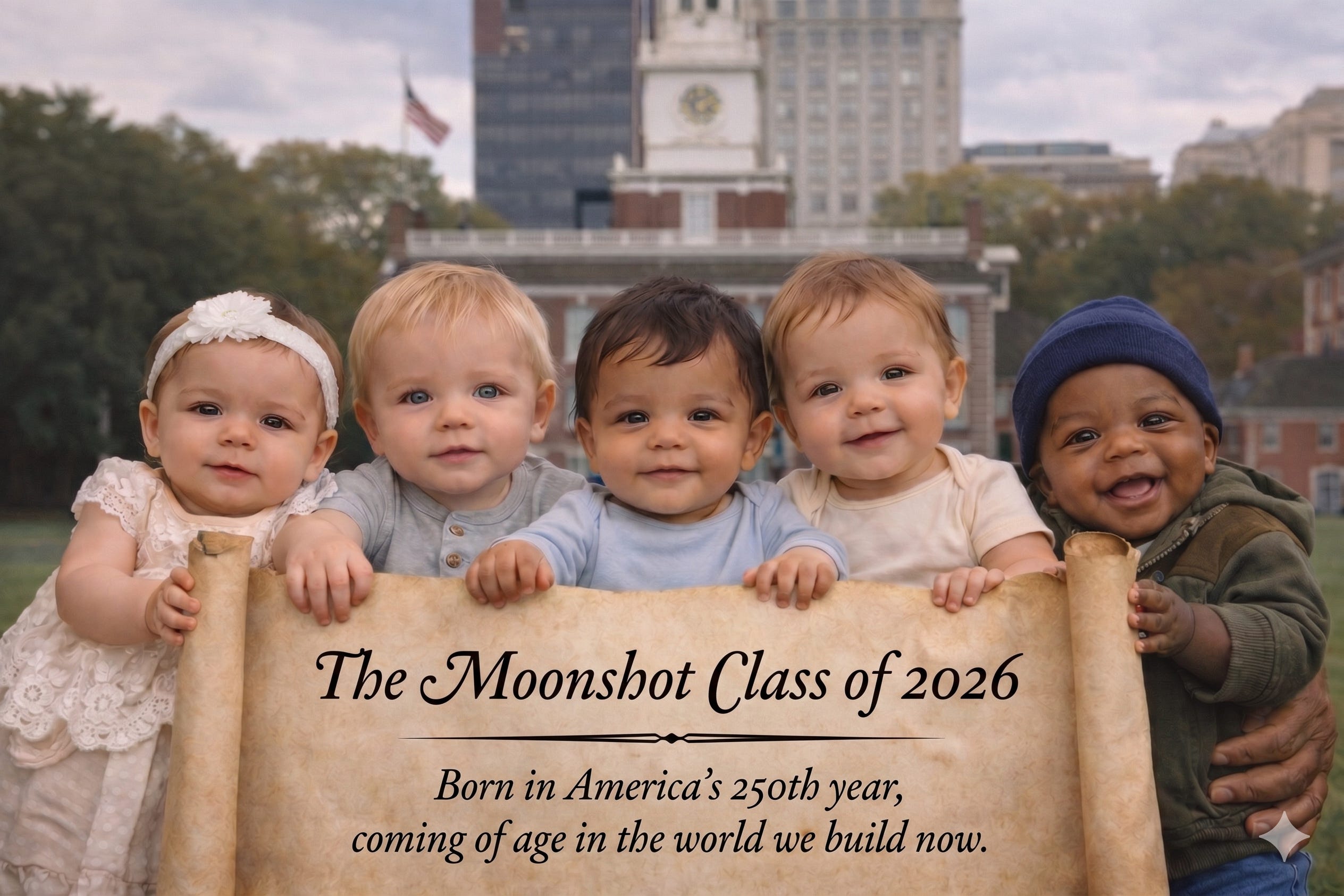
The babies of the Moonshot Class of 2026 are AI-generated composites and images, not real individuals
The communities are real places, drawn on through AI-facilitated data and research, used as representative settings rather than precise portraits of those localities
They serve as a vehicle to understand varied American experiences from birth
Readers uncomfortable with AI-generated content may choose not to engage
Feedback to improve accuracy is welcomed

.
On January 20, 2025, as the country watched Donald Trump take the oath of office, roughly ten thousand babies took their first breaths in the United States.
Most political writing treats a new administration like a hinge in history.
This essay treats it like something more intimate—and more revealing:
What happens to those babies in the next 1,000 days will echo for decades—into classrooms, workplaces, neighborhoods, and voting booths.
Because the first 1,000 days aren’t just “important.” They are formative in the strictest biological sense. In this window, a child’s brain is building its basic architecture at extraordinary speed—shaped by nutrition, responsive caregiving, sleep, toxins, and stress. The science isn’t sentimental: early experience doesn’t merely influence development. It helps construct it.
Or as Jack Shonkoff has put it through the work of Harvard Center on the Developing Child: it’s not nature versus nurture—it’s how nurture shapes nature.
Now consider five children—born the same day, under the same flag—entering five different Americas.
Emma arrived in Chestnut Hill, Massachusetts.
Liam was born in Somerset, Pennsylvania.
Amare took his first breath on Chicago’s South Side.
Eva entered the world in Tompkinsville, Kentucky.
And Mateo—a U.S. citizen from his first cry—was born in San Antonio to undocumented parents.
They share a birthday and a country.
They share almost nothing else.
Over the next 1,000 days, each child’s developing brain will be “tuned” by everyday conditions: safety or chaos, consistency or disruption, calm or vigilance, support or isolation. Those conditions shape more than health and school readiness. They shape the foundations of citizenship:
whether a person expects systems to help or harm
whether they feel agency or resignation
whether they approach others with trust or suspicion
whether they experience the common good as real—or as a story for other people
This is not a metaphor. It is development.
And it leads to a national question we rarely ask plainly:
Can we build a democracy where a child’s capacity to flourish—and to participate—doesn’t depend on the accident of birth?
Emma — Chestnut Hill, Massachusetts
Affluence and every advantage
Emma enters a home designed—quietly, almost invisibly—for human flourishing. Her parents have excellent healthcare. They have time. They have paid leave or flexible work. They have savings that absorb surprises instead of turning them into emergencies.
Her days will be thick with what child-development researchers call “serve-and-return”: the back-and-forth of attention, language, facial expression, and play that wires the brain for learning and emotional regulation. By age two, Emma will have experienced thousands of hours of responsive interaction that makes school feel navigable, institutions legible, and the future expectable.
Her path toward becoming an informed, engaged citizen is being paved before she can walk.
But Emma’s story also raises a quieter—and more politically important—question:
When children are given every advantage, do we also teach them that their flourishing is bound up with other people’s?
Because democracies do not run on capability alone. They run on responsibility.
Privilege without purpose is its own kind of poverty.
Liam — Somerset, Pennsylvania
Love, work, and the thin ice of stability
Liam is born to parents who adore him—and who live with a low, constant hum of economic worry.
His father’s job has been threatened by automation and volatility for years. His mother works service shifts. They’re not asking for luxury. They’re asking for margin: enough time and stability to do the most important job in the world without being punished for it.
Weeks after Liam is born, his mother returns to work—not because she’s ready, but because the bills don’t pause for bonding. Childcare becomes a patchwork: grandmother when she can, a neighbor when schedules collide, improvisation when someone gets sick or hours change.
Liam will still be loved. But the conditions of that love matter. Exhausted caregivers have less bandwidth for the patient, playful interaction that builds language, attention, and self-regulation. Chronic stress doesn’t just affect adults; it shapes the emotional climate a baby’s nervous system learns from.
By toddlerhood, Liam may lag behind Emma on measures that too often get labeled “parenting.” But what’s really being measured is capacity—and capacity is a policy choice.
Liam represents millions of children raised where love is abundant but stability is fragile.
He didn’t choose his zip code.
Why should it choose his destiny?
Amare — South Side, Chicago
Resilience that should never be required
Amare is born into a family rich in what money cannot buy: extended kinship, cultural pride, faith, and fierce protective love. His parents will do many things “right.” They will show up. They will advocate. They will patch holes in a system that asks them to be superheroes.
And still, the zip code will press in.
Some neighborhoods come with higher exposure to asthma triggers, violence, under-resourced schools, and long waits for pediatric specialists and early intervention. Even when services exist, they can be harder to access—more paperwork, more delays, more humiliations, more closed doors.
The point is not that Amare’s community lacks strength.
The point is that the country too often treats that strength as a substitute for investment.
When chronic adversity becomes normal, a child’s developing stress-response system can become calibrated for vigilance. That has downstream effects on sleep, attention, immune function, and learning. Over time it can shape something even more civic than academic: the ability to trust.
Amare will be asked to be exceptional in order to reach outcomes Emma can achieve by being ordinary.
But resilience should not be a prerequisite for citizenship.
Eva — Tompkinsville, Kentucky
When place still determines possibility
Eva is born in a rural county where distance is not an inconvenience—it’s a developmental variable.
The nearest pediatric specialist may be over an hour away. High-quality childcare options may be scarce or nonexistent. In many rural areas, hospital closures and the loss of labor-and-delivery units have turned pregnancy and birth into logistical endurance events.
When Eva misses a milestone—as many children do—her parents will face a choice: drive long distances repeatedly for evaluation and therapy, or wait and hope she “catches up.” Many families wait. Not because they don’t care, but because the system makes caring expensive.
That delay matters because early intervention is most powerful when the brain is most plastic.
Eva will grow up learning a lesson children shouldn’t have to learn: opportunity exists somewhere else. Institutions will feel distant, under-resourced, and unrelated to daily life. And when institutions feel irrelevant, civic participation doesn’t feel like a duty—it feels like a luxury.
Geography isn’t destiny.
Unless we decide it is.
Mateo — San Antonio, Texas
A citizen raised under fear
Mateo is a United States citizen. He is entitled—on paper—to healthcare, nutrition programs, early supports, and the protections citizenship confers.
His parents are not.
They whisper dreams into his ear and calculate risks in the next breath. Is it safe to take him to the clinic? To enroll in benefits? To fill out forms? To be visible?
Fear is not just emotional; it is physiological. Babies do not need to understand immigration policy to absorb the stress in a household living under threat. Chronic vigilance changes adult behavior—sleep, tone, availability—and children learn the world through that atmosphere.
Mateo is eligible for services his parents may be afraid to access.
He is a citizen whose experience of citizenship begins with exclusion.
He represents hundreds of thousands of American children whose early development is shaped not by parental failure, but by policy-created fear.
And one day, we will ask him to trust the institutions that frightened his family.
Two futures
It’s 2043. The children born on January 20, 2025 are voting for the first time.
In one future:
Emma volunteers because she was taught that citizenship is participation, not consumption.
Liam votes in every election because his family had support when it mattered—leave, childcare, stability.
Amare runs for office, not in spite of the system, but because the system finally invested in his community.
Eva finishes nursing school and returns home because rural health became a national priority, not a forgotten slogan.
Mateo votes alongside his parents, because his family gained stability—and his earliest memories aren’t saturated with fear.
In another future:
Emma votes but keeps her distance; politics feels like noise outside her life.
Liam disengages after the plant closes; survival takes all the oxygen.
Amare stays involved but becomes deeply cynical—promises made, promises broken.
Eva never registers; the hurdles were small individually, crushing in aggregate.
Mateo’s family is separated early; trust never recovers.
The gap between these futures is not fate.
It is a choice we are making right now—in what we fund, what we ignore, and what we tolerate.
The investment we keep postponing
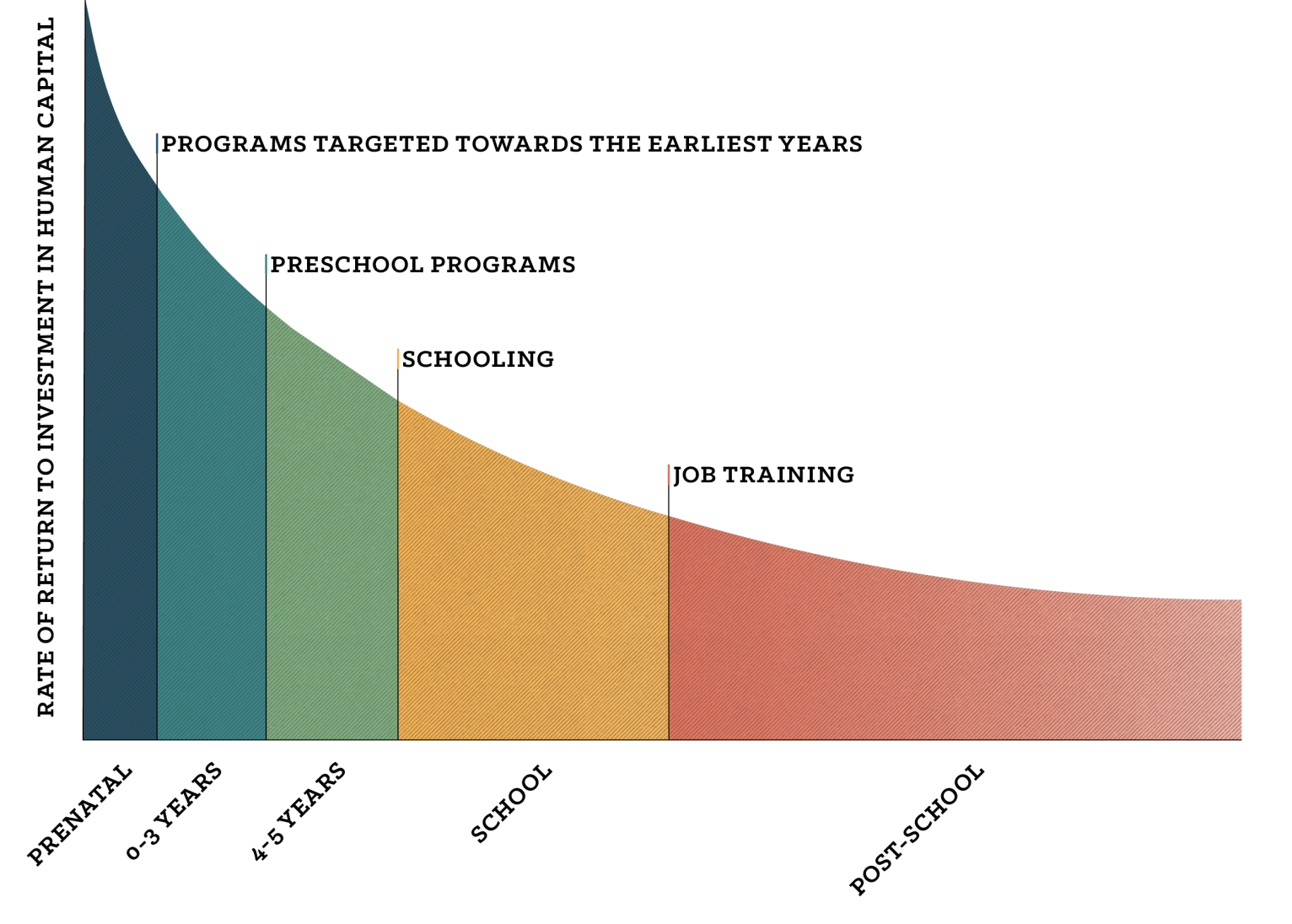
We do not lack a policy menu. We lack the will to treat the first 1,000 days like national infrastructure.
Decades of research in early childhood development and economics—including work associated with James Heckman—show that high-quality early investments can yield large returns across health, education, earnings, and reduced downstream costs. The reason is simple: early support prevents expensive repair later.
What does “support” look like in real life?
paid family leave so bonding isn’t a financial crisis
home visiting and maternal mental health supports
stable, high-quality childcare
developmental screening and early intervention that families can actually access
nutrition security and safe housing during pregnancy and infancy
healthcare that is reachable, continuous, and trusted
None of this is mysterious. The question is whether we are willing to stop treating it as charity and start treating it as a civic necessity.
Because we are not only shaping children.
We are shaping the future electorate.
The question we can’t outsource
“We hold these truths to be self-evident, that all men are created equal.”
Equal at what moment?
Equal under what conditions?
Equal with what support?
If equality ends at birth—if we celebrate new life and then abandon families to wildly unequal circumstances—then we have not honored the promise. We have repeated the words.
The babies born on January 20, 2025 are now past their first year. They have roughly 600+ days remaining in the most sensitive developmental window of their lives. Every day, their brains are being wired—for trust or suspicion, engagement or withdrawal, hope or resignation.
Emma’s nervous system is learning that the world is stable.
Mateo’s may be learning that it is dangerous.
That difference is not destiny.
It is design.
So here is the question this project exists to pursue—relentlessly, concretely, and in public:
Can we ensure that every child born in America—regardless of where, to whom, or under what circumstances—develops the capacity to flourish as a human being and participate as a citizen?
The children born on Inauguration Day will answer with their lives.
And we will answer with our choices.
About The Moonshot Class of 2026
The Moonshot Class of 2026 tracks how policy shapes life trajectories from the earliest days. In the months ahead, we’ll follow Emma, Liam, Amare, Eva, and Mateo—examining the systems that support or fail them, the research that explains why the first 1,000 days matter, and the choices that could change their futures.