


The verdict in the Musk VS. Altman trial in Oakland will tell us whether a jury of nine citizens believes that OpenAI breached a charitable trust. The trial revealed what every honest observer of the AI economy already suspected: the choice between mission-without-a-motor and motor-without-a-moral-compass is not the only choice available to us. There is a third way. We have not yet built it.
“The care of human life and happiness, and not their destruction, is the first and only legitimate object of good government.”
— Thomas Jefferson
As a federal jury in Oakland begins to deliberate the fate of the most consequential AI charter ever broken, the deeper question they cannot answer is the one the country most needs to ask: what kind of institution should hold the fire of artificial general intelligence? The legal forms currently available offer two choices, both inadequate. The The People’s Commission on Technology and the American Future proposes a third.
The Musk v. Altman trial is, at its surface, a contract dispute. At its center, it is a metaphysical question: can a corporation be trusted with a technology powerful enough to reshape every economy on Earth, govern every workplace in America, and intervene in every life from gestation to death? The legal frameworks currently available to answer that question are insufficient in opposite ways.
The non-profit form, as the OpenAI Foundation has now demonstrated, can be a mission without a motor — nominally chartered to benefit humanity but structurally incapable of acting at the scale the technology demands, financially captured by the for-profit entity it is supposed to oversee, governed by directors whose fiduciary interests run in the opposite direction from the public interest the charity was created to protect.
The for-profit form, even in its most evolved version — the Public Benefit Corporation — remains a motor without a moral compass. It can be legally instructed to consider stakeholder interests, but its accountability runs ultimately to shareholders. Its incentives are clean and powerful: build the product, capture the market, deliver the return. Its mission language is sincere. Its mission enforcement is structurally constrained.
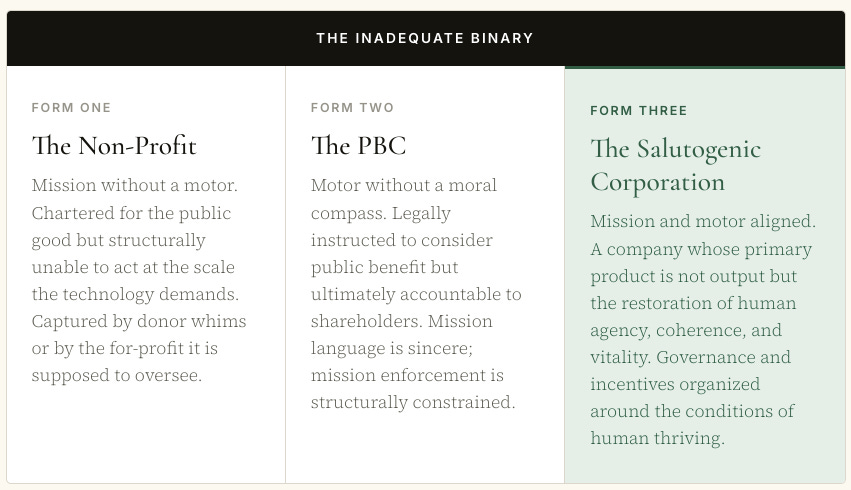
The trial in Oakland exposes the limits of the binary. Whichever side wins, neither answer is adequate to the scale of the technology now arriving. A jury verdict can restore a charter. A court order can rearrange a balance sheet. Neither can produce an institution structurally capable of governing AI in the public interest, because no such institutional form yet exists in American law.
That gap is the opening for a different proposition.
The Salutogenic Organization
The concept derives from the work of Aaron Antonovsky, the medical sociologist who, in 1979, asked a question that pathogenic medicine had been quietly ignoring: why are some people healthy? Modern medicine had organized itself around the causes of disease. Antonovsky organized his thought around the origins of health. He called the resulting framework salutogenesis — from the Latin salus (health) and the Greek genesis (origin).
His central finding was that human thriving is not the absence of illness. It is the presence of three conditions, which together produce what he called a Sense of Coherence: the deep human experience that the world is Comprehensible (it can be understood), Manageable (one has the resources to meet its demands), and Meaningful (its challenges are worth engaging). When these three conditions are present, human beings flourish. When they are absent, no amount of material affluence or technological power can substitute for them.
A salutogenic organization is one whose primary product is not output but the restoration of human agency, coherence, and vitality — an institution organized around the origins of human thriving, not merely the causes of economic value.
Apply this framework to the AI moment, and the inadequacy of current corporate forms becomes legible in a new way. The non-profit and the for-profit alike are organized around what economists have always measured: outputs, revenues, valuations, capabilities. Neither is organized around what Antonovsky measured: whether the people who live in the world the corporation creates can understand it, cope with it, and find meaning in it.
A salutogenic organization would be. Its charter would commit it not to benefit humanity in the abstract, but to strengthen the specific conditions under which human beings actually thrive. Its governance would be structured to enforce that commitment against commercial pressure. Its products would be evaluated against the three-dimensional standard. Its leadership would be accountable not only to shareholders or donors, but to the salutogenic outcomes its operations produce in the communities most affected by them.
This is not philanthropy. It is not regulation. It is a new corporate form built for a technology that touches every dimension of human coherence at once.

The Three Pillars of Coherence
What would distinguish a salutogenic organization from a Public Benefit Corporation is not the elegance of its mission statement. It is the specificity of the standard against which its operations are measured. Antonovsky’s three pillars, applied to AI development, produce concrete and measurable governance criteria.
PILLAR ONE Comprehensibility
Does the AI system make the world more understandable, or more opaque?
A worker whose job is restructured by AI should be able to understand what happened and why. A patient whose treatment is influenced by AI should comprehend the basis for the recommendation. A citizen whose civic participation is mediated by AI should see how their input was processed and what influence it had. The Salutogenic organization maintains explainability standards for every product deployed in employment, healthcare, education, and civic life — standards assessed not by engineers but by the people who live inside the systems. A farmer in Iowa. A nurse in Philadelphia. A small-business owner in Montgomery County. If they cannot understand what the system is doing to them, the system fails the test.
PILLAR TWO Manageability
Does the AI system increase human capacity to cope, or create new dependencies and vulnerabilities?
When AI restructures an industry, the people displaced must have the resources to navigate the transition: retraining infrastructure, income support during the transition, broadband and digital literacy adequate to the new economy, institutional support that does not require a law degree or a venture-backed startup to access. The Salutogenic organization funds and evaluates transition programs before the disruption arrives, not after. It measures whether the communities most affected by its products have the resources to manage what is coming — and directs resources to close the gap when they do not. The test is not whether the company has made the AI more capable. The test is whether the people exposed to it are more or less capable than they were before.
PILLAR THREE Meaningfulness
Does the AI system preserve the conditions in which work is experienced as purposeful and dignified?
This is the dimension no AI company has yet seriously addressed. When a nurse practitioner uses AI-assisted diagnostics, does she experience her work as more meaningful — her reach expanded, her judgment deepened — or reduced to monitoring an algorithm she does not understand? When a teacher uses AI tutoring tools, does he feel his professional judgment matters more or less? When a paralegal uses AI legal research, does she experience professional growth or professional obsolescence? Meaningfulness is the question of whether AI development preserves or destroys the conditions under which work is dignified and purposeful. It is the dimension of the transformation most likely to produce lasting harm if mismanaged — and the dimension corporate governance has been least equipped to measure. The Salutogenic organization makes it the central measurement.
The Annual Salutogenic Impact Assessment
Principles without measurement are aspirations. The Salutogenic organization makes its commitment operational through a single durable instrument: an Annual Salutogenic Impact Assessment, commissioned from independent researchers with expertise in occupational health, organizational psychology, and community well-being — not from the company’s own employees, and not from consultants whose continued engagement depends on producing favorable conclusions.
The Assessment evaluates whether the company’s products and development trajectory strengthen or undermine Comprehensibility, Manageability, and Meaningfulness for the specific workers and communities most affected by its AI deployment. Its findings are published. Its results are presented at an annual public meeting at which community members can question the evaluators and the company’s leadership directly. Its conclusions are integrated into the company’s governance decisions — product roadmaps, deployment timelines, executive accountability — with the same weight as financial performance metrics.
THE COMMISSION’S POSITION
The Salutogenic Standard should govern every AI institution claiming to benefit humanity — beginning with the OpenAI Foundation and extending across the industry.
If Judge González Rogers finds liability in Musk v. Altman, the structural relief she orders should require the OpenAI Foundation to adopt the Salutogenic Standard as a condition of its continued operation. If she does not, the Foundation should adopt it voluntarily, as the credible answer to the question its current governance cannot answer: what does “benefit humanity” mean in measurable, publicly accountable terms?
And every AI laboratory whose founding mission invokes humanity should be measured against the same standard. Anthropic. Google DeepMind. Meta AI. xAI. Microsoft. If the missions are real, the measurement should be real. The Salutogenic Standard is what makes the difference between a promise and an institution.
Why Now
The argument for the Salutogenic organization is not that it would have prevented the OpenAI conversion. It is that it is the only institutional form adequate to the next decade of AI deployment, regardless of what the jury in Oakland decides.
Consider the trajectory. AI capabilities are doubling on an eighteen-month rhythm. The compute, capital, and talent required to train frontier models are now beyond the reach of universities, governments, and most of civil society. The institutions building this technology will, for the foreseeable future, be a small number of extraordinarily well-capitalized private companies. The legal forms available to them — non-profit foundations and Public Benefit Corporations — were designed for the technological and economic conditions of the twentieth century. Neither is structurally equal to the governance question that artificial general intelligence poses to society.
Salutogenesis, applied to corporate governance, is not utopian. It is operational. It produces a standard against which any company can be measured. It generates governance criteria that can be enforced. It provides the framework for an Annual Impact Assessment that no existing regulatory mechanism currently requires — but that every honest reading of the AI moment demands.
The trial in Oakland will end. The verdict will come. The remedy, if there is one, will be ordered. The IPO will follow. The technology will keep advancing at a pace no court can match. What endures, what must endure, is the institutional capacity to ensure that the most powerful technology in human history is governed in the interest of the human beings whose lives it will reshape.
That capacity does not exist by default. It has to be designed. The Salutogenic organization is the design the Peoples’ Commission proposes. It is the answer to the trial’s exposed binary. It is the form that mission, motor, and moral compass can finally share.
· · ·
OpenAI’s Foundation was chartered, in its own words, to ensure that AGI benefits all of humanity. The words are not wrong. The institution built to deliver them is. A salutogenic OpenAI Foundation — or a salutogenic successor foundation, modeled on The California Endowment and built to the standards thirty years of conversion law has established — would mean something specific. It would commit to strengthening Comprehensibility for the workers whose professional lives AI is restructuring. It would commit to building Manageability for the communities AI is reshaping. It would commit to preserving Meaningfulness in the work that AI is augmenting or replacing. And it would submit to an Annual Salutogenic Impact Assessment that would tell the public, in measurable terms, whether the commitment is being kept.
That is what an AI Foundation worthy of its founding promise would do. That is what the Peoples’ Commission asks the court, the regulators, the Foundation’s board, and the AI industry to consider. And that is what citizens, deliberating seriously on remedy, can demand — not as a wish, but as a standard with a history, a method, and an instrument of accountability.
The promise was made to humanity. The instrument for keeping it can finally be built.
The People's Commission on Technology and the American Future: Toward a Social Contract for Citizen Thriving
The Framework Series
Written with Claude Opus 4.7 Assist