


The Red Heifer is Moonshot Press's groundbreaking weekly column that bridges ancient Torah wisdom with contemporary challenges through an innovative partnership between human authors and artificial intelligence. Named after the enigmatic purification ritual in Numbers 19, the column explores how each week's Torah portion (parsha) can illuminate modern dilemmas in ethics, leadership, technology, and social justice. By leveraging AI as a sophisticated research partner—capable of cross-referencing vast commentaries, identifying textual patterns, and generating fresh interpretive possibilities—The Red Heifer creates a new form of collaborative study that honors both millennia-old traditions and cutting-edge innovation. Each installment offers readers deep textual analysis, contemporary parallels, technology spotlights, and actionable insights, making ancient wisdom accessible and relevant for today's complex world while demonstrating how artificial intelligence can enhance rather than replace human understanding of sacred texts.
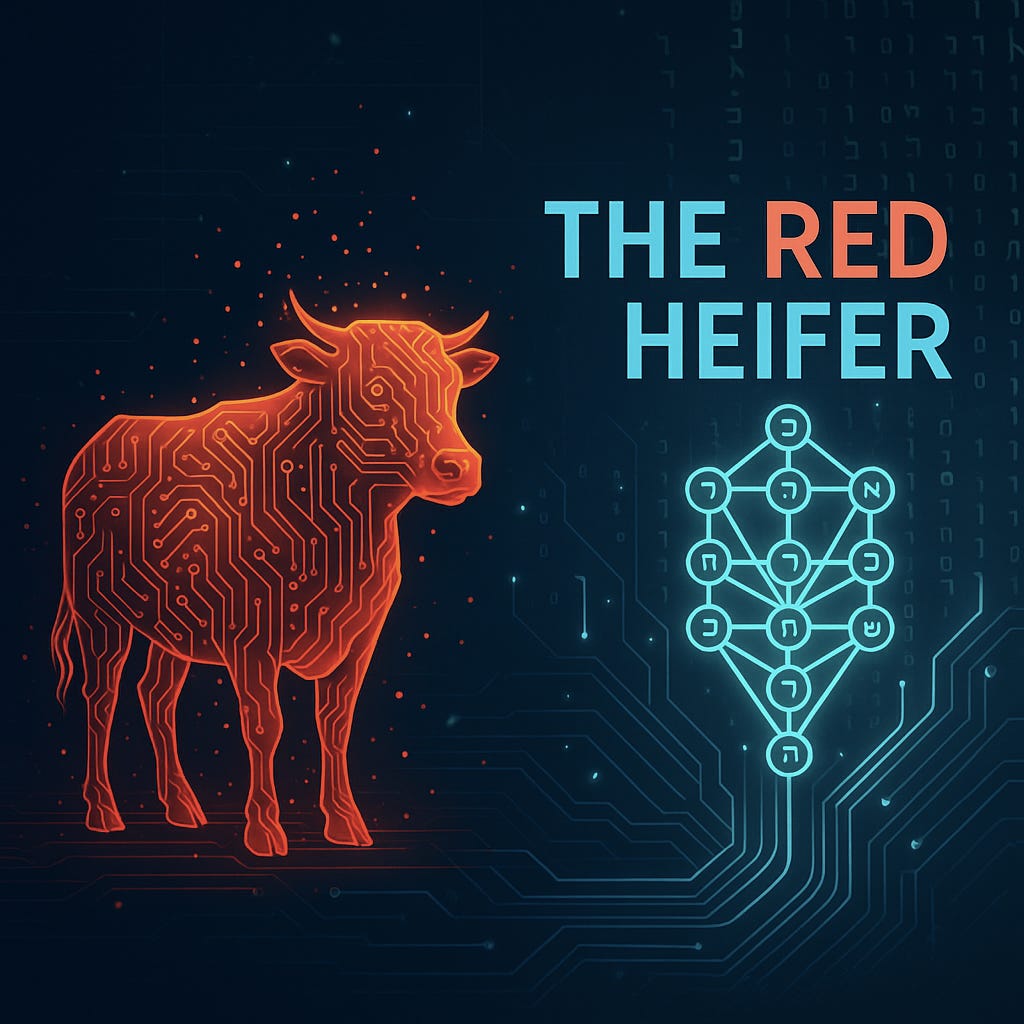
The Red Heifer: Where Ancient Wisdom Meets Tomorrow's Challenges
In the beginning…
These opening words of Genesis have echoed through millennia, marking not just the dawn of creation but the eternal moment when possibility transforms into reality. Every groundbreaking discovery, every innovative solution, every leap forward begins with this same creative spark—the recognition that ancient wisdom and cutting-edge technology can illuminate each other in extraordinary ways.
Today, Moonshot Press launches The Red Heifer, a weekly column that bridges the timeless teachings of the Torah with the pressing challenges of our technological age—written in partnership with artificial intelligence models that serve as both research assistants and interpretive collaborators. This isn't about choosing between tradition and innovation—it's about discovering how they can collaborate to address the complex questions of our time, with AI itself becoming part of that collaborative process.
The Mystery of the Red Heifer
The Red Heifer ritual in Numbers 19 presents one of the Torah's most enigmatic teachings: a ceremony of purification that defied logical explanation yet opened pathways to spiritual renewal. Through seemingly paradoxical means—mixing ash with living water, embracing mystery while seeking clarity—the ancient Israelites found their way back to wholeness.
This profound metaphor guides our column's mission. Just as the Red Heifer ritual transformed the incomprehensible into a source of purification, The Red Heifer will explore how each week's parsha can illuminate modern dilemmas through the lens of both ancient wisdom and contemporary innovation, with AI models serving as sophisticated research partners that can cross-reference vast commentaries, identify patterns across texts, and generate fresh interpretive possibilities that human authors might never have considered alone.
A New Kind of Study Partner
What makes The Red Heifer unique is its embrace of AI as a legitimate partner in the ancient practice of chavruta—collaborative study that has been central to Jewish learning for centuries. Just as traditional study partners challenge each other's assumptions and offer new perspectives, our AI collaborators bring unprecedented capabilities to textual analysis:
Pattern Recognition: AI can identify thematic connections across the entire corpus of Jewish texts, revealing links between distant passages that human readers might miss
Linguistic Analysis: Machine learning models can detect subtle word choices, grammatical structures, and literary devices that illuminate deeper meanings
Comparative Scholarship: AI can instantly cross-reference interpretations from hundreds of commentators, identifying consensus views and highlighting unique perspectives
Contemporary Connections: By processing vast amounts of current research and news, AI helps identify relevant parallels between ancient texts and modern situations
This isn't about replacing human insight—it's about augmenting it. The AI serves as a research assistant that never tires, a study partner that has read every commentary, and a creative collaborator that can suggest unexpected connections.
Each installment of The Red Heifer will offer readers:
Deep Dive into the Parsha: We'll explore the week's Torah portion with fresh eyes, making its themes accessible to both seasoned scholars and curious newcomers. Our AI collaborators help identify linguistic patterns, cross-reference commentaries across centuries, and suggest interpretive angles that emerge from processing vast amounts of textual data. Every story, every character, every commandment becomes a doorway to understanding enhanced by both human insight and machine analysis.
Modern Parallels: How does Jacob's wrestling with the angel inform our struggles with artificial intelligence ethics? What can Moses' leadership challenges teach us about managing remote teams? We'll draw these connections with intellectual rigor and practical insight.
Technology Spotlight: Guest interviews with data scientists, bioethicists, community organizers, and tech innovators who are applying ancient wisdom to solve contemporary problems. From machine learning algorithms that embody Talmudic reasoning to virtual reality experiences that recreate biblical narratives, we'll showcase how tradition and innovation intersect.
Actionable Wisdom: Each column concludes with concrete ways readers can integrate these insights into their daily lives, whether in boardrooms, classrooms, or community spaces.
Innovation Meets Tradition
The Red Heifer doesn't just talk about bridging ancient and modern—it embodies that bridge through cutting-edge features:
Our interactive platform allows readers to explore deeper layers of meaning through AI-generated commentary, audio reflections, and visual aids that bring abstract concepts to life. Click on any passage to unlock additional perspectives, historical context, or contemporary applications.
A global study community connects readers worldwide, recreating the collaborative spirit of traditional study halls while leveraging modern communication tools. Share insights, ask questions, and join discussions that span continents and time zones.
Data-driven analysis occasionally reveals surprising patterns—perhaps showing how the social dynamics described in Exodus mirror modern network theory, or how the economic principles in Leviticus align with contemporary sustainability research.
From Genesis to Genesis
In the beginning signals not just a historical moment but an ongoing process of creation and renewal. The Red Heifer embraces this spirit of continuous beginning, treating each week's exploration as an opportunity to discover new connections between the wisdom of our ancestors and the innovations of our contemporaries.
The challenges we face today—ethical technology development, sustainable resource management, building inclusive communities, navigating global interconnectedness—were prefigured in the stories and teachings our tradition has preserved for millennia. By bringing these ancient insights into conversation with modern tools and perspectives, enhanced by AI's ability to process and connect vast amounts of information, we create space for solutions that honor both our heritage and our future.
Join the Conversation
The Red Heifer welcomes all seekers: longtime Torah students and technology professionals, ethicists and entrepreneurs, anyone curious about how ancient wisdom can inform modern challenges and how AI can serve as a partner in that exploration. Whether you're designing algorithms, building communities, or simply trying to live more thoughtfully in our complex world, these weekly explorations offer fresh perspectives on timeless questions—perspectives that emerge from the unique collaboration between human wisdom and artificial intelligence.
Subscribe to join us on this journey where every parsha becomes a lens for understanding our technological age, and every innovation offers new ways to engage with eternal truths.
The journey of a thousand insights begins with a single word. Let that word be Bereshit—and let our conversation begin now.