

The Poison of Contempt
A Psychiatrist’s Perspective on America’s Deepening Divide—and the Healing Power of Gratitude

As a clinical psychiatrist with decades in the trenches of human suffering, I’ve spent countless hours in rooms where words hang fragile and silence weighs heavy. In those spaces, I’ve witnessed how ruptures—between spouses, parents and children, or even within one’s own mind—rarely mend through sharp debates or intellectual triumphs. Healing emerges from something quieter, more deliberate: ritualized acts of attention. It’s showing up fully, setting a clear intention, listening deeply to the pain beneath the surface, naming what truly matters, and choosing, time and again, to stay in relationship despite the discomfort.
Over the past few years, I’ve become convinced that our nation is crying out for precisely this kind of therapeutic container. We’re not just politically polarized; we’re ensnared in a pathology of contempt—a reflexive disdain that reduces fellow citizens to caricatures, twists disagreements into irrevocable moral judgments, and makes withdrawal feel like the safest path. The symptoms mirror what I see in fractured families: eroded shared identity, anxious sidestepping of tough talks, and rituals—like our national holidays—stripped of their connective power. Thanksgiving, that most universal American gathering, too often becomes a missed opportunity, a table laden with food but starved of genuine communion.
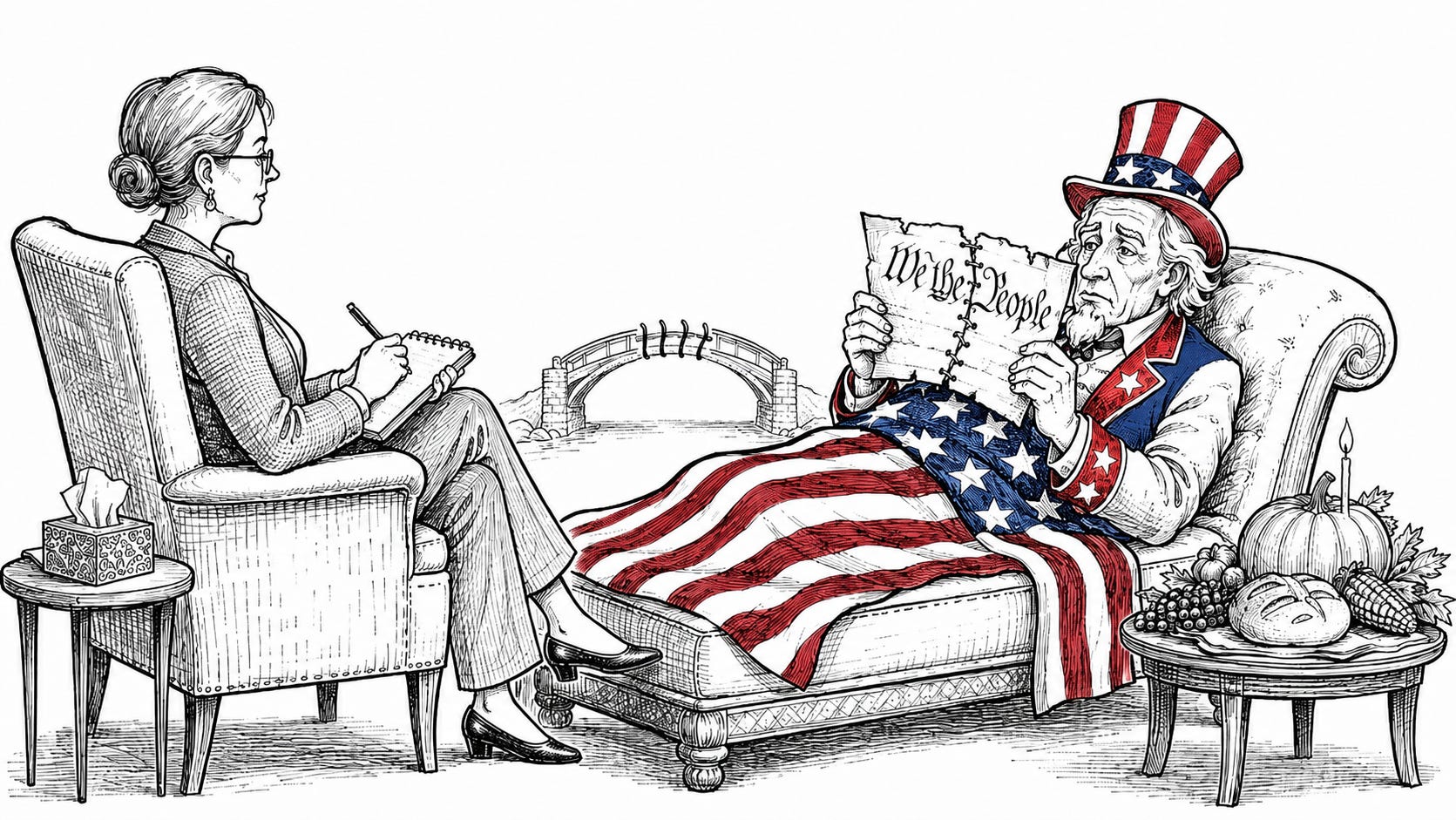
This contempt isn’t a fleeting mood; it’s a corrosive force deliberately amplified over decades, turning polarization into a self-perpetuating storm. But as a clinician, I know pathologies can be treated—not with denial or confrontation alone, but with structured practices that rebuild empathy and interdependence. This year, I’m launching Building Arks, Weaving Bridges: A Journey from Contempt to Connection. It’s not a cure-all, but a practical “treatment plan”—civic infrastructure disguised as dinner, blending shared stories, simple symbols, and intentional acts to hold us through the hard work of citizenship.
Contempt, in psychological terms, is more than anger or dislike; it’s the “unsullied conviction of the worthlessness of another,” a judgment that dissolves empathy and shared humanity. In therapy, it’s the silent killer of relationships, often signaled by sarcasm, eye-rolling, or outright dismissal—the point where one partner stops seeing the other as a flawed human and starts viewing them as irredeemable. Scaled to our civic life, contempt dehumanizes opponents, framing them not as fellow travelers with differing views, but as existential threats. Recent surveys reveal this starkly: Over 60% of Republicans and Democrats now see the other side as a danger to America’s core values, a sentiment that has doubled since the 1990s. This isn’t organic evolution; it’s the fruit of coordinated strategies that have weaponized emotion for political gain.
The blueprint traces back to the 1980s, when Newt Gingrich, as a rising Republican force, retooled politics into moral warfare. His memos to GOP colleagues prescribed inflammatory language—branding Democrats as “corrupt,” “pathetic,” and “traitors”—to exploit cultural fears and grievances. This “wedges and magnets” approach, honed with marketing pros, shifted discourse from policy nuance to binary crusades. The 1987 repeal of the Fairness Doctrine unleashed partisan media, with Rush Limbaugh’s radio empire normalizing contempt as daily fare, blending outrage with entertainment to rally bases. By 1995, as House Speaker, Gingrich gutted bipartisan structures, slashing committee staff and centralizing power in party hands, embedding dysfunction into Congress.
The left mirrored this escalation. Keith Olbermann’s MSNBC tirades in the 2000s echoed right-wing venom, decrying conservatives as “cowards” and “fascists,” while David Brock’s Media Matters systematized takedowns of right-leaning outlets as “hate machines.” The 2010s brought social media’s algorithmic boost, where platforms like Facebook and X rewarded contemptuous content for engagement, forging echo chambers that reinforce “unshared realities.” Donald Trump’s rise amplified it all—his nicknames and rally chants dripped with personal scorn—while responses from the left painted his supporters as “deplorables.” Steve Bannon’s directive to “flood the zone with shit” drowned facts in disinformation, deepening mutual distrust.
By the 2020s, AI and deepfakes have turbocharged this, enabling misinformation at scale and eroding any remnant of shared truth. A 2025 UCLA analysis ties this to surging “affective polarization,” where emotions, not ideas, dominate, triggering amygdala-driven threat responses that entrench black-and-white thinking. Right-wing populism, fueled by backers like Peter Thiel, mocks “globalist elites” as cultural saboteurs, while left-wing activism scorns conservatives as “authoritarians” thwarting justice. The toll is profound: Gridlocked governance, rising violence threats, and a happiness deficit, as contempt breeds chronic resentment. Even post-2024 elections, a University of Pennsylvania study shows this hostility lingers, untethered from outcomes. Globally, America’s case is acute, linking to democratic erosion.
From my clinical vantage, this mirrors untreated relational trauma: Untended wounds fester, leading to isolation. But just as therapy interrupts cycles through intentional practices, so can we counter contempt. Gratitude emerges as a potent antidote, rooted in positive psychology and relational science. It reframes scarcity into abundance, deactivating fear circuits and fostering neural pathways for connection. Arthur Brooks describes it as affirming interdependence—”I need you”—against contempt’s isolating sneer. Journaling specific kindnesses from “the other side” can lower hostility, humanizing adversaries.
This insight inspired The Civic Ritual for Thanksgiving. Drawing from traditions like the Passover Seder, it’s a structured gathering: Set intentions for respectful dialogue, pose four probing questions (e.g., “What are we truly hungry for as a nation?”), toast to unalienable rights while naming exclusions, acknowledge modern “plagues” like mistrust, and commit to small actions. It’s civic therapy—gratitude not as blind optimism, but as disciplined appreciation for shared goods: free speech, neighborly courage, national parks. Critics warn gratitude can mask inequities if misused, but when authentic, it demands moral clarity without dehumanization. A 2025 Medium piece on “gratitude politics” advocates its use in communities to rebuild trust.
In my practice, I’ve seen gratitude rituals mend what arguments shatter. Applied nationally, they can depolarize by inviting presence over perfection. As Thanksgiving 2026 nears, envision tables where contempt yields to curiosity, where we hold heartbreak alongside hope. This isn’t escapism—it’s reclamation. In a republic of “e pluribus unum,” gratitude reminds us our stories intertwine. By embracing it, we can heal the pathology of contempt, one intentional act at a time.