

My most memorable New Year was January 1st, 1970. My father, my sister, and I got the call that my mother had died. We had been expecting it — a few months earlier she’d been diagnosed with cancer that had already spread. Three days before, December 28th, had been her 52nd birthday. She was 52. I was 19.
I don’t remember missing her. That’s the truth I’ve had to sit with for most of my life. My mother was warm, loving, present — and still, our relationship was shaped more by my discomfort than by my love. In Israel, she never learned Hebrew, and that left her outside the world I was building for myself. When we landed in Los Angeles — I was twelve, and it was just days after JFK was killed — she never learned English either. We spoke Yiddish, when we spoke at all, and even that I resented, embarrassed by a language that marked us as not-quite-American. Like so many of her generation, she carried the war in silence, and I let that silence stand.
It took me decades to ask who she actually was.
Perla Rochman Waldfogel was seventeen when the police came for her. It was Shabbat, the family at the table, when an officer arrived at the house in Zamosc, Poland, with news of her arrest. She’d been caught on her way to another town carrying leaflets protesting the treatment of workers; a search of the house turned up more of the same. She never had a trial. She was sent to Bereza Kartuska, a prison built for political dissenters, and she stayed there roughly five years.
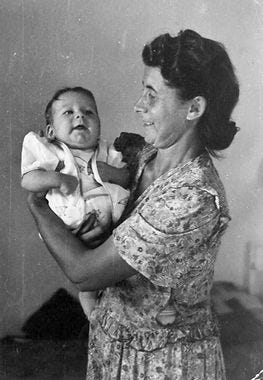
On the night of September 17–18, 1939, as the Soviet invasion of Poland threw the region into chaos, she and other prisoners dug through a wall and escaped. She fled east into the Soviet Union and spent the next six years in a labor camp. Two years after that — a political prisoner for five years, a laborer for six, still only in her twenties — she chose to build a family anyway. My sister was born. Then me. They moved to Israel. I look at a photograph of her holding me as an infant and feel something between awe and grief: awe at what she carried into that moment, grief that I never asked her about it while I still could.
I didn’t understand, growing up, that her silence wasn’t emptiness — it was survival, carried forward. I spent thirty years as a psychiatrist, much of it in the company of older adults near the end of their working lives, watching people meet loss — of capacity, of role, of the work that had defined them. What I learned in that practice was not a clinical insight. It was a human one. People do not break under hardship the way the textbooks predict. They break when their world stops making sense, when they no longer believe they have the resources to meet what’s in front of them, and when the thread connecting their effort to something larger goes slack. The researcher Aaron Antonovsky called those three things comprehensibility, manageability, and meaningfulness — the science of what keeps people well, rather than the science of what makes them sick. He called it salutogenesis. Viktor Frankl, writing from inside Auschwitz, a place none of us should have to write from, said it more simply: a person who has a why to live can bear almost any how.
I only found the language for my mother’s survival after I’d spent a career learning it for other people’s parents. That is its own kind of regret, and I’ve decided to put it to use rather than sit with it.
Here is what I keep returning to. At seventeen, with almost nothing, my mother’s answer to an unjust world was a stack of leaflets — paper, ink, and the conviction that ordinary people speaking plainly to one another could still change how they were treated. It cost her five years in prison and six more in exile. She paid that price before she was twenty-five, and she never once described it to me as a sacrifice. She simply acted, in the way available to her, with the tools she had.
I am now entering the stage of life Erik Erikson called integrity versus despair — the reckoning at the end of a working life with whether it added up to something. David Brooks calls it the second mountain: the first mountain is the one we’re told to climb, the career and the credential and the long ascent of building a life; the second is the one we discover, often after a quiet valley, when the question changes from what do I want to make of myself to what am I here to give. David Rubenstein, in his late fifties, put it more bluntly than either of them: “I’m running out of time. Before I die, I’d like to have been truly transformative in at least one area.” That’s where I find myself. Not climbing. Asking, the way Frankl insisted life is always asking us: not what do I want from the world, but what does the world ask of me now?
My answer is Moonshot Press. It is my leaflet — different tools, a different century, none of the danger she faced, but the same wager: that citizens who show up for each other, plainly and directly, are how a society holds itself together when it’s under strain. She didn’t have the luxury of organizations or institutions behind her, just conviction and a handful of paper. I have far more at my disposal, and far less excuse not to use it.
Moonshot Press is the publishing arm — where ideas about technology, democracy, work, and human flourishing get written in language ordinary citizens can use, not policy-speak. The Institute for Salutogenesis is the framework underneath it — the patient effort to bring Antonovsky’s science of health, the one that finally let me understand my own mother, into how we talk about families, communities, workplaces, and public policy. The People’s Commission on Technology and the American Future is the civic body — a room where workers, parents, educators, and local leaders can deliberate seriously about what artificial intelligence is doing to American life, and turn that deliberation into accountability. Project 2026 is the calendar — the recognition that the country’s 250th anniversary is not a parade but a reckoning, and that citizens have a year to make it count.
These are not four projects. They are one project with four faces, and all four trace back to a seventeen-year-old with leaflets in her bag, deciding the treatment of workers in a small Polish town was worth the risk of prison.
I should say plainly that this work is possible at this scale only because of artificial intelligence. The same technology I am asking the country to govern more wisely is the technology that lets one physician in Montgomery County, Pennsylvania, draft policy briefs, run civic frameworks, produce publishing material, and convene a national conversation that would have required a building full of staff a generation ago. That is not a contradiction. It is the point. AI is neither savior nor threat in the abstract. It is a tool whose consequences depend on the hands that hold it and the purposes those hands are serving. I am trying, in public and with disclosure, to show what it looks like to use these tools in service of human flourishing rather than in flight from it.
I am under no illusion about what one person can finish. The honest version is that I am trying to start something that other people — younger, smarter, closer to the communities most affected — can carry further than I can. That is what the second mountain actually asks of us. Not heroism. Stewardship. The patient handing-on of the conditions under which the next generation can govern itself.
My mother was never able to teach me any of this directly. She died before I knew enough to ask. But she was, and remains, my best teacher — and this is the leaflet I’ve decided to carry.
If any of this resonates with where you are in your own life — whatever mountain you’re on — I would be grateful for your company in the work.