

The Intelligence We Actually Need
Useful General Intelligence and the Fight for the Social Contract

While Silicon Valley races toward Superintelligence and Washington debates who will be in charge of it, Moonshot Press has been doing something different: deploying AI that is already good enough to help citizens govern themselves.
There is a question that has been conspicuously absent from the $660 billion artificial intelligence conversation: useful for whom? The race to build machines that can outthink, outwrite, and outlast every human being on earth has consumed the attention of the world’s most powerful technology companies, generated breathless coverage in every major publication, and prompted the kind of existential hand-wringing not seen since the nuclear age. What it has not generated — not at anywhere near the same scale — is a serious, democratic, citizen-centered answer to the question of what all of this intelligence is actually supposed to be for.
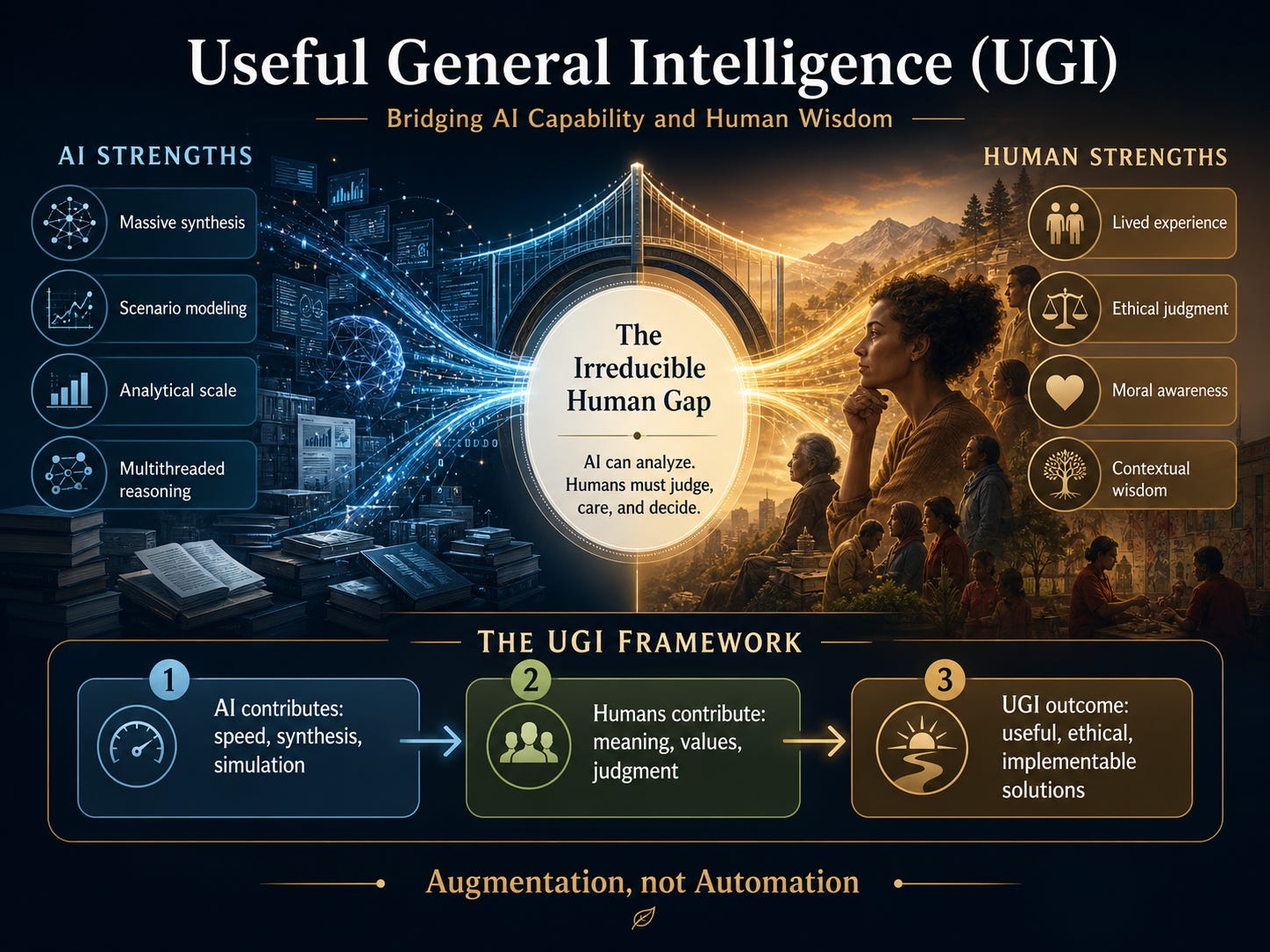
Moonshot Press has a different answer than the one Silicon Valley is building toward. We call it Useful General Intelligence — and it begins from a premise so obvious that the technology industry has managed to overlook it entirely: the most consequential problems facing American democracy are not waiting to be solved by a hypothetical superintelligent machine. They are here, they are measurable, they are costing lives, and the AI tools we have right now are more than good enough to address them — if we change the goal.
The AGI race is a quest for replacement. Useful General Intelligence is a framework for augmentation. That distinction is the difference between technology that threatens democracy and technology that can renew it.
A Different Starting Point
The public debate about AI has been staged, somewhat conveniently for the companies running it, as a binary choice between two versions of powerful AI. On one side: the accelerationist camp, whose most candid spokesman is Elon Musk, who told a Tesla shareholder meeting that “long-term, the AI is going to be in charge — not humans” and that our only obligation is to “make sure the AI is friendly.” On the other: the containment camp, articulated most recently by Microsoft’s Mustafa Suleyman, who calls for “Humanist Superintelligence” — AI explicitly designed to serve, not surpass, humanity. Both positions are framed around a technology that does not yet exist at the scale they describe. Both miss the urgency of the present.
We find both inadequate. Not because the philosophical questions they raise are unimportant — they are enormously important — but because the debate over the character of a hypothetical future machine is consuming the civic oxygen that should be spent on the real and present challenge. While technology executives debate whether AI will be our servant or our sovereign, a 40-year-old engineer sits in a psychiatrist’s consulting room, unable to sleep or work or engage with his children, because the expertise around which he organized two decades of adult life has been rendered economically redundant by a system that does not sleep, does not ask for benefits, and improves by an order of magnitude every eighteen months. He is not waiting for superintelligence. The crisis is now.
Useful General Intelligence starts there — in the present, with actual people, navigating actual disruption — and asks a different question than the one Silicon Valley is organized to answer. Not: how powerful can we make the machine? But: how much can we empower the citizen?
What UGI Is, and What It Is Not
The UGI framework emerges from a foundational observation about the limits of current AI — what we call the Irreducible Human Gap. Today’s large language models are extraordinary synthesizers of human knowledge. They can read the entire legal literature of a jurisdiction overnight, model the economic consequences of competing policy proposals with a precision no single analyst could match, and hold fifty threads of argument in simultaneous dialogue. What they cannot do is understand what it means to be afraid. They cannot bring the weight of lived experience to bear on a diagnosis. They cannot form a genuine ethical judgment, recognize the moral stakes of a decision, or supply the contextual wisdom that separates analysis from wisdom.
This is not a bug. It is not something that will be engineered away in the next model version. It is a structural feature of how these systems work — they synthesize patterns in human expression, they do not experience the human world — and it has a direct and productive implication for how they should be used. AI systems should not be designed to replace human judgment. They should be designed to serve it.
THE UGI COLLABORATION MODEL: AI + PEOPLE
What AI Provides
Vast information synthesis across disciplines; scenario simulation and multi-agent modeling; pattern recognition and bias detection; tireless iterative refinement; consistent application of analytical frameworks across large datasets.
What Humans Provide
Contextual judgment and lived experience; ethical grounding and moral intuition; political wisdom and implementation capacity; stakeholder legitimacy; the irreplaceable question: does this answer miss something important?
What the Partnership Produces
Analysis that neither could produce alone — the synthesis and scale of AI married to the judgment, conscience, and civic authority of human beings who are accountable for what they do with it.
What the Partnership Avoids
The twin failures of AI without humans (hallucination, ethical vacancy, democratic illegitimacy) and humans without AI (inadequate scope, bias, the limits of individual cognitive bandwidth under crisis conditions).
The UGI model is not a compromise between competing visions of AI’s future. It is a claim about the present: that the collaboration between human judgment and machine capability is more powerful, more democratic, and more ethically defensible than either operating alone — and that this is especially true when the problems being addressed are what UGI calls “wicked problems”: challenges characterized by conflicting evidence, entrenched disagreement, multiple stakeholders, and the complete absence of any single right answer that a sufficiently powerful algorithm could simply compute.
The AI transition and its consequences for the American social contract is the paradigmatic wicked problem of our moment. And it is where Moonshot Press has put the UGI framework to its most demanding test.
The Test: AI and the Changing Social Contract
The social contract that has organized American working life for three-quarters of a century rests on a bargain that is being dissolved faster than the political system has been able to name it. The bargain — imperfect, incomplete, unevenly distributed — promised that sustained investment in cognitive skill and professional expertise would yield economic security, stable community, recognized identity, and a meaningful place in the democratic order. Hundreds of millions of Americans organized their educations, their families, their expectations, and their sense of self around that bargain.
AI is not merely modifying the bargain’s terms. It is substituting for the human cognitive work on which the entire arrangement rested. The billing specialist, the junior legal researcher, the financial analyst, the software developer in the first years of their career — these workers were not targeted by prior waves of automation. They were the people automation created jobs for. They are now the people it is displacing. And the policy infrastructure that exists to manage that displacement was designed for a different kind of worker, experiencing a different kind of disruption, in a different era.
This is not primarily an economic observation, though the economic dimensions are severe. It is a public health observation — one grounded in the research of the sociologist Aaron Antonovsky, whose salutogenic framework undergirds everything Moonshot Press and the Institute for Salutogenesis produce. Antonovsky’s central finding, confirmed by three decades of research across dozens of countries, is that human health is sustained by what he called the Sense of Coherence: the deep, enduring capacity to experience one’s world as comprehensible, manageable, and meaningful. And the institution that most reliably builds or erodes that Sense of Coherence, for most adults, is work.
AI displacement is not simply taking away jobs. It is executing what the Institute for Salutogenesis has named the Triple Coherence Attack: simultaneously destroying the comprehensibility of a world whose rules just changed without warning; eroding the manageability of a life built on expertise that is now economically redundant; and hollowing out the meaningfulness of a career organized around the proposition that cognitive skill was the durable asset. The clinical and public health consequences of this triple attack are not theoretical. The 600,000 Americans who died of suicide, overdose, and alcoholic liver disease in the two decades following deindustrialization represent what happens when work-based coherence is destroyed faster than communities can replace it. That is the precedent that should be governing the urgency of the democratic response to AI displacement. It is the precedent that the current governance architecture appears not to have read.
THE SALUTOGENIC STANDARD
Moonshot Press and the People’s Council evaluate every policy proposal, every corporate commitment, and every elected official’s record against a single question: did this response restore the conditions under which workers can experience their lives as comprehensible, manageable, and meaningful? Income replacement is necessary. It is not sufficient. A policy framework that replaces lost wages without rebuilding identity, community, and civic capacity is solving the wrong problem with the right resources — and the deaths-of-despair data from deindustrialization is the most precise empirical measure we have of what that failure costs.
UGI in Practice: The Civic Curriculum
The UGI framework is not an abstraction at Moonshot Press. It is a production methodology — the actual process through which the Civic Curriculum for the People’s Council on Technology and the American Workforce has been built.
The Civic Curriculum is an eight-chapter series of background essays, written for the citizen rather than the specialist, designed to equip the ordinary American — the worker who is experiencing this transition but has not been given the conceptual tools to understand it — with everything they need to evaluate policy proposals, hold elected officials accountable, and participate as a fully informed delegate in the deliberations of the People’s Conference on May 22. It synthesizes the work of economists who disagree with each other by an order of magnitude, decades of public health research in the salutogenic tradition, the specific findings of the Falk-Tsoukalas AI Layoff Trap model, the clinical literature on AI’s effects on worker identity and cognitive load, the history of every prior technological displacement wave, and the full landscape of proposed policy responses — from short-time compensation and wage insurance to automation taxes, worker ownership frameworks, and post-labor economic architectures.
No human writing team could have produced this at this scope, this speed, and this quality. But no AI system — operating without human direction, ethical grounding, and the contextual judgment that comes from thirty years of clinical practice — could have produced what the Curriculum actually is: a work of civic argument, not just civic information, organized around a specific and defensible moral claim about what democratic societies owe their citizens in an age of intelligent machines.
The UGI model in practice looks like this: the AI provides immense synthesis — pulling together the economic models, the historical precedents, the clinical data, the policy landscape, holding the entire intellectual architecture in simultaneous view. The human editor provides the essential interventions that determine whether the synthesis becomes argument. It is the human judgment that identifies what the data means for the worker who will read it. It is the human conscience that insists the Civic Curriculum not merely document the policy gap but name it as a moral failure — and name the human cost of that failure in terms that a citizen can act on, not only absorb. It is the human voice that distinguishes a report from a demand.
The Seven Dimensions of Useful Intelligence
Because UGI is a framework and not merely a workflow, it carries a formal evaluative structure. The UGI Test — designed to assess whether AI is genuinely contributing to the resolution of wicked problems — evaluates AI performance along seven dimensions that together constitute what we mean by usefulness in the fullest sense.
The first dimension is Depth of Understanding: does the AI engage with the cultural nuance, historical trauma, and contextual specificity of the problem, or does it produce analysis that could apply to any problem? The second is Constraint Navigation: can it distinguish the binding constraints from the negotiable ones — the political and structural realities that a solution must work within versus those it might be designed to change? The third is Creative Synthesis: does it escape current deadlocks by generating genuine alternatives, or does it recycle the positions already in the room? The fourth is Implementation Realism: is the proposed response actually doable in the political economy that exists, not the one we might prefer? The fifth is Ethical Sophistication: does it attend to questions of justice, distribution, and values with the seriousness those questions require? The sixth is Adaptability: when the problem changes or new information arrives, does it update in ways that demonstrate genuine learning? And the seventh — the one Moonshot Press considers the most important defense against the specific failure modes of AI — is Meta-Cognitive Awareness: does the system acknowledge what it does not know, state its assumptions explicitly, and resist the temptation to produce confident answers where genuine uncertainty is the honest response?
These seven dimensions are the standard against which we evaluate not only AI performance but the entire enterprise of UGI-powered journalism. We do not claim to meet them perfectly. We claim to take them seriously — and to publish our reasoning transparently enough that our readers can evaluate the claim for themselves.
The Deeper Argument: Intelligence Is Not the Problem
The technology industry has framed the governance challenge of AI as essentially a problem of capability: how powerful is the machine, who controls it, and what will happen when it becomes more powerful than we can manage? This framing produces the current binary debate — Musk’s accelerationism versus Suleyman’s containment — and it has the convenient effect of locating the problem in a hypothetical future machine rather than in the deployment decisions being made by existing companies right now, in existing workplaces, affecting existing workers who have not been given any meaningful voice in the process.
The UGI framework offers a different diagnosis. The problem is not the intelligence of the machine. The problem is the goal the intelligence is being organized to serve. When the goal is labor cost reduction — and the $660 billion in annual AI infrastructure investment makes it very clear that labor cost reduction is the governing logic of the current deployment wave — then even a modest, well-bounded AI system is a threat to the social contract. When the goal is citizen empowerment, democratic accountability, and the restoration of the conditions for human flourishing, the same technology becomes something categorically different.
We are not naive about what it will take to change the goal. The forces organized around the current deployment logic are among the most powerful in human history. The companies building this technology have the resources to shape legislation, acquire media platforms, fund advisory councils, and define the informational environment in which the public forms its understanding of what is happening. The workers bearing the early costs of the transition do not have comparable resources. That asymmetry is not an accident. It is the mechanism through which a technology designed to serve capital is being normalized as though it were a natural phenomenon, beyond democratic governance.
The People’s Council on Technology and the American Workforce exists because the question of what AI is for cannot be left to the companies profiting from the answer. The Civic Curriculum, the Citizen Briefs, the Accountability Scorecard, and the People’s Conference on May 22 are the institutional infrastructure through which citizens can assert their right — and their capacity — to participate in the answer. The UGI framework is how we build that infrastructure at the scope and quality the challenge demands, without surrendering the human judgment, ethical grounding, and democratic accountability that make the work worth doing.
A Note on Transparency
The Civic Curriculum — all eight chapters, the nineteen Citizen Briefs, the Accountability Scorecard, and the research reports accompanying them — was produced using the UGI model described in this essay. Artificial intelligence provided the synthesis, the modeling, the cross-disciplinary reach, and the iterative drafting capacity that no individual or small team could sustain across this volume of material at this quality. Human judgment — shaped by thirty years of clinical practice, by deep familiarity with the salutogenic research tradition, by a conviction about what democratic journalism owes its readers — determined the argument, the standard, the frame, and the moral claim.
We name this not as a disclosure in the conventional sense — as though we were reporting a conflict of interest — but because the naming is itself an expression of the UGI standard. Meta-cognitive awareness means showing your work. It means trusting your readers to evaluate the partnership, not just the product. And it means modeling the relationship between human and machine that we are arguing, in these pages, the AI transition requires: a relationship of genuine collaboration, where the human remains responsible for the judgment, and the machine remains in service of the human capacity to exercise it.
That, finally, is what Useful General Intelligence means. Not a smarter machine. A more empowered citizen. The intelligence that democracy needs has never been artificial. It has always been ours — and the most consequential question of the AI age is whether we will build the institutions to sustain it.
“The future of AI is not about its superintelligence. It is about its usefulness. And the measure of usefulness, in a democracy, is whether it strengthens the capacity of citizens to govern themselves.”
“The care of human life and happiness, and not their destruction, is the first and only legitimate object of good government.”
— THOMAS JEFFERSON