The Declaration Was America’s First Moonshot
America’s first moonshot declared the promise. The Moonshot Class of 2026 asks us to keep it.

Before America reached for the moon, it reached for something even more audacious.
It declared that human beings are born with inherent dignity. That governments exist to secure life, liberty, and the pursuit of happiness. That ordinary people are not subjects of distant power, but citizens capable of shaping their common future.
The Declaration of Independence was America’s first moonshot.
It was not a technical achievement. It was a moral horizon. It did not say the work was finished. It announced the work that every generation would have to continue.
In 2026, America will mark the 250th anniversary of that Declaration. There will be speeches, fireworks, museum exhibits, commemorations, arguments, and invocations of the founding promise.
But the real test of the anniversary will not be what we say about the Declaration.
It will be whether we are willing to renew it in the lives of the children being born now.
A child born in 2026 will enter life in the 250th year of the American experiment. That child will not remember the ceremonies. But that child will inherit the answer to the question the anniversary places before us:
Do we still mean it?
Do we mean life — enough to protect pregnancy, birth, infancy, nutrition, safety, and health?
Do we mean liberty — enough to create the conditions in which children can develop agency, trust, language, resilience, and the capacity to participate in the world?
Do we mean the pursuit of happiness — enough to support families, strengthen communities, and build the foundations of flourishing from the very beginning of life?
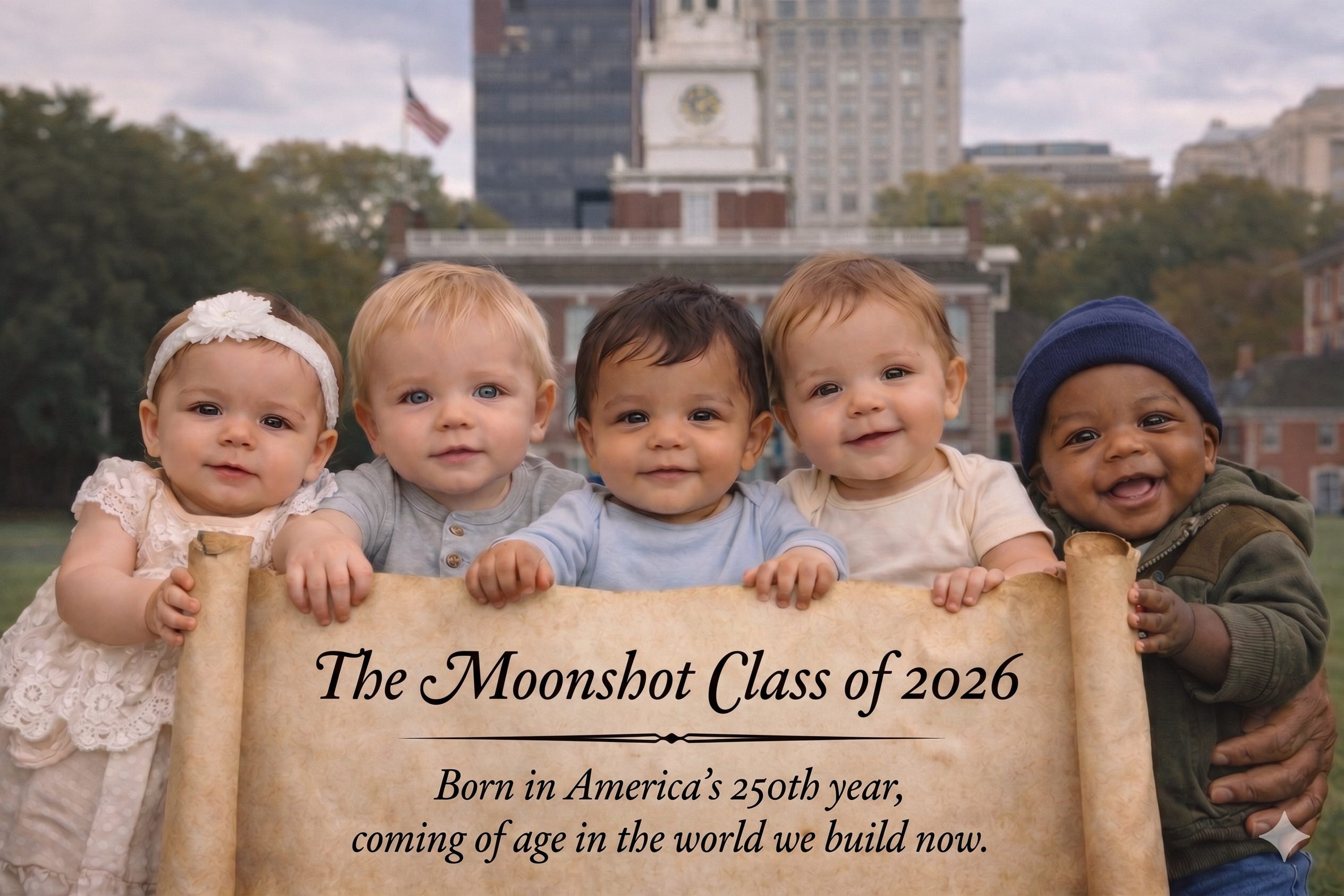
This is the Moonshot Class of 2026: the babies born in America’s 250th year, coming of age in the world we build now.
They are not abstractions. They are not future statistics. They are not merely future workers, consumers, patients, or voters. They are persons of dignity. They are future citizens. They are the living test of whether the promise of the Declaration can be made real in our time.
The Declaration was America’s first moonshot.
The Moonshot Class of 2026 is our test of whether we still mean it.
The Declaration Begins at Birth
The Declaration speaks in universal language: life, liberty, and the pursuit of happiness. But for a newborn child, these are not abstractions.
Life begins with a safe pregnancy, a healthy birth, a mother who is cared for, a family that is not abandoned, and a child whose basic needs are met.
Liberty begins with development: the capacity to form secure attachments, regulate stress, explore the world, learn language, develop trust, and gradually become an agent in one’s own life.
The pursuit of happiness begins with the conditions that make flourishing possible: love, safety, nutrition, responsive care, meaningful relationships, stable homes, healthy communities, and institutions that help rather than overwhelm.
A country cannot claim to believe in equal opportunity if a child’s future is shaped too heavily by the accident of birth.
A country cannot claim to believe in life if it cares about birth but not infancy.
A country cannot claim to believe in liberty if millions of children begin life under conditions that undermine their capacity to thrive before they ever enter school.
A country cannot claim to believe in the pursuit of happiness if families are left alone to carry burdens that should be shared by communities, institutions, and public life.
The First 1000 Days — from conception through roughly age two — are where the Declaration becomes developmental reality.
The First 1000 Days Are Where the Future Begins
Every day in America, thousands of babies take their first breath. Each one arrives with astonishing possibility. Each one enters a family, a neighborhood, a healthcare system, a food system, an economy, a media environment, and a democracy.
The First 1000 Days are among the most important windows in human development. During this period, the foundations of brain architecture, emotional security, stress regulation, language, attachment, trust, and lifelong health are taking shape with extraordinary speed.
These days do not determine everything. Human beings are resilient. Families overcome hardship. Later intervention matters. But the earliest years create direction. They build either a sturdy or fragile foundation for what follows.
A nation serious about opportunity cannot begin at kindergarten.
A nation serious about health cannot begin when disease appears.
A nation serious about democracy cannot wait until a young person turns eighteen to ask whether they are ready to participate in civic life.
The First 1000 Days are where health, opportunity, and citizenship begin.
From Healthcare to Salutogenesis
The First 1000 Days Initiative is not only a healthcare project.
It is a salutogenic project.
Salutogenesis means the creation of health. The term comes from medical sociologist Aaron Antonovsky, who asked why some people and communities are able to move toward health even under conditions of stress and adversity. Rather than beginning only with disease, risk, and pathology, salutogenesis asks what helps human beings flourish.
What makes life comprehensible — understandable, coherent, and navigable?
What makes life manageable — supported by resources, relationships, institutions, and practical help?
What makes life meaningful — worthy of investment, commitment, love, and hope?
For the First 1000 Days, this means asking more than whether a baby survives, whether a birth was medically safe, or whether a developmental delay was detected. Those questions matter deeply. But they are not enough.
A salutogenic approach asks:
Does the mother feel accompanied or abandoned?
Can the family understand and navigate the systems meant to help them?
Are parents supported in bonding, feeding, soothing, reading, playing, and responding?
Is the child surrounded by safety, rhythm, voice, touch, nutrition, and love?
Does the community understand that every newborn is part of its common future?
A baby is not simply growing inside a home.
A baby is growing inside an ecosystem.
That ecosystem includes parents and caregivers, pediatricians and obstetricians, grandparents and neighbors, childcare providers and employers, food systems and housing policies, public health departments and libraries, faith communities and local media, transportation systems and digital platforms.
A salutogenic First 1000 Days agenda therefore does not ask only how to reduce infant mortality, preterm birth, developmental delay, maternal depression, food insecurity, or toxic stress — though it must ask all of those things.
It asks what a flourishing beginning looks like.
And then it asks whether America is willing to build it.
What We Owe the Moonshot Class of 2026
We owe them healthy pregnancies and safe births.
We owe them mothers whose physical and mental health are protected.
We owe them fathers and caregivers who are invited into responsibility.
We owe them food, shelter, clean air, safe water, and protection from violence and toxic stress.
We owe them parents who are supported, not abandoned.
We owe them early relationships rich in touch, voice, play, rhythm, language, and love.
We owe them healthcare that sees the whole child in the whole family.
We owe them communities where libraries, pediatricians, obstetricians, childcare providers, faith communities, public agencies, employers, neighbors, and local media understand that babies are not someone else’s concern.
We owe them measurement that matters — not only the tracking of disease and deficits, but indicators of flourishing: attachment, caregiver wellbeing, developmental progress, family stability, food security, social connection, access to care, and community trust.
Most of all, we owe them a country that does not celebrate children in speeches while leaving families to struggle alone.
The Questions That Will Guide the People’s Commission
The People’s Commission begins with questions because democracy begins with questions.
Not questions asked only by experts.
Not questions answered only by agencies.
Not questions translated immediately into partisan talking points.
Questions that citizens can gather around.
What do we, as a society, owe newborns?
What does every family need during the First 1000 Days?
What are the core capabilities that allow a child to flourish?
What are the early markers of a flourishing life?
What conditions make family life more comprehensible, manageable, and meaningful?
What barriers prevent children from receiving the foundation they deserve?
What should communities measure if they want to know whether babies and families are truly thriving?
What roles should parents, clinicians, educators, employers, faith communities, public officials, and neighbors play?
How can local communities create environments where every child has a genuine chance to thrive?
And how can Moonshot Press help citizens see, understand, deliberate, and act?
These are not academic questions. They are founding questions.
They will guide the work of the People’s Commission on the First 1000 Days of Life. They will shape local conversations, citizen briefs, public forums, data dashboards, family stories, policy proposals, and practical tools.
The goal is not simply to produce another report.
The goal is to help America make a promise to the Moonshot Class of 2026 — and then build the systems, communities, and public will required to keep it.
Montgomery County as a Place to Begin
Every national moonshot needs a place where the work becomes real.
Montgomery County, Pennsylvania can be one of those places.
Here, as everywhere, babies are born into very different circumstances. Some families are surrounded by support. Others face quiet struggles with childcare, transportation, food insecurity, maternal mental health, housing costs, fragmented services, or the exhaustion of trying to navigate too much alone.
But Montgomery County also has extraordinary assets: healthcare institutions, pediatricians, obstetricians, schools, libraries, public health agencies, faith communities, civic organizations, local leaders, and families who know what is working and what is not.
The question is whether these assets can become an ecosystem.
Can every expecting family know where to turn?
Can pediatricians, obstetricians, public health agencies, libraries, doulas, home visitors, childcare providers, and community organizations work from a shared map?
Can families help identify the barriers professionals miss?
Can local media tell the story of child and family flourishing in a way that builds trust?
Can Montgomery County become a living laboratory for what a First 1000 Days community looks like?
The moonshot is national.
The work begins locally.
Join the Moonshot
America once declared a moral horizon: that human beings are born with dignity, rights, and the possibility of flourishing.
That mission continues.
The Moonshot Class of 2026 is being born now. Their first 1000 days are not waiting for our politics to become less divided, our systems to become less fragmented, or our public debates to become less exhausted.
Their lives are beginning.
So must our work.
Read the Manifesto of the Moonshot Class of 2026.
Follow and participate in the People’s Commission on the First 1000 Days of Life.
Share this article with someone who cares about children, democracy, health, opportunity, or America’s future.
Ask your community one question:
What would it take for every baby born here to have a genuine chance to flourish?
The first 1000 days are the most important years most of us never remember.
But their impact echoes across a lifetime.
And across a nation.
The question is not whether we can afford to invest in the First 1000 Days.
It is whether a country founded on life, liberty, and the pursuit of happiness can afford not to.
The Declaration was America’s first moonshot.
The Moonshot Class of 2026 is our test of whether we still mean it.
The future is already being born.
Let us build the world they deserve.