

Created with Grok Research
AI has become one of the most polarizing and high-stakes topics in the United States, shaping debates in business, politics, academia, media, and everyday life. Enthusiasts see it as a once-in-a-century general-purpose technology capable of driving explosive growth and solving humanity’s biggest challenges. Critics warn of overhype, profound societal disruptions, or even existential dangers.
Public conversation is organized into several distinct but overlapping “camps.” These reflect differing worldviews on AI’s capabilities, timeline, benefits, risks, and appropriate societal response. The camps influence investment decisions, policy proposals, corporate strategies, and public opinion. Many individuals and organizations straddle multiple camps, and positions evolve with new technical developments.
A major dimension of the conversation — strongly emphasized by the current U.S. federal government — is strategic competition with China. Public discourse is organized into several distinct but overlapping “camps.” These reflect differing worldviews on AI’s capabilities, benefits, risks, and appropriate societal and geopolitical response. The camps influence investment, policy, corporate strategy, and public opinion. Many voices straddle multiple camps.
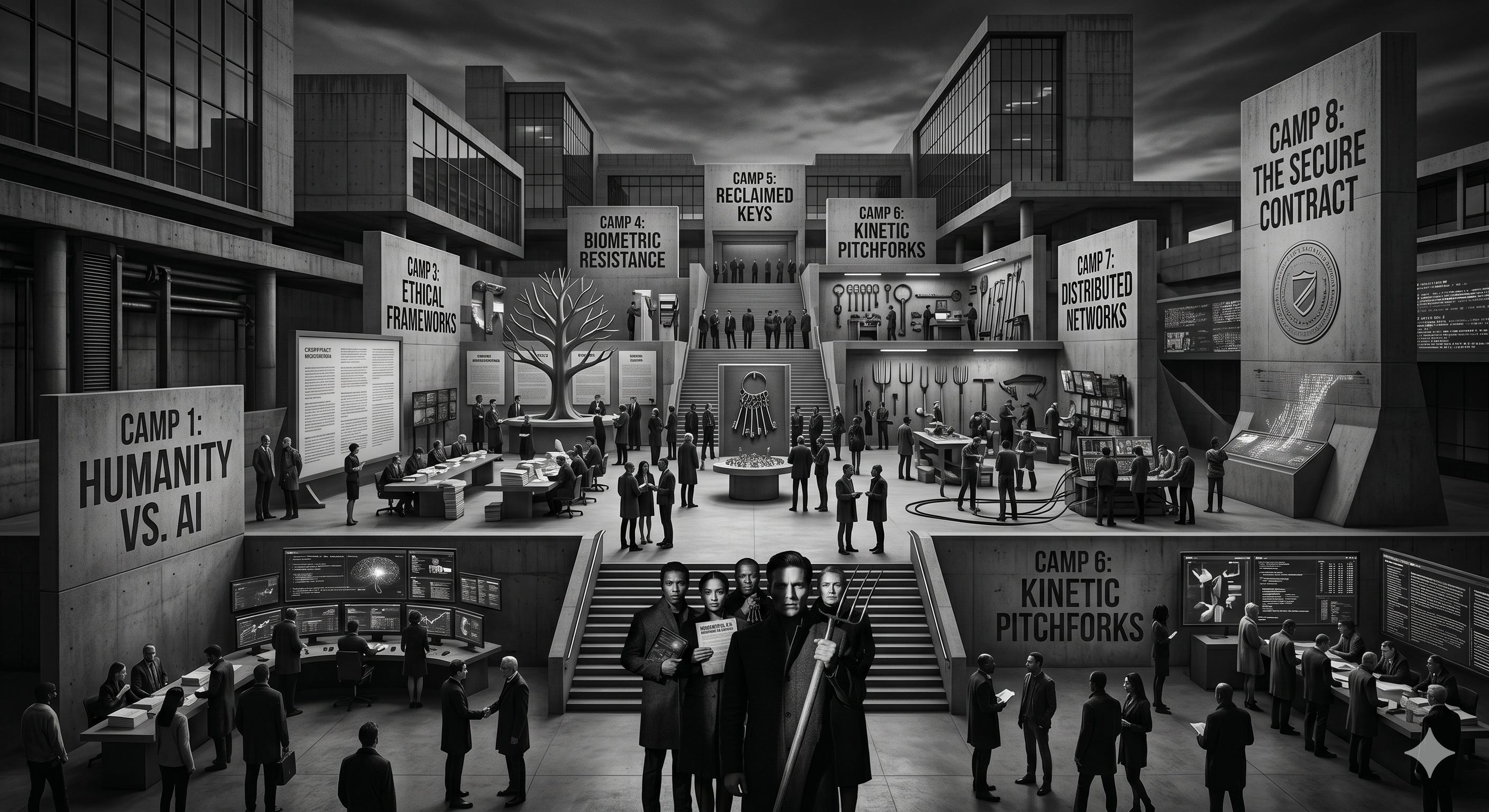
Below is a comprehensive master list of the primary camps active in U.S. discourse:
1. AI Optimists / Accelerationists / Techno-Optimists
Position: AI is a profoundly positive, transformative force that will drive unprecedented economic growth, scientific breakthroughs, and human flourishing. Development should be accelerated with minimal regulatory barriers.
Main points: Exponential progress toward AGI will create abundance; over-regulation risks ceding leadership to China; focus on rapid building and deployment.
Representative spokespeople: Marc Andreessen (a16z), Sam Altman (OpenAI), Jensen Huang (NVIDIA), Ray Kurzweil, Elon Musk (xAI).
Supportive media/outlets: a16z publications, The Information, Forbes, WSJ business sections, X/Twitter.
2. AI Skeptics / Hype Critics
Position: Much of the AI boom is marketing hype; current technologies have fundamental limitations and are unlikely to deliver transformative results soon.
Main points: Hallucinations, high costs, modest productivity gains, risk of AI winter.
Representative spokespeople: Gary Marcus, Yann LeCun (on extreme claims).
Supportive media/outlets: MIT Technology Review, academic critiques, skeptical NYT pieces.
3. AI Doomers / Existential Safety Advocates
Position: Advanced AI poses catastrophic or existential risks. Development must be slowed or heavily controlled until safety is assured.
Main points: Misalignment, loss of control, inadequate current alignment techniques.
Representative spokespeople: Eliezer Yudkowsky, Geoffrey Hinton, Yoshua Bengio, Nick Bostrom.
Supportive media/outlets: The New Yorker, The Atlantic, effective altruism platforms.
4. AI Pragmatists / Balanced Realists
Position: AI offers real benefits alongside serious risks. Pursue responsible innovation with smart, evidence-based governance.
Main points: Focus on workforce adaptation, bias, privacy, and proportionate regulation.
Representative spokespeople: Fei-Fei Li, Andrew Ng, Ro Khanna.
Supportive media/outlets: The Economist, Brookings Institution, mainstream policy coverage.
5. Societal Impact / Labor & Ethics Camp
Position: AI will exacerbate inequality, displace jobs, amplify biases, and raise ethical concerns. Prioritize human-centered protections.
Main points: Labor disruption, IP issues, surveillance, power concentration in Big Tech.
Representative spokespeople: Timnit Gebru, Writers Guild advocates, progressive sociologists.
Supportive media/outlets: The Guardian, New York Times societal sections, Wired.
6. AI Democracy & Social Cohesion Defenders (Information Integrity Camp)
Position: Generative AI threatens democracy and social trust through disinformation, deepfakes, and erosion of shared truth.
Main points: Election interference, polarization, “crisis of knowing,” need for watermarking and literacy.
Representative spokespeople: Maria Ressa, Tristan Harris, Daron Acemoglu, Shoshana Zuboff, Brennan Center experts.
Supportive media/outlets: The New York Times, The Atlantic, The Guardian, policy journals.
7. AI Regulation & Governance Camp (The Regulatory Divide)
Position: AI requires governance, but stakeholders are deeply divided on scope, strictness, and level of government.
Sub-camp A: Light-Touch / Innovation-First
Favor federal preemption and minimal rules to protect competitiveness.
Spokespeople: Industry leaders, certain Republican lawmakers.
Media: WSJ, business press.
Sub-camp B: Protective / Risk-Based
Support stronger, enforceable rules with state flexibility.
Spokespeople: State AGs, civil society, certain Democrats.
Media: NYT, Brookings.
8. US-China AI Competition / Strategic Race Camp
Position: AI is a critical great-power competition with China. The U.S. must win decisively to maintain technological, economic, military, and ideological superiority. Strongly supported by the current federal government.
Main points:
AI is a zero-sum strategic contest; China uses state-driven theft, distillation of U.S. models, and massive investment.
Maintain U.S. leads in compute, talent, models, and infrastructure.
Policy tools: export controls on chips/models, IP protection, domestic buildout, allied AI coalitions, and counter-intelligence.
Prevent China from setting global AI standards or achieving military-civil fusion dominance.
Key Federal Government Elements:
America’s AI Action Plan (2025): Explicit “Winning the Race” framework.
Executive Order 14179: “Removing Barriers to American Leadership in Artificial Intelligence.”
Tightened BIS export controls and sanctions on advanced AI tech to China.
House Select Committee on the Strategic Competition Between the United States and the Chinese Communist Party (Chairman John Moolenaar) — major hearings on “China’s Campaign to Steal America’s AI Edge.”
Representative spokespeople:
Rep. John Moolenaar (House Select Committee Chairman)
Michael Kratsios (Chief Science and Technology Adviser)
President Donald Trump (administration framing)
Gregory C. Allen (CSIS), Dmitri Alperovitch (Silverado Policy Accelerator), Matt Pottinger, David Sacks (AI Czar influence)
Supporting groups & think tanks:
America First Policy Institute, Silverado Policy Accelerator, CSIS, House Select Committee on CCP.
Supportive media/outlets: Wall Street Journal editorials, Fox News, national security-focused publications, congressional releases.
This master list captures the main contours of the American AI public discourse ecosystem as of 2026. The camps are not rigid silos—debates frequently blend concerns (e.g., democracy risks with regulation, or optimism with pragmatic governance)—but they help clarify the competing narratives shaping policy, investment, and cultural attitudes toward AI. The discourse continues to evolve rapidly with technological progress and real-world deployments.