
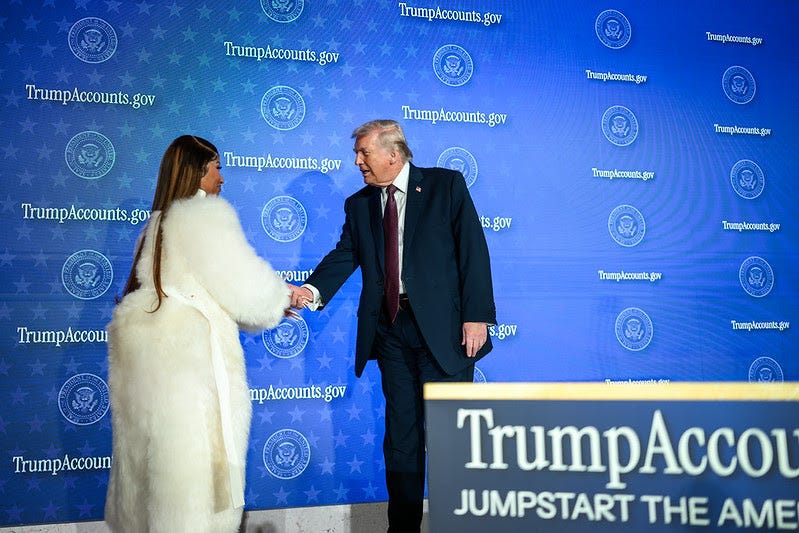
Picture a mother at a kitchen table in Norristown or North Philadelphia this week — call her Sarah, though she is a composite of thousands of real Pennsylvania parents in exactly this position. Her three-week-old daughter, Maya, sleeps in a carrier beside her. Trump Accounts launched nationwide on July 4th, and Sarah has just filed the paperwork — IRS Form 4547 — to claim Maya’s account: a $1,000 federal deposit that will be invested in the stock market until Maya turns 18. It feels like the government believes in her daughter’s future.
But here is what no form told Sarah. The same week she enrolled Maya in one account, she remained unenrolled in a dozen others — the county’s nurse home-visiting program, expanded WIC benefits she qualifies for, early-intervention screening, childcare subsidies. Those programs won’t show a balance when Maya turns 18. They will determine whether Maya can actually use the balance she receives.
This is the central paradox of Trump Accounts as they open across America: we have just made a multibillion-dollar collective bet on children’s financial futures while systematically underinvesting in the developmental foundations those futures require.
The Promise and the Gap
Trump Accounts rest on a powerful and correct insight: ownership matters. Roughly four in ten American adults own no stock at all, and for their families, Wall Street’s gains are abstractions rather than shared prosperity. Giving every child a stake in American capitalism is a genuine attempt to bridge that divide — and the response has been real. Treasury reports nearly six million children were signed up before the July 4th launch. The Dell family has pledged $6.25 billion to seed accounts with $250 for some 25 million children born too early to qualify for the federal deposit. Ray and Barbara Dalio pledged $75 million more for Connecticut children.
The administration’s projections are ambitious: with maximum family and employer contributions, an account could exceed a million dollars by age 28. Even seed-only accounts could reach roughly $5,000–6,000 at 18 by the government’s estimates — enough for education costs or a first step toward a home, the uses the law favors. (Independent analysts note the real purchasing power will be lower, and that other withdrawals before retirement carry a tax penalty — but something is genuinely better than nothing.)
Here is what the promotional materials don’t say: by the time Maya opens her account in 2043, the foundational architecture determining whether she can leverage that capital will have been built — or compromised — seventeen years earlier, during a period our public investment largely ignores.
The Science of the First 1,000 Days
From conception through age two, a child’s brain undergoes its most dramatic transformation. During these First 1,000 Days, the brain forms more than one million new neural connections every second, and grows to roughly 80 percent of its adult size by age three — establishing the biological infrastructure for everything that follows: executive function, emotional regulation, learning capacity, stress response, and the ability to form relationships.
Three factors largely determine whether that construction builds capacity or fragility: maternal mental health during pregnancy and postpartum, adequate nutrition, and stable, responsive caregiving. When maternal depression goes untreated, stress hormones affect fetal brain development. When infants experience food insecurity, inadequate nutrition constrains both physical and cognitive growth. When caregiving is chronically disrupted — by unpredictable work schedules, absent childcare, untreated mental illness — children’s stress-response systems become dysregulated in ways that persist.
These are not soft problems with soft consequences. Landmark longitudinal research on intensive early-childhood programs — the work for which economist James Heckman is best known — finds returns on the order of seven dollars in societal benefit for every dollar invested, through higher earnings, better health, lower crime, and reduced remedial spending. The inverse is equally true: a Trump Account cannot retroactively repair neural architecture that wasn’t built at age two. Money at 18 cannot buy back a million connections per second disrupted sixteen years earlier.
The Participation Gap
The program’s design is more forgiving than early critics feared: families can claim the $1,000 anytime until the year their child turns 17, online at trumpaccounts.gov without filing a tax return. There is no hard deadline that permanently excludes a newborn.
But a soft barrier can exclude as effectively as a hard one. The families least likely to claim the account — those not required to file taxes, without stable addresses, without time or trust to navigate a federal portal — are disproportionately the same families whose children face the steepest developmental headwinds. Roughly 40 percent of American births are covered by Medicaid; nearly one in five families eligible for the Earned Income Tax Credit never claims it. If Trump Account participation follows the same pattern, hundreds of thousands of the children with the most to gain will be left out — not by statute, but by the same fragmentation that keeps families out of every other program.
The Coordination Crisis
Because here is the frustrating part: America already runs the programs the First 1,000 Days require. WIC for nutrition. Medicaid covering some 40 percent of births. Evidence-based nurse home visiting, which randomized trials show reduces maternal depression and improves children’s cognitive outcomes. Early Head Start. Childcare subsidies.
These programs work. They just don’t work *together*. Each requires a separate application with separate eligibility rules and separate enrollment windows; no agency is responsible for connecting a family to all of them; and families under the most stress have the least capacity to navigate the maze. A mother like Sarah typically qualifies for five or more early-childhood supports and accesses one or two — not because she doesn’t need the rest, but because nobody told her they exist and no system enrolled her.
The Integration Opportunity
The moment Sarah filed Form 4547, she handed the government everything needed to change that: her name, address, income context, and Maya’s Social Security number — the exact data points that determine eligibility for nearly every early-childhood program. Trump Account enrollment could function as the front door to the entire First 1,000 Days system: one filing triggering automatic screening for WIC, home visiting, childcare subsidy, maternal mental-health support, and Medicaid — with a navigator to follow up.
Nothing in current federal policy does this. The philanthropic pledges — the Dells’ billions, the Dalios’ millions — put money *into* accounts; none yet connects account enrollment to developmental services. That is the unbuilt bridge, and it is buildable at the state and county level without waiting for Washington: Pennsylvania could link Form 4547 data or birth registration to a single coordinated eligibility screen tomorrow, and any county could pilot it.
The Cost Question
Can we afford it? The federal seed program costs roughly $14–15 billion over four years — about a twentieth of one percent of federal spending. Comprehensive First 1,000 Days support — universal home-visiting access, fully funded WIC, maternal mental health integrated into primary care, childcare assistance for low-income families — runs an estimated $30–40 billion a year, well under half a percent of the budget. This is not a resource constraint. It is a priority constraint. We have just demonstrated, with bipartisan enthusiasm and billionaire participation, that America can mobilize billions for children’s accounts. The question is whether we will apply the same will to the foundations the accounts require.
Two Futures
In 2043, Maya and millions of children born in 2025 will open their accounts into one of two Americas — and we are choosing between them right now.
In one, Maya finds several thousand dollars. But she struggled in school because early learning deficits were never addressed, faces employment instability because emotional-regulation challenges were never treated, and carries chronic health conditions traceable to her earliest years. She has an asset without the capability to leverage it. The check clears; the foundation doesn’t.
In the other, Maya opens the same account — but her mother received home visiting that caught postpartum depression early, WIC kept nutrition steady, quality childcare held while her parents worked, and early intervention addressed a speech delay at two instead of ten. She has both the asset and the capability. Same account. Different foundations. Radically different lives.
What You Can Do — This Month, in This Region
If you’re expecting or have a child under 18: Claim the account at trumpaccounts.gov (children born 2025–2028 get the $1,000; any child under 18 with a Social Security number can open one). Then take the same care with the accounts that don’t show a balance — the ones that build the child during the first 1,000 days. If you’re in Montgomery County, meet Ada, Moonshot Press’s free, whole-person health guide for pregnancy, postpartum, and early childhood, at thrivemontco.org/meet-ada; Ada can help you understand what your family may qualify for and connect you to trusted local resources — WIC, nurse home-visiting, childcare assistance, and maternal-health support. (Ada is a guide, not a clinician; she doesn’t diagnose or replace medical care, and for emergencies you should call 911 or 988.) You can also dial 2-1-1 or contact your county’s Early Intervention line to ask, in one conversation, about the same programs, and in both Montgomery County and Philadelphia organizations like the Maternity Care Coalition exist precisely to help families navigate all of it at once.
If you want this fixed for everyone: Ask one question of your county commissioners, your state representative, and the candidates on your November ballot — “Will you support making birth registration and Trump Account enrollment an automatic screening point for every early-childhood program a family qualifies for?” It is a specific, answerable, inexpensive question — and their answer will tell you what they believe children are owed.
If you’re an employer: The law lets you contribute up to $2,500 a year to employees’ children’s accounts tax-free. Pair it with the benefit that matters even more in the first 1,000 days: schedule stability and parental leave.
As America marks its 250th anniversary, Trump Accounts acknowledge a real injustice — that a child’s ZIP code shapes their trajectory more than their potential — and attempt to answer it through ownership. That is genuinely valuable. But ownership without capability is an empty promise. If we can mobilize billions for accounts that open at 18, we can mobilize the will for support that begins at birth.
We’ve made the down payment on our children’s financial futures. The investment in their human futures is still owed — and the window for Maya’s generation is open for exactly 1,000 days.
About this story: “Sarah” and “Maya” are illustrative composites representing circumstances common to thousands of Pennsylvania families; they are not real individuals, and no quotes are attributed to them. Program facts were verified against IRS and U.S. Treasury sources, and reporting by NPR, CNN, AP, and the Connecticut Mirror, as of July 2026. AI assistance: background research, source verification support, and draft revision were AI-assisted under the Moonshot Press Constitution; editorial judgment, framing, and final responsibility are human.