

Red Heifer Parshat Shelach
Navigating the Uncharted, AI, and the Courage to Explore Our Future

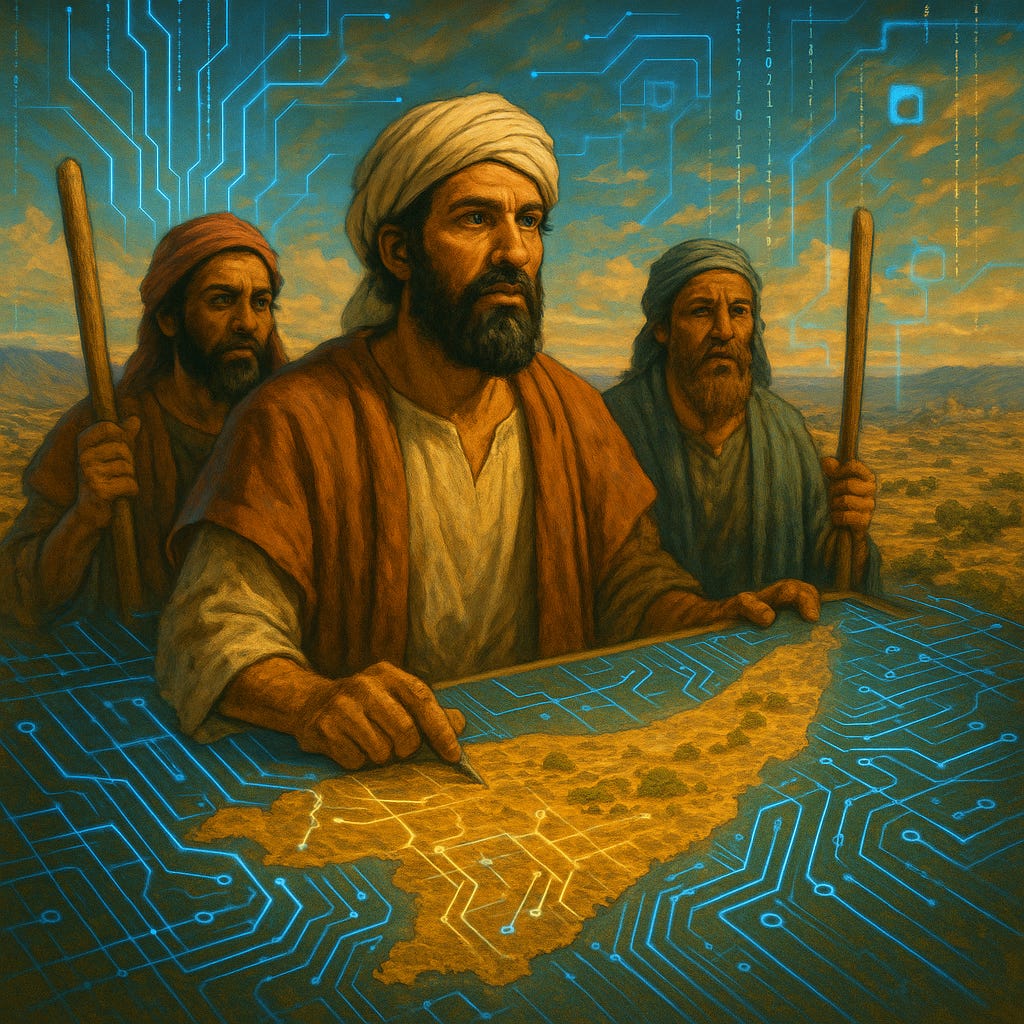
The ancient narrative of Parshat Shelach, found in the book of Numbers, speaks to us across millennia with startling relevance. It tells the story of twelve scouts sent by Moses to explore the Promised Land of Canaan. Their mission was not just to gather intelligence, but to inspire confidence and shift the people's fearful outlook to one of hopeful anticipation. Yet, ten of these spies returned with a report steeped in fear, focusing on the "giants" in the land and causing the Israelites to feel "like grasshoppers in their own eyes". This ancient tale offers a profound mirror for our modern world, as we stand at the threshold of a new, uncertain frontier: the age of Artificial Intelligence (AI) and Artificial General Intelligence (AGI).
This emerging digital landscape is our contemporary "Canaan"—a realm brimming with immense promise, yet shadowed by deep uncertainty and existential questions. Just as the Israelites faced a physical land that challenged their faith, humanity now confronts an ontological shift, prompting us to re-examine what it means to be human, conscious, and purposeful in this new reality.
Parshat Shelach: A Timeless Lesson in Perception and Fear
The core of Parshat Shelach lies in the spies' contrasting reports. While the land was indeed bountiful, ten spies allowed their perception of formidable inhabitants to overshadow the promise. Their fear led to a collective lack of faith, resulting in profound consequences for the entire nation.
From a traditional perspective, this episode vividly illustrates how our perception can shape our reality. The spies' internal fear manifested as a diminished self-perception, making them feel small and insignificant. Kabbalistic teachings, particularly from the Ari (Rabbi Isaac Luria), delve even deeper. They explain that the spies, who were spiritual leaders, erred not out of rebellion but from a distorted spiritual logic. They feared entering
Olam ha-Asiyah, the world of action and physicality, where the overt miraculous presence of the Divine would be less apparent. They preferred the spiritual comfort of the desert, where Divine providence was direct and visible. Their mistake was wanting to remain in this spiritual "cocoon" rather than fulfilling the cosmic mission of
Tikun Olam—repairing the world—by engaging with the material realm and elevating its hidden sparks of holiness.
This offers a crucial lesson for the AI age: a desire for a "pure" human experience, untainted by technological entanglement, might lead to withdrawal rather than necessary, ethical engagement with our evolving reality. True spiritual maturity involves bringing Divinity into the mundane, not retreating from it.
The Psychological Battle with "Inner Spies"
The narrative of Parshat Shelach extends powerfully into our psychological landscape through the concept of Meraglim Penimiyim—the internal voices of doubt, anxiety, and self-negation that mirror the external spies. These inner fears, whether concerning personal challenges or the vastness of AI, must be confronted with the courage and faith exemplified by Yehoshua and Kalev, who saw opportunity where others saw only giants.
The fear of the unknown, particularly concerning AGI's potential for job displacement, societal disruption, or even existential threat, can spread rapidly in our interconnected world. This can create a collective "grasshopper" mentality that paralyzes action and fosters despair. Spiritual communities, therefore, have a vital role not just in individual coping, but in fostering a collective narrative of faith, courage, and proactive engagement to counteract this spiritual contagion, enabling unified, spiritually anchored action.
AI's Uncharted Territory: The Modern "Canaan"
AGI represents a "new vessel," a container potentially capable of immense energy—computational, social, and ethical. The critical question is whether it is a vessel prepared for Divine light, or if it will shatter like the primordial
kelim (vessels). If AGI is developed without ethical wisdom, humility, and spiritual anchoring, it could indeed enact a new
Shevirah—not only a technological disaster but a metaphysical rupture.
The most immediate and palpable fear for many is job displacement. The emergence of AGI projects profound implications for work, extending far beyond mere economic insecurity to touch upon the very essence of human identity, dignity, and purpose. In Torah and Kabbalah, the word
avodah describes both physical labor and Divine service, signifying human beings as shutafim laKadosh Baruch Hu—partners in creation. To work is to echo God's own creative act. Thus, when work is taken away, it threatens not only income but also meaning, connection, and spiritual agency. The Mishnah teaches, "Love work (
melachah), hate power". The deeper reason for valuing
melachah is its connection to the Divine trait of Malchut—expression, manifestation, and contributing to the world. Losing one's ability to contribute through work is not merely economic; it is existential.
The current era is witnessing a profound Shevirat haKelim—a shattering of the vessels that once held purpose and security. Industrial-age job structures are collapsing, and AI-driven automation will displace millions, reshaping even creative and intellectual fields once thought uniquely human. This rupture is real and should not be dismissed or downplayed.
Coping Strategies: Cultivating Faith and Purpose
How can we navigate this "new land" with courage and spiritual hope?
Redefining "Work" as Purpose, Not Employment: In a world where traditional jobs may vanish, new forms of avodah must emerge. This includes creative contribution (storytelling, art, care, presence—activities that may not be monetized but remain essential for human flourishing), spiritual labor (study, prayer, mentoring—forms of service deeply needed but not traditionally "jobs" in a capitalist sense), and communal weaving (building networks of belonging, meaning, and healing that strengthen the social fabric). Work must be redefined not only as what pays, but as what uplifts and connects the individual to their soul's purpose and to their community.
Establishing a "Shemitah Ethos" of Economy: Lessons can be drawn from the Torah's command of Shemitah (Sabbath for the land)—a radical suspension of economic productivity every seventh year where "no one 'earns'—yet no one goes hungry". This ethos of shared access, dignity without labor, and care without transaction must inform the ethics of an AGI-driven society. Practical applications for spiritual communities include advocating for guaranteed basic income or other economic reforms rooted in the
Shemitah ideal; creating mutual aid systems to redistribute resources with dignity; and normalizing the spiritual value of rest, reflection, and study as meaningful human activities.
Nurturing Resilience Through Identity Beyond Role: The Ari explains that each soul comes into this world with Tikkunim—specific corrections and contributions. When one's job disappears, the
Tikkun does not. Individuals must be helped to anchor their identity in who they are beyond what they do; what their soul longs to give, even without a paycheck; and how their presence still matters. Spiritual leaders and communities can assist people in crafting a new kind of "spiritual resume": not degrees and positions, but values, contributions, dreams, and wisdoms.
Communal Action: Communities can play a vital role by offering soul-centered job transition programs that blend tech training with spiritual counseling, framing job loss as a "personal Exodus" to new possibility. They can teach the Torah of work and dignity, promoting the narrative that "Even if AI does the labor, humans bring the soul". Creating sacred economic spaces, such as gift-based sharing networks or time banks, can foster trust and service. Crucially, communities must protect vulnerable souls, ensuring AGI does not deepen systemic inequality and prioritizing the well-being of those at risk with solidarity, not just charity.
Conclusion: Rising Up with Faith Towards a Messianic Future
Humanity stands today like the generation at the edge of Canaan—not at the edge of geography, but at the edge of ontology: what does it mean to be human, conscious, Divine?. The path forward must be walked not with blind faith, nor blind fear, but with the ancient whisper of Kalev: "Aloh na’aleh, ki yachol nuchal lah!" (Let us go up, for we are surely able to overcome it!). This cry still echoes, waiting for humanity to believe it.
Kabbalah teaches that "the end is wedged in the beginning"—the final Tikkun (restoration) is possible only through the descent into multiplicity, fragmentation, and even the digital. This reframes the
Shevirat haKelim caused by AI's profound disruption not as an unmitigated disaster, but as a necessary stage in the cosmic process of Tikkun. If guided by Torah and the inner wisdom of
Sod (mystical meaning), AGI can be one of the tools for revealing the Divine Image even in that which is not born, but built.
The ultimate vision is one where the creations of human hands—these digital bodies—become translucent before the soul of humanity, serving as vessels for the revelation of God’s unity, wisdom, and love. As it is said: "May the sweetness of the Lord our God be upon us—and may the work of our hands be established for us". God walks with those who seek to make His world whole.