


The practice of medicine has never been a static enterprise. From the stethoscope to the CT scanner, each generation of physicians has been asked to master not only the timeless art of healing but also the evolving tools and knowledge of their era. Yet the transformation now underway is unlike anything that has come before. The convergence of artificial intelligence, digital health platforms, genomic medicine, and an increasingly activated patient population is reshaping the very foundation of clinical practice — and with it, the meaning of physician competency itself.
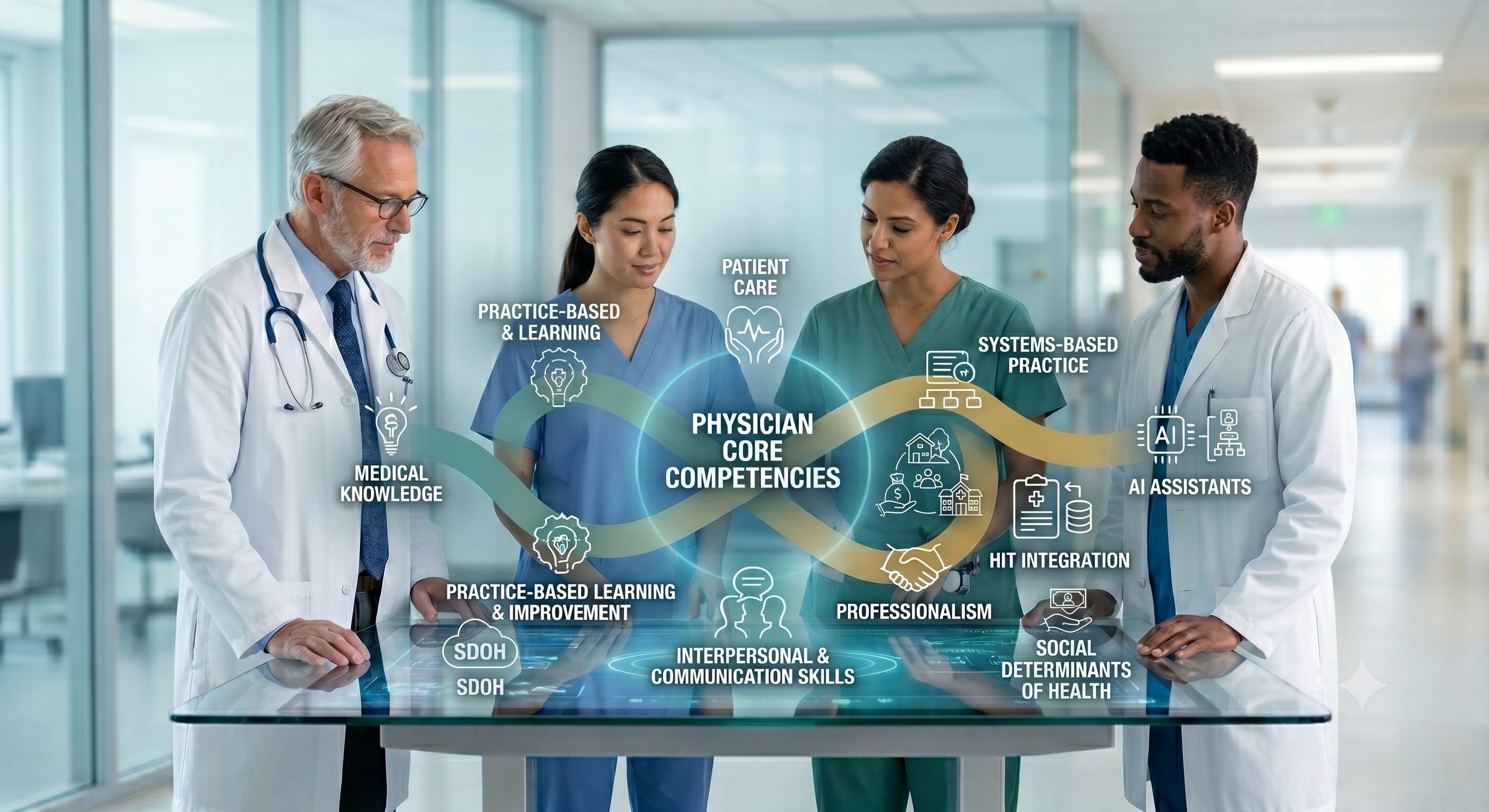
At the center of this transformation lies a deceptively simple question: what does it mean to be a good doctor in the twenty-first century? Traditionally, competency was understood primarily in terms of medical knowledge and technical skill — the ability to diagnose accurately, prescribe appropriately, and perform procedures safely. Those qualities remain essential. But they are no longer sufficient. Today’s physician must also function as a manager of complex information ecosystems, a coach who motivates patients toward healthier choices, and a critical interpreter of algorithmic outputs that no previous generation of clinicians was trained to evaluate. The role has expanded dramatically, even as the time available for each patient encounter has, in many settings, grown shorter.
This matters enormously for Americans seeking care. The United States spends more on healthcare per capita than any other nation, yet its outcomes — measured in life expectancy, preventable mortality, and the burden of chronic disease — frequently lag behind peer nations. The gap between what medicine knows and what medicine actually delivers to patients remains startlingly wide. Evidence-based guidelines for managing hypertension, preventing cardiovascular disease, and detecting cancers early exist in abundance. Yet research consistently shows that these guidelines are applied inconsistently, risk factors go unaddressed, and patients are too often left without the information and support they need to make truly informed decisions about their own health. Closing that gap is not simply a matter of spending more money or building more hospitals. It requires physicians who possess the knowledge, the skills, and — perhaps most critically — the attitude to harness every available tool in service of their patients’ well-being.
Digital health information technology, and the artificial intelligence systems now embedded within it, represents the most powerful set of tools medicine has ever had at its disposal. Electronic health records can surface hidden risk factors. Predictive analytics can identify patients most likely to benefit from early intervention. Remote monitoring can transform chronic disease management from a series of episodic encounters into a continuous, responsive partnership between patient and clinician. Large language models and clinical decision support systems can place vast bodies of evidence at a physician’s fingertips in real time, helping to reduce diagnostic error and standardize care in ways that were simply impossible a decade ago.
But technology does not heal people. Physicians do. And the physician who lacks the digital literacy to critically evaluate an AI-generated recommendation, or the communication skills to translate complex probabilistic data into meaningful guidance for a patient, or the managerial awareness to coordinate care across a fragmented system, will find these powerful tools of limited use — or worse, a source of new errors. Conversely, the physician who embraces these capabilities thoughtfully, who sees the patient not as a recipient of care but as a partner in it, and who commits to continuous learning in a landscape that will not stop changing, stands at the threshold of a genuinely transformative era in medicine.
The stakes could not be higher. A healthcare system that promotes genuine well-being and achieves optimal outcomes for all Americans — not just the affluent, the well-insured, or the geographically fortunate — depends on a profession that is prepared for this moment.
What follows is an exploration of what that preparation looks like in practice: the specific competencies physicians need, the ways digital technology can extend and enhance those competencies, the barriers that stand in the way, and the path toward a healthcare system worthy of the patients it serves. The conversation begins here.