

Parashat Pinchas: Rabin's Murder
Was Pinchas a hero or a fanatic? Did his zeal heal the people—or scar them?

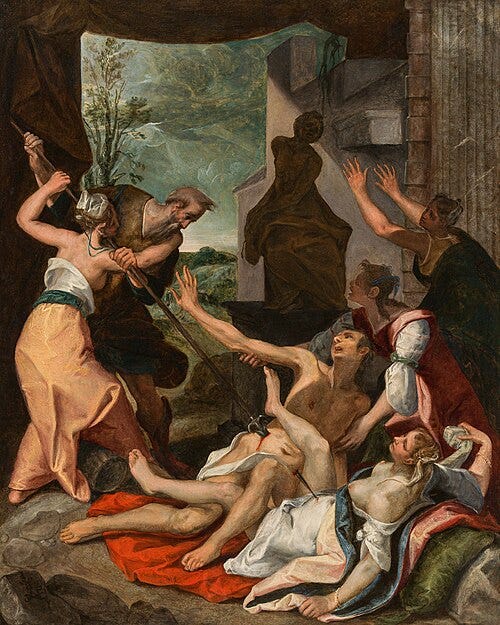
This week’s Torah portion, Parashat Pinchas (Numbers 25:10–30:1), opens with one of the most controversial moments in the Hebrew Bible. In a single act of violent zealotry, Pinchas, the grandson of Aaron the High Priest, spears an Israelite leader and a Midianite woman in the midst of their public transgression. His action halts a deadly plague ravaging the Israelites, and God responds by granting him a “covenant of peace.”
For centuries, commentators have wrestled with this story. Was Pinchas’s act righteous or reckless? Does his zeal provide a model for decisive moral action—or a warning about the dangers of religious extremism?
These questions are not confined to the desert of ancient Israel. In our own time, zealotry cloaked in religious language has shaped some of the most consequential events in Israeli history—including the assassination of Yitzhak Rabin—and continues to reverberate in today’s political landscape and conflicts.
In exploring Pinchas’s zeal, we confront a deeper question: how do we distinguish between passion that heals and zeal that destroys?
“The settlement movement is comparable to a cancer in the tissue of Israel’s democratic society.”
—Yitzhak Rabin, 1976
When Yigal Amir pulled the trigger on Yitzhak Rabin in November 1995, he didn’t see himself as a murderer. He saw himself as a savior. Like Pinchas, the biblical zealot who speared Zimri and Cozbi to halt a plague, Amir believed he was acting in the name of God to rescue Israel from a dangerous leader. Rabin’s pursuit of the Oslo Accords, in Amir’s eyes, was nothing less than treason against the divine covenant with the Jewish people.
Nearly three decades later, Rabin’s murder feels less like a historical aberration and more like a harbinger. What was once a fringe ideology—religious-nationalist zealotry anchored in messianic fervor—has metastasized into the political mainstream. It animates settlement expansion, annexationist policies, and even the language of top Israeli leaders who speak of Palestinians as Amalek, an enemy to be utterly destroyed.
And now, in the flames of the Israeli-Gaza war, the aftershocks of that ideology are all too visible. Military campaigns framed as holy wars, settler violence surging in the West Bank, and political rhetoric infused with apocalyptic tones suggest that the Pinchas archetype has not only survived but evolved into a collective mindset.
This raises uncomfortable questions: Are we witnessing the rise of modern Pinchases? And if so, what does Jewish tradition itself teach about the danger of such zealotry—and how to confront it without replicating its destructive fire?
🌿 Pinchas in the Wilderness: An Archetype of Zeal
The biblical Pinchas appears at a moment of profound moral collapse. The Israelites, weary and disoriented in their desert wanderings, turn to sexual immorality and idol worship with the women of Midian. As a plague sweeps the camp, Moses stands silent. Into this vacuum steps Pinchas. Seeing Zimri, an Israelite prince, consorting with Cozbi, a Midianite woman, Pinchas drives a spear through them both. His act stops the plague.
God rewards him:
“Pinchas… has turned My wrath away from the Israelites by being zealous with My jealousy… Therefore I grant him My covenant of peace.” (Numbers 25:11–12)
For generations, this story has provoked discomfort. Was Pinchas a hero or a fanatic? Did his zeal heal the people—or scar them?
The mystical tradition offers a critical insight. In the Torah scroll, the word shalom (“peace”) in God’s covenant is written with a broken vav—a subtle fissure in the letter. Isaac Luria (the Ari) teaches that this fracture symbolizes the incompleteness of Pinchas’s peace. His act may have stopped the immediate crisis, but it left behind a wound in the collective soul. Zealotry, even in service of the sacred, is a dangerous fire. It purifies or destroys depending on its source.
🔥 Rabin’s Assassin: A Pinchas Gone Wrong
Yigal Amir drew directly on the archetype of Pinchas. He was not a madman acting alone but the product of a religious subculture that sees the settlement of the biblical Land of Israel as a divine imperative. Influenced by teachings rooted in Rabbi Zvi Yehuda Kook’s vision of redemption, Amir and his circle believed that surrendering land was not merely a political mistake but a sin against God’s plan.
In their narrative, Rabin became Zimri—leading the people into desecration by shaking hands with Yasser Arafat and negotiating away parts of Greater Israel. Amir invoked halachic concepts like din rodef (the law allowing one to kill a “pursuer” endangering Jewish lives) and din moser (the informer law) to justify his act.
But there was no divine plague, no prophetic silence, no clear mandate from heaven. Unlike Pinchas, whose act the Torah frames as utterly selfless and aligned with divine will, Amir’s zeal was born of ideological certainty, fear, and hatred. His fire was not the sacred kinah (jealousy for God) but a counterfeit—what Kabbalah calls a klipah, a husk mimicking holiness but severed from its source.
🕯 Zealotry as a Collective Consciousness
The tragedy of Rabin’s assassination is not just that it happened, but that its ideological seeds have flourished. Movements once considered fringe—Gush Emunim, Hilltop Youth, and now the Religious Zionist Party—have shaped a new Israeli reality. Messianic fervor drives relentless settlement expansion, opposition to Palestinian statehood, and even judicial overhauls aimed at clearing obstacles to annexation.
This ideology now directly impacts the Israeli-Gaza war. Settler violence in the West Bank has surged since October 7, 2023, with documented attacks on Palestinian communities and property. Cabinet ministers openly advocate for mass displacement of Gaza’s population. The language of war is suffused with biblical references to Amalek and divine vengeance, sacralizing military action and discouraging restraint.
This is no longer the act of one zealot with a pistol. It is a collective consciousness—a society increasingly animated by the spirit of Pinchas but detached from his divine alignment.
✡️ Beyond the Spear: How Do We Deal with Zealotry in Practice?
If religious-nationalist zealotry is a distortion of holy passion—a fire without boundaries—then how does a society extinguish it without being consumed by its own reactive flames? Jewish tradition, for all its complexity around zeal, offers clues for a multi-layered response.
🕯 1. Legal: Drawing Clear Boundaries
Prosecute incitement and violence consistently, even when it comes from powerful rabbis or settler leaders.
Expand the Shin Bet’s mandate to monitor extremist networks without political interference.
Restore red lines in public discourse so that talk of “Amalek” or “rodef” applied to political opponents is delegitimized.
📚 2. Educational: Reclaiming Jewish Texts and Values
Support mechinot (pre-army academies) and yeshivot that integrate Torah with democracy and human rights.
Promote alternative religious voices emphasizing coexistence as a Jewish value.
Teach Kabbalistic concepts like tikkun olam and hamtakat ha-dinim to counter absolutist, punitive readings of tradition.
🏘 3. Communal: Creating Spaces for Moral Courage
Build networks of religious and secular leaders willing to publicly challenge messianic violence.
Encourage diaspora Jewish organizations to speak out, recognizing that unconditional support fuels zealotry’s confidence.
Strengthen civil society groups like Breaking the Silence, Tag Meir, and Yesh Din to challenge extremist violence and reframe national narratives.
✨ Conclusion: Healing the Broken Vav
Rabin foresaw the danger. In 1976, he described the nascent West Bank settlement movement as “a cancer in the tissue of Israel’s democratic society.” Today, that movement has grown into a dominant political force, shaping the conflict and narrowing the space for peace.
The broken vav in Pinchas’s shalom is a warning. Peace achieved through zealotry is fractured. True brit shalom—a covenant of peace—requires courage of a different kind: the courage to listen, to compromise, to honor both the particular covenant with the Jewish people and the universal image of God in every human being.
The Exodus is not over. The wilderness is within us still. The question for Israel, and for Jews everywhere, is whether we will repeat the mistakes of katnut ha-daat—smallness of mind—or rise into gadlut ha-daat, an expansive consciousness that can hold fire and water, justice and mercy, land and peace.
📌 Action Is Urgent
This is not a theoretical debate. As the Gaza war burns on and settler violence escalates, Israelis and diaspora Jews must ask: what kind of covenant do we seek? The spear of Pinchas stopped one plague, but it will not stop this one. Only the healing of the broken vav—through law, education, and moral courage—can prevent zealotry from consuming the very soul of Israel’s democracy.