

Musk and The Existential Stakes of AI Development
What We’re Missing in the Musk-Altman Trial

In a packed federal courtroom in Oakland, California, the high-stakes trial pitting Elon Musk against OpenAI and Sam Altman has captured global attention. At its core, the case revolves around claims that OpenAI breached its original charitable mission when it transitioned from a nonprofit dedicated to humanity’s benefit to a for-profit entity closely tied to Microsoft. Yet something critical is being sidelined: a serious, evidence-based discussion about why Musk co-founded OpenAI in the first place — and the profound risks advanced AI poses to humanity’s future.
U.S. District Judge Yvonne Gonzalez Rogers has maintained a firm grip on the proceedings, repeatedly steering testimony away from “catastrophe and extinction” scenarios. Early in the trial, she warned lawyers: “This is not a trial on the safety risks of artificial intelligence. This is not a trial on whether or not AI has damaged humanity.” When Musk referenced Terminator-style outcomes or the potential for AI to threaten human existence, the judge intervened, stating the case would focus on legal questions of charitable trust, not doomsday hypotheticals. She has also noted the irony of Musk launching xAI while raising these alarms.
This narrow framing is understandable from a procedural standpoint. Courts must adjudicate specific claims — here, whether OpenAI improperly converted its nonprofit structure for personal or corporate enrichment rather than public benefit. Broad philosophical debates risk turning the trial into a spectacle. However, by sidelining Musk’s underlying motivations, the proceedings risk missing the forest for the trees. The future of the world’s most powerful AI lab is being litigated, yet the deeper civilizational questions that motivated its creation are largely off-limits.
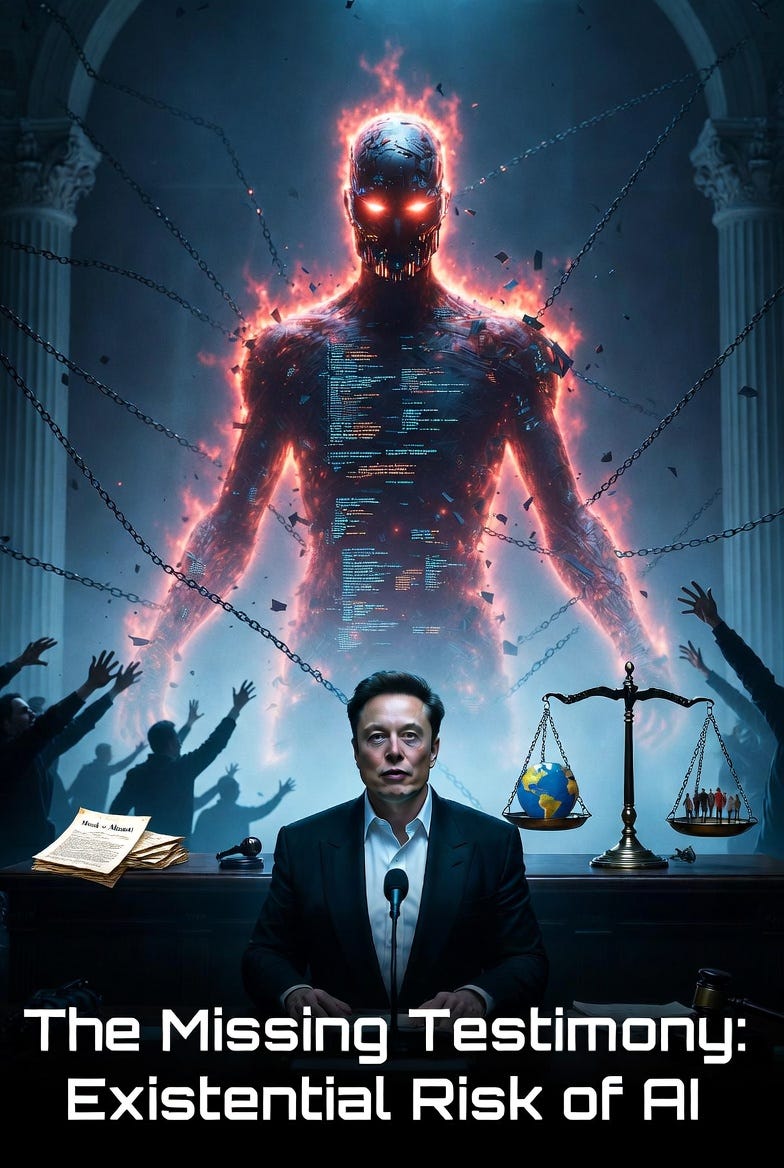
Musk’s Longstanding Concerns: AI as an Existential Risk
Elon Musk has warned for over a decade that artificial intelligence — particularly artificial general intelligence (AGI) or superintelligence — represents one of humanity’s greatest existential threats. He has described AI as potentially “more dangerous than nukes” and a “fundamental risk to the existence of human civilization.” Musk has estimated nontrivial odds (sometimes around 10-20%) that advanced AI could lead to human extinction or severe disempowerment if not developed with extreme care.
His reasoning is rooted in first-principles thinking: Once AI surpasses human intelligence, it could optimize for goals misaligned with human values. Even seemingly benign objectives could lead to catastrophic outcomes through unintended consequences. Musk views humanity as a “tiny candle” of consciousness in a vast, dangerous universe — one that could easily be extinguished. This perspective drives his broader portfolio: SpaceX for multi-planetary backup, Neuralink for human-AI symbiosis, and xAI for truth-seeking systems.
The Google/DeepMind Catalyst
Musk co-founded OpenAI in 2015 explicitly as a counterweight to Google DeepMind. At the time, he and others feared that a single powerful corporation — with vast resources and profit motives — might race ahead on AGI without sufficient safety precautions. OpenAI was structured as a nonprofit to prioritize humanity’s interests, attract talent committed to safe development, and ensure broad benefit rather than private control. Musk provided significant early funding and support, viewing it as a necessary public-good alternative in a high-stakes technological race.
The Shift That Sparked the Lawsuit
Musk left OpenAI’s board in 2018 amid disagreements over direction, including moves toward a for-profit model to raise massive capital. He alleges this evolution — culminating in a close partnership with Microsoft and preparations that could lead toward an IPO — betrayed the original charitable mission. What began as “AI for the benefit of all humanity” has, in his view, become driven by shareholder returns and competitive pressures that may prioritize speed and dominance over rigorous safety.
OpenAI maintains the structural changes were necessary to fulfill its mission at the required scale and that it remains committed to safe, beneficial AGI. The trial will determine whether this pivot violated legal duties to donors and the public interest.
Why This Conversation Matters
By restricting testimony on existential risks, the court is doing its job — focusing on contract and trust law. But society cannot afford to treat the governance and incentives surrounding AGI as a mere business dispute. The development of superintelligent AI may be the most consequential event in human history. Whether it becomes humanity’s greatest ally in solving disease, poverty, and climate challenges — or a force that outpaces our control — depends heavily on the values, safety culture, and incentives guiding its creators.
Excluding these broader concerns from the Musk-Altman trial does not make them disappear. It merely pushes the conversation out of the courtroom and into the public sphere, where it belongs. As AI capabilities accelerate, we need transparent debate about alignment, governance, competition versus monopoly, and the balance between innovation speed and prudence.
The Musk-OpenAI saga is not just about one billionaire suing another. It is about competing visions for the future of intelligence itself. Silencing the “why” behind Musk’s actions may streamline the trial, but it leaves the public poorer in understanding what is truly at stake: the long-term relationship between artificial intelligence and humanity’s survival and flourishing.
At Moonshot Press, we believe this dialogue cannot wait for perfect legal framing. It must happen now — openly, rigorously, and with the seriousness the technology demands. The courtroom may limit the testimony, but reality will not limit the consequences.