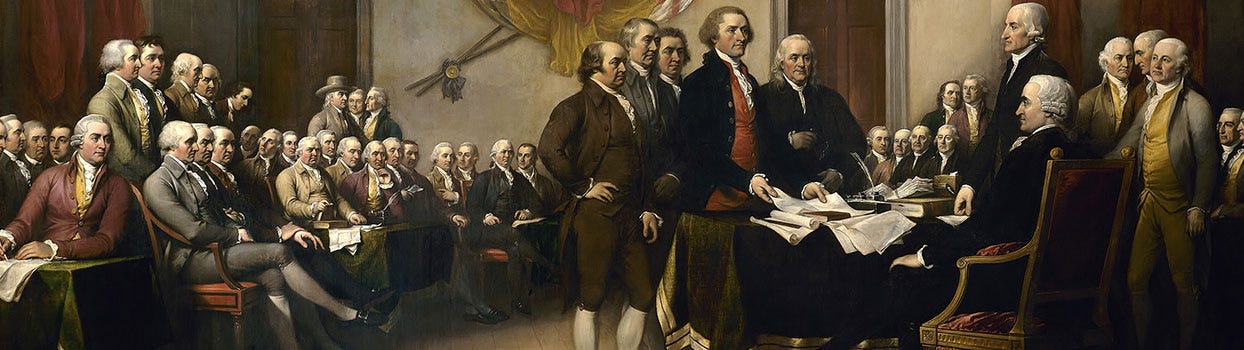

Declaration to Constitution — Article One
Declaration to Constitution begins with James Madison’s diagnosis of the central danger facing republican government: faction animated by passion and interest. This installment asks how a free society can manage those forces without destroying the liberty that gives them life.
A Sunday at the Constitution Center
On a hot Sunday afternoon in August 2009, I sat inside the National Constitution Center in Philadelphia and watched American democracy become emotional.
Just outside stood Independence Hall, where the Declaration of Independence had been adopted and the Constitution debated. Inside, Health and Human Services Secretary Kathleen Sebelius and Pennsylvania Senator Arlen Specter were holding a town hall meeting about healthcare reform.
The subject was healthcare. The atmosphere was about much more.
The room was crowded and charged. Questions about insurance, cost, government authority, and access to care were met with cheers, jeers, and interruptions. Some people feared that Washington was preparing to take greater control over deeply personal decisions. Others feared that a healthcare system already failing millions of Americans would remain unchanged.
At a building devoted to the American practice of self-government, we were having difficulty governing the argument.
As a psychiatrist, I had spent much of my professional life listening beneath the surface of what people said. Anger can contain fear. Certainty can protect against helplessness. A demand for control may arise when someone feels that important decisions are being made by distant institutions that neither see nor hear them.
I could not know what any individual in that room was feeling. Nor should political disagreement be reduced to psychology. People had real interests, moral commitments, and policy arguments. But I recognized familiar human responses to threat: fear of loss, fear of abandonment, fear of being deceived, fear that one’s identity and way of life were no longer secure.
The positions differed. The underlying experience often rhymed: Something important is happening to us, and we do not trust the people controlling it.
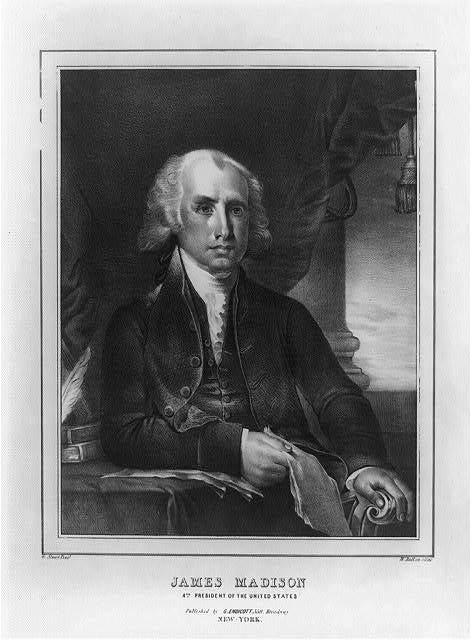
That afternoon became a civic turning point for me. It led me back to James Madison—not only Madison the founder, but Madison the diagnostician of republican government.
Madison’s Diagnosis
Madison was not a physician. Yet the method he brought to politics often resembles disciplined clinical reasoning.
Before the Constitutional Convention, he studied the failures of ancient and modern confederacies. In his 1787 memorandum Vices of the Political System of the United States, he catalogued recurring breakdowns in the young nation: unstable laws, weak national authority, conflicts among states, and majorities willing to violate private rights. He did not treat each crisis as an isolated outrage. He looked for patterns, underlying causes, and the ways different failures reinforced one another.
His most enduring diagnosis was faction.
In Federalist No. 10, Madison described a faction as a group of citizens—whether a minority or a majority—united by a shared passion or interest that becomes adverse to the rights of others or to the lasting interests of the community.
The precision of the definition matters.
Madison did not define faction as disagreement. He did not condemn citizens for organizing around beliefs, economic interests, religious convictions, regional concerns, or demands for reform. Such differences are unavoidable in a free society. They can also be productive. They bring injuries to public attention, challenge complacency, and allow citizens to pursue competing visions of the common good.
Faction begins when passion, interest, and power combine in a way that places victory above justice.
Opponents cease to be fellow citizens and become enemies to be defeated. Facts are judged by whether they help the cause. Institutions are respected only when they deliver the desired result. Rights become protections for allies rather than principles that apply across disagreement.
The gravest danger, Madison believed, was not merely a noisy minority. It was a majority faction with enough power to make its immediate desire appear identical to the public good.
The False Cures
Madison’s deepest insight may have been his rejection of treatments that would destroy the freedom they claimed to protect.
He considered two ways of removing the causes of faction.
The first was to destroy liberty. The second was to give every citizen the same opinions, passions, and interests.
The first cure was worse than the disease. “Liberty is to faction what air is to fire,” Madison wrote. Freedom allows factions to form, but it also allows conscience, worship, association, dissent, journalism, political opposition, and movements for reform. A government powerful enough to prevent faction from organizing would also be powerful enough to prevent citizens from resisting injustice.
The second cure—uniformity—was impossible without coercion. Human beings do not have identical experiences, interests, beliefs, memories, or judgments. A society that permits people to think will produce disagreement.
This remains a difficult democratic truth. When conflict becomes frightening, every faction is tempted by some version of the same false cure: silence the dangerous voices, disable the opposing movement, place our own side beyond challenge, or impose unity before trust has been earned.
But a coerced consensus is not republican unity. It is submission.
Madison refused the fantasy that a healthy republic could be created by removing difference. The task was to preserve liberty while preventing difference from becoming domination.
Passion Is Not the Enemy
Madison’s concern with passion can make him sound suspicious of emotion itself. That would be a mistake.
Democracy needs passion.
The love of liberty is a passion. So are the demand for justice, anger at corruption, loyalty to community, grief after public tragedy, and hope that institutions can be made better. The movements that abolished slavery, expanded political membership, protected workers, and advanced civil rights did not arise from detached calculation. They were animated by moral conviction and powerful feeling.
Emotion carries information. Fear tells us that something feels threatened. Anger may reveal injury or injustice. Grief tells us that something valued has been lost. Shame may expose a wound to dignity or belonging.
But emotion is not automatically an accurate explanation of events, and it is not always a wise guide to action.
Fear can become vigilance—or persecution.
Anger can become reform—or vengeance.
Loyalty can become public service—or blind submission.
Distrust can become accountability—or conspiracy.
Hope can become sustained action—or fantasy.
The problem is not passion. The problem is passion becoming politically sovereign—answerable to no evidence, no competing interest, no constitutional right, and no institution capable of restraint.
In personal life, maturity requires some space between feeling and action. A republic needs that space as well: time to gather facts, hear competing claims, consider consequences, protect rights, and ask whether the remedy will create greater harm.
Madison’s Constitution was meant to help create that space.
The Republican Remedy
Because the causes of faction could not safely be removed, Madison turned to controlling its effects.
The Constitution was not designed to make Americans agree. It was designed to make disagreement governable.
Representation would place some distance between immediate public impulse and governmental decision. A large republic would contain many communities and interests, making it harder for a single faction to dominate the whole. Public power would be divided so that ambition and authority would encounter counterweights rather than accumulate without resistance.
These mechanisms did not depend on the belief that leaders would always be wise or virtuous. They assumed that officials, like citizens, would possess interests, loyalties, ambitions, and blind spots.
The constitutional remedy was therefore not a cure for human nature. It was an architecture built around it.
The detailed workings of that architecture—representation, separated powers, federalism, and the extended republic—will be examined later in this series. For now, the central point is simpler:
Madison approached political conflict as a permanent condition of freedom to be understood and constitutionally managed, not an enemy to be eliminated.
The Constitution would not abolish passion. It would require passion to encounter other passions.
It would not eliminate interest. It would prevent one interest from easily becoming absolute.
It would not promise harmony. It would protect the possibility of continuing together after disagreement.
An Incomplete Founder, an Enduring Method
To learn from Madison does not require turning him into a marble saint.
Madison enslaved human beings at Montpelier. The Constitution he helped create protected slavery and excluded most of the population from equal political membership. People whose labor sustained his world were denied the liberty and standing his republican theory claimed to defend.
This contradiction is not a footnote to the constitutional story. It is part of the diagnosis.
Madison understood that a majority could sacrifice the rights of a minority. Yet he lived within—and benefited from—a system that denied an entire people the recognized power to defend their own rights.
The lesson is not that Madison has nothing to teach us. It is that his method must also be applied to Madison and to the constitutional order he helped create.
No founder is beyond examination. No institution is self-correcting. No generation completes the work of aligning American power with the Declaration’s promise of equal human dignity.
Madison’s enduring contribution is therefore not a set of answers to be repeated without question. It is a way of approaching the dangers of self-government.
Study the condition before prescribing the cure.
Listen to the passions without allowing passion to decide everything.
Distinguish legitimate disagreement from the factional pursuit of domination.
Protect liberty even when liberty permits opposition.
Reject remedies that require silence, uniformity, or dehumanization.
Design institutions for imperfect human beings—including ourselves.
The angry room I witnessed in 2009 was not proof that democracy had failed. It was evidence of a democracy struggling to contain fear, distrust, competing interests, and moral urgency within a shared constitutional life.
The challenge was not to make those forces disappear. It was to prevent them from destroying the rights, relationships, and institutions that allow disagreement to continue without becoming permanent political war.
That challenge remains ours.
Can Madison’s method help us examine the modern body politic with clarity, humility, and courage—without demonizing the fellow citizens with whom we must still share a republic?
Next in Declaration to Constitution:
The Promise and the Problem: Why the Declaration Required a Constitution