


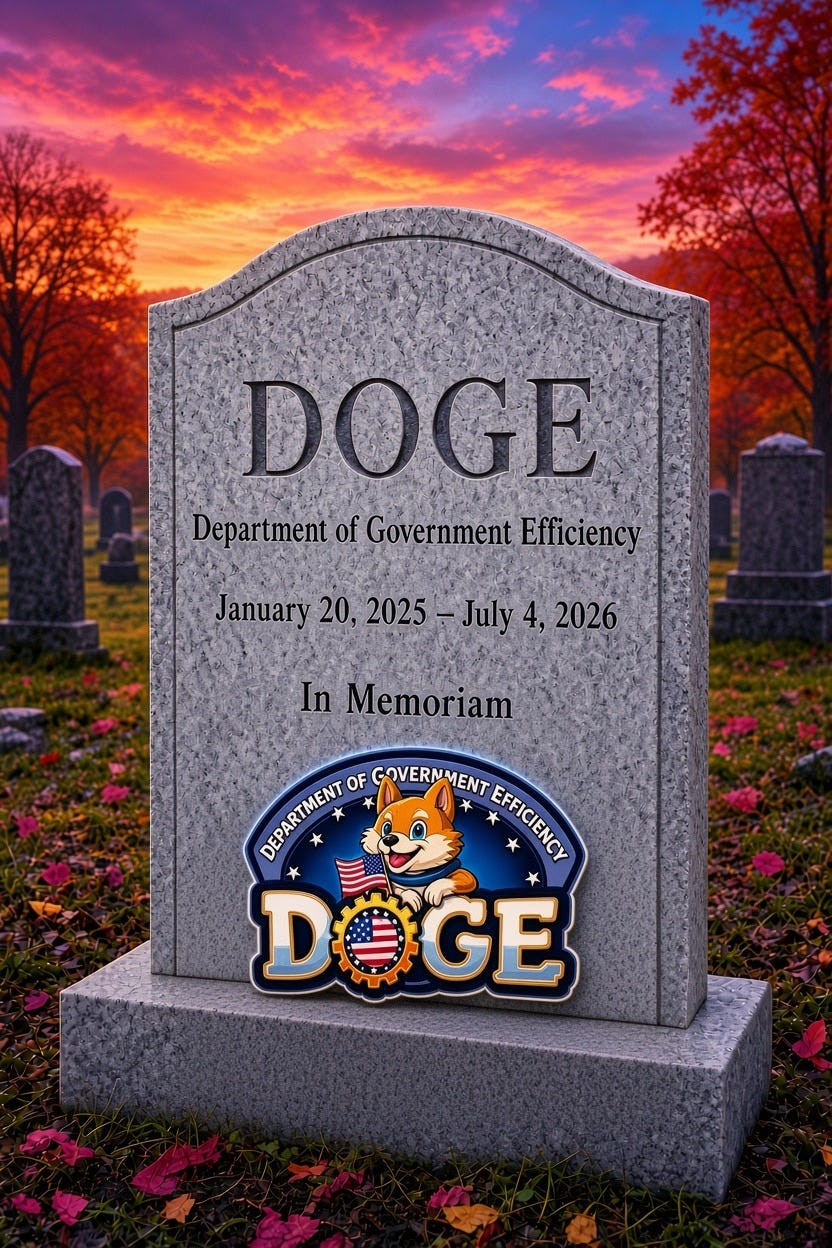
The Department of Government Efficiency, known as DOGE, a temporary federal initiative established to modernize technology and software across the U.S. government in pursuit of greater efficiency and productivity, formally concluded its charter on July 4, 2026. Created by Executive Order on the first day of President Donald Trump’s second term, it was framed as an 18-month effort timed to deliver “a smaller Government, with more efficiency and less bureaucracy” as a gift on the 250th anniversary of the Declaration of Independence.
DOGE emerged from the renaming and reorganization of the preexisting United States Digital Service into the United States DOGE Service within the Executive Office of the President, alongside a temporary organization dedicated to the President’s DOGE agenda. Its stated purpose centered on software modernization, interoperability of agency systems, data integrity, and maximizing governmental efficiency. In practice, its activities expanded to encompass rapid reviews of contracts, grants, leases, regulations, and the federal workforce, reflecting a Silicon Valley-inspired approach of swift disruption, data-driven scrutiny, and public transparency.
Key figures included Elon Musk, who served as a senior adviser and de facto leader in the early months, applying methods drawn from his private-sector experience in cost-cutting and technology overhauls. Vivek Ramaswamy was initially named as a co-leader but departed early to pursue the Republican nomination for governor of Ohio. Amy Gleason served as acting administrator for much of the organization’s life. Supporting teams of engineers, human-resources specialists, attorneys, and special government employees were embedded across agencies, often granted broad access to unclassified records and IT systems. The initiative’s style emphasized urgency, artificial-intelligence tools for identifying inefficiencies, and a public “Wall of Receipts” tracking claimed terminations—initially promised with frequent updates for accountability.
Among its reported activities, DOGE and agency partners terminated or modified thousands of contracts (approximately 13,400 listed, with claimed savings around $61 billion), grants (about 15,800, claimed around $49 billion), and leases (264, claimed about $113 million). Additional efforts targeted duplicative software licenses, underutilized office space, diversity-equity-and-inclusion grants, and programs at agencies including the U.S. Agency for International Development. Workforce measures included a hiring freeze, reductions in force, and a “Fork in the Road” deferred-resignation program that saw roughly 140,000 participants accept continued pay and benefits for a period before departing. Overall federal civilian workforce reductions in 2025 were reported in the range of more than 250,000 to over 270,000 through various channels. Technology modernization initiatives sought digital improvements, such as streamlining retirement processes.
DOGE publicly claimed total estimated savings of approximately $214–215 billion—equating to roughly 1,300–1,335 per taxpayer—through a combination of contract and grant cancellations, lease terminations, asset sales, fraud and improper-payment reductions, programmatic and regulatory changes, interest savings, and workforce reductions. Initial ambitions had been higher, with early targets discussed in the range of $1–2 trillion before later revisions.
Independent reviews, including by the Government Accountability Office and multiple news organizations, found that a substantial portion of the Wall of Receipts figures could not be fully substantiated or reflected overstatements. Examples included contracts listed as terminated that were not, savings calculated on ceiling values rather than actual obligated amounts, credit taken for actions initiated before DOGE’s establishment, double-counting, and insufficient documentation for large shares of grant claims. Federal spending overall continued to rise during the period, and the national debt increased; major entitlement and defense outlays remained largely untouched. Some workforce reductions later faced legal challenges, with partial rehiring reported at certain agencies. Critics highlighted operational disruptions, while supporters pointed to concrete terminations of wasteful spending and a cultural shift toward scrutiny of taxpayer dollars.
The temporary organization effectively wound down earlier in late 2025, with functions absorbed into entities such as the Office of Personnel Management, though its formal sunset remained July 4, 2026. In a final message on its X account that day, DOGE stated: “While the formal mission of DOGE has come to an end, the mission to eliminate waste, fraud, and abuse will continue. Good stewardship of taxpayer dollars and accountable government are not temporary initiatives.” Remnants of its personnel and priorities persist in various agencies.
DOGE is survived by ongoing debates over federal efficiency, the practical limits of rapid executive-branch reform, and the enduring challenge of aligning government operations with fiscal restraint. Its brief tenure leaves a record of ambitious intent, measurable disruptions, contested savings claims, and a public experiment in applying private-sector urgency to the machinery of government.
OBITUARY: The Department of Government Efficiency (2025–2026)
NAME: Department of Government Efficiency (USDS / DOGE)
BORN: January 20, 2025 (via Executive Order 14158)
DIED: July 4, 2026 (Disbanded, aged 18 months)
CAUSE OF DEATH: Acute constitutional friction, administrative atrophy, and collision with federal fiscal arithmetic.
Life & Premise
The Department of Government Efficiency (DOGE), later operating as the United States DOGE Service, was born on Inauguration Day 2025 with grand aspirations, Silicon Valley swagger, and a mandate to “move fast and break things” inside the federal bureaucracy.
Conceived as a disruption machine, DOGE arrived promising to prune what it termed a sclerotic administrative state. Armed with meme branding and corporate dashboards, leadership initially proclaimed it would rip $2 trillion in waste out of the federal budget—a figure larger than the government’s entire non-defense discretionary budget and exceeding total annual discretionary appropriations.
The Disruption Arc
During its brief and tempestuous 18-month existence, DOGE sought to treat public administration as an engineering sprint. It centralized database access across sensitive agencies, unilaterally targeted grant programs, and sought to bypass statutory constraints under the guise of post-Chevron executive prerogative.
Its signature public legacy, the “Wall of Receipts” dashboard, claimed tens of billions of dollars in taxpayer savings. However, formal post-mortem audits delivered a sobering reality check:
The Arithmetic Deficit: The initial $2 trillion pledge was continually dialed back down to $500 billion, before actual realized structural savings amounted to only a fraction of those claims.
Watchdog Accounting: According to audits by the Government Accountability Office (GAO), the dashboard suffered from severe data quality issues. GAO revealed that over 96% of grant cuts lacked verifiable calculation methodologies, more than 100 terminated leases had already been slated for closure prior to DOGE’s creation, and multi-billion-dollar contract claims (such as a $1.7 billion defense health IT termination) never actually occurred.
Institutional Collision: Legal challenges under the Administrative Procedure Act (APA), civil service merit protections, and Congressional pushback ground its top-down pruning into administrative deadlock.
Survivors & Succession
DOGE is survived by:
The Office of Personnel Management (OPM), which absorbed its remaining operational remnants;
Thousands of disputed agency spreadsheets, orphaned software dashboards, and unresolved database audit logs;
A refreshed public realization that constitutional checks and balances are structural safeguards, not software bugs.
Civic Memorial & The Path Ahead
DOGE operated on the premise that government is an optimization problem best solved by elite technologists and top-down executive command. Its demise illustrates that true democratic reform cannot be delivered by decree or crowdsourced deletion.
A durable, effective government requires civic excellence over technocratic pruning—replacing top-down cuts with citizen-led audits, transparent public deliberation, and democratic co-creation.
MEMORIAL CONTRIBUTIONS:
In lieu of flowers, the public is encouraged to file Freedom of Information Act (FOIA) requests, participate in public agency comment periods, and engage in local deliberative governance.
For an in-depth video analysis on how DOGE’s initial savings projections compared to post-hoc fiscal reality, watch the WSJ Analysis on DOGE’s Actual Savings, which breaks down the gap between the promised $2 trillion targets and the audited federal budgetary results.