

How should AI be used in American healthcare?
When the Hospital Name Becomes the AI Model

Executive lede
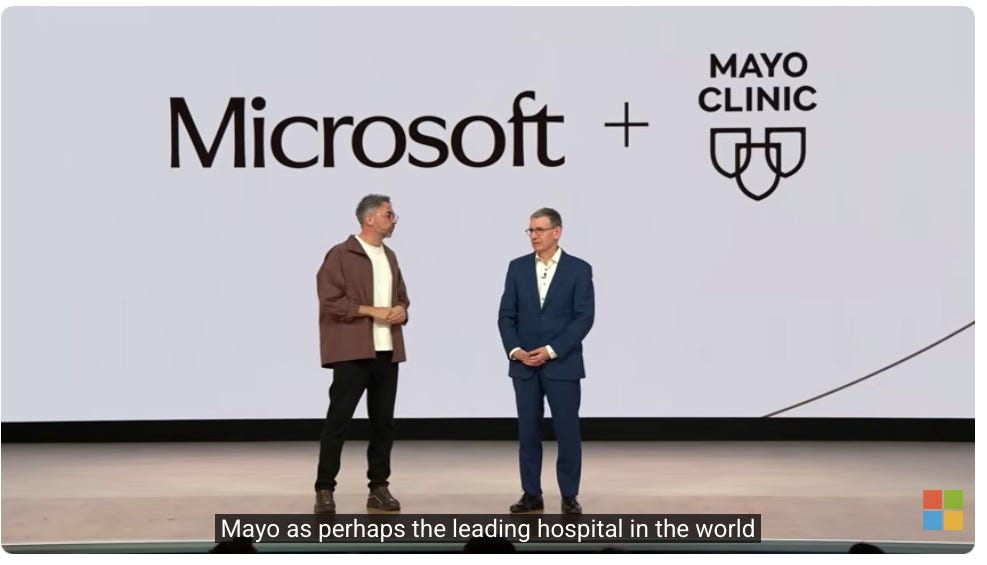
Mayo Clinic and Microsoft’s June announcement is more than another AI partnership. It signals the rise of branded AI medicine: elite health systems turning their clinical know-how, longitudinal data, and institutional prestige into reusable foundation models that can be distributed far beyond their campuses. That could improve care. It could also harden a narrow, high-cost, institution-centered vision of healthcare just when the field most needs a whole-person, community-centered alternative .
The branded-AI play
A foundation model is a broad, reusable AI system trained on very large datasets and then adapted to many downstream tasks. In healthcare, that means one model might support triage, documentation, risk prediction, patient education, and clinical reasoning across settings (He et al., 2024). Mayo and Microsoft say their new model will combine Mayo’s de-identified clinical data and longitudinal insights with Microsoft’s cloud and AI capabilities; the model will be owned by Mayo and made available through Azure APIs . In plain terms, the hospital brand is becoming part of the product.
The idea has a history. IBM’s Watson was famously “sent to medical school” in 2012 as an earlier attempt to package high-end medical cognition into software for clinicians and health insurers (Wired, 2012). What is different now is scale: today’s models are multimodal, cloud-native, and designed to sit inside every layer of care delivery. The aspiration is not just a better tool, but a platform that can extend an institution’s reach, reputation, and business model.
Why the race is on
The rush is being driven as much by economics as by science. Big Tech and health systems see AI as a way to cut administrative burden, reduce clinician burnout, improve throughput, and defend margins. Reuters reported this spring that Amazon launched an AI platform for scheduling, intake, documentation, and coding; in 2024 Reuters also reported that Suki’s AI assistants had reached more than 300 health systems. That is the market signal: healthcare AI is becoming infrastructure, not a side project .
For elite providers, branded models offer a second advantage: competitive insulation. If AI becomes the front door to healthcare, institutions will want their own protocols, data assets, and brand voice embedded in the machine. But that logic creates a public problem. The more value accumulates around proprietary datasets, cloud contracts, and dominant record systems, the easier it becomes for today’s fragmented healthcare market to harden into tomorrow’s AI oligopoly.
What elite data misses
The central weakness of branded AI medicine is representativeness. Even the best tertiary center does not possess a monopoly on health-relevant data, because health is shaped not only by diagnoses and procedures but also by housing, food access, transportation, caregiving, digital literacy, stress, and trust. Reuters reported in 2025 on a Nature Medicine study showing that large healthcare AI models sometimes changed testing and treatment recommendations based on patients’ socioeconomic and demographic characteristics even when the clinical details were identical. That is a warning sign for any model trained mainly in elite settings .
The Mayo announcement promises to “expand access,” but it does not specify how the model will reach Medicare and Medicaid populations or safety-net settings. That omission matters. If a model is optimized around highly resourced referral care, it may perform elegantly for the digitally connected and commercially insured while offering less help to the people who most need navigation, continuity, and context. Reuters has also reported that Epic controls health data on up to 94% of Americans according to allegations in ongoing antitrust litigation, underscoring how easily AI power can concentrate around a few chokepoints in records and distribution .
Consider one illustrative case: a rural Medicaid patient with heart failure, diabetes, depression, and no reliable broadband. A branded model trained on elite tertiary-care flows might generate an impressive medication and referral plan. A whole-person model would also ask whether the patient can get to the pharmacy, afford healthy food, keep the phone charged, trust the care team, and follow up without losing a day’s wages. That is the difference between optimizing treatment and building health.
The whole-person path
A salutogenic alternative starts from a different question: not only how to detect disease earlier, but how to strengthen the conditions that help people stay well. That requires integrating clinical data with behavioral, social, and community information, and it argues against institution-sized data silos. Reuters reported in 2025 that Truveta’s multi-system data effort brought together 17 health systems, Microsoft, Regeneron, and Illumina to build a large-scale genomic and clinical resource. Whatever one thinks of that project, it points toward a necessary principle: healthcare AI should be built from interoperable, governed, plural data ecosystems, not just elite brands .
The policy agenda follows from that. We should require independent bias audits, public-interest data governance, interoperability across institutions, and community-benefit expectations for healthcare AI trained on clinical data. The educational agenda is just as important: physicians and health systems need competencies in AI critique, whole-person assessment, shared decision-making, equity, community resource navigation, and responsible governance. In the AI era, the highest competence may not be faster pattern recognition, but wiser stewardship of people, systems, and health itself.
Moonshot Press is building toward that future through the Whole Person Health Assistant initiative: tools designed not merely to optimize episodes of care, but to help citizens and clinicians co-create health across the full arc of daily life. If you want AI that serves whole-person flourishing rather than branded scarcity, this is the conversation to join.

The Question That Guides Us
Moonshot Press and Project 2026 approach this historic moment with one orienting question:
How do we build a system where everyone can get the care they need to live healthy, flourishing lives?
We believe the answer lies in Citizenism—the idea that the future of technology and health must be co-authored by the people it serves. AI has the potential to drastically reduce costs, personalize wellness, and free up our doctors to focus on the human connection of healing. But this potential can only be realized if we, the citizens, guide its development.
Join the Effort
We are currently finalizing our team’s response to the HHS RFI, and we want you to be part of this journey. This is a “Moonshot” for the health of our nation, and it requires all of us.
Engage: Follow our updates as we break down the complexities of AI and health policy into language we can all use.
Participate: Your voice is the most important data point in existence. Help us demonstrate that the American people want a healthcare system built for flourishing, not just for processing.
Aspiration: Let’s move beyond “fixing” what is broken and start building what is possible.
The year 2026 marks a milestone for our country. Let’s make it the year we reclaimed our health and used the power of technology to ensure that every American has the opportunity to thrive.
In health and solidarity,
The Moonshot Press Team Project 2026: Toward a Flourishing Nation