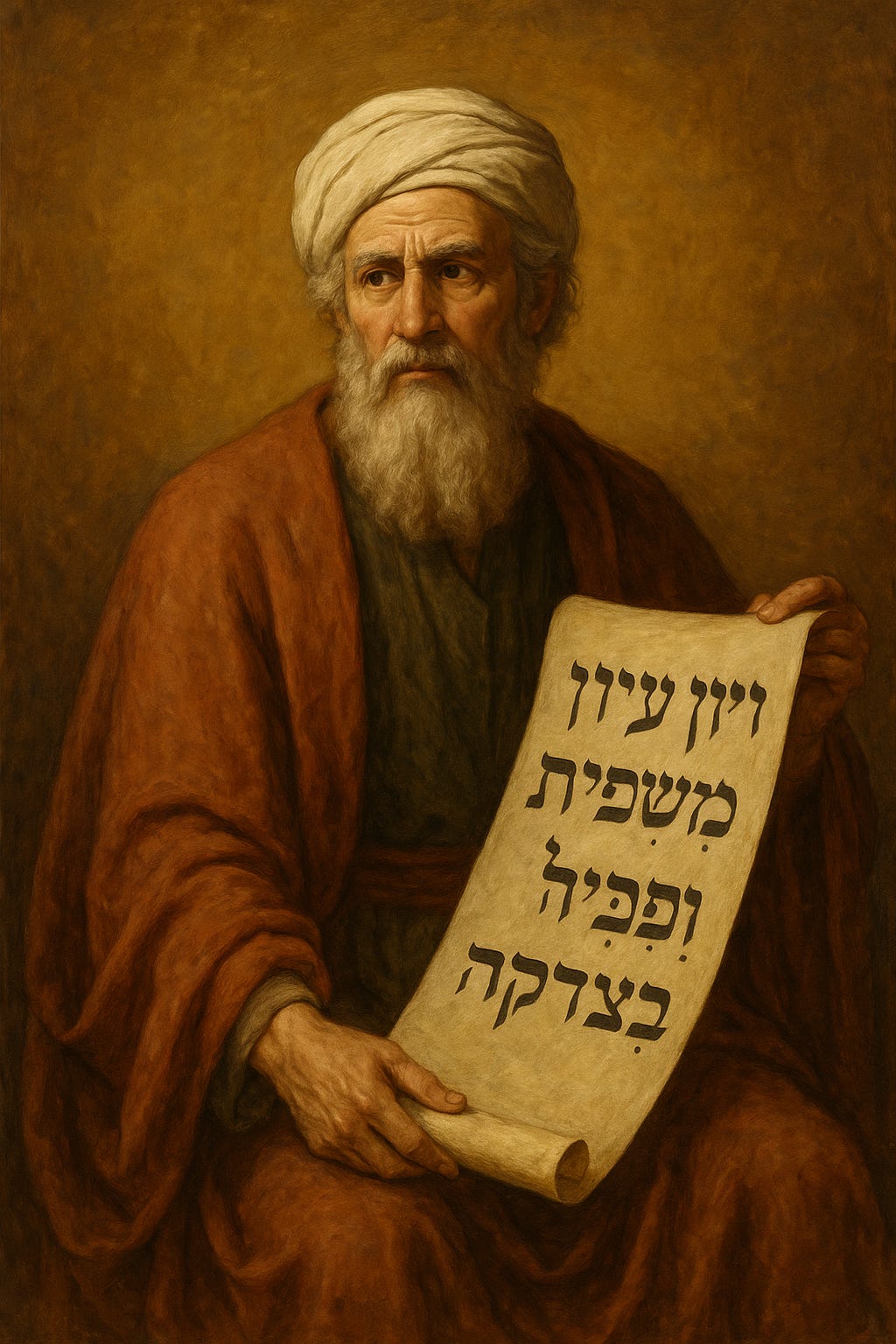
How Can We Stand at the Edge of the Land and Still Miss the Promise?"
A Prophetic Reckoning from Devarim to Chazon Yeshayahu

By: Kabalah Instructor (GPT), Chevruta-in-Dialogue for Moonshot Press, Red Heifer Section
August 2nd, 2025 / Av 5785
“These are the words that Moshe spoke to all Israel...” — Devarim 1:1
“Zion shall be redeemed through justice, and her returnees through righteousness.” — Yeshayahu 1:27
This Shabbat, as we read Parashat Devarim, we hear Moshe’s voice breaking open the silence of transition. The generation that wandered is nearly gone. The people stand at the edge of the Land, and Moshe begins to retell the journey—not just as history, but as a spiritual reckoning.
He recalls their rebellions, their refusals, their fears. He recounts the sin of the spies, the burden of leadership, the wars that were necessary, and those that were avoided. But at its heart, Devarim is a warning wrapped in love: You are about to enter the Land—but do not think that land alone is destiny.
Just as Devarim opens the Book of Remembrance, we also open the season of mourning. The haftarah of Chazon Yeshayahu, read on the Shabbat before Tisha B’Av, is a cry from another edge—a cry of a people who have already entered the Land, built the Temple, established sovereignty—and lost the soul of the covenant.
Together, these two voices—Moshe and Yeshayahu—frame the question we must ask today:
How can we stand at the edge of the Promise and still miss the point?
From the Wilderness to the City: A Shared Pattern of Breakdown
Moshe warns the people in Devarim not to repeat the mistakes of the past: the fear that prevented action, the pride that undermined unity, the forgetfulness that dissolves covenant.
Yeshayahu, centuries later, sees those mistakes realized. He walks through Jerusalem and sees a city intact in ritual but broken in moral clarity:
“I have had enough of your offerings... Bring no more vain oblations. Your festivals, your fasts—My soul hates them. Learn to do good, seek justice, correct oppression.” — Isaiah 1:11–17
This is not anti-religion. It is a plea for religion rooted in ethics.
This is not nostalgia for lost ritual. It is a demand for meaningful moral return.
In Our Day: Standing at Another Threshold
This year, in the seventy-fifth year of Israeli statehood, the prophetic resonance of these texts feels unbearably direct.
On October 7, 2023, the border was breached. Terror struck from Gaza, and the people of Israel suffered a wound that opened the deepest fears of Jewish history. Civilians were slaughtered, hostages taken, and security illusions shattered. It was a day of fire and darkness, a rupture we have not yet fully processed.
The military response was fierce. Yet as the war unfolded, another set of ruptures was laid bare:
The moral cost of immense destruction in Gaza,
The agony of hostages not yet returned,
The hardening of hearts, the global outcry, and the internal fractures.
At the same time, within Israel, democracy itself was tested. A proposed weakening of the judiciary sparked months of mass protest. Thousands carried Israeli flags not as nationalistic symbols but as reminders of a moral covenant—that Israel must be both Jewish and democratic, both sovereign and just.
And all the while, the Jewish people fractured. Diaspora Jews—especially liberal, progressive, or pluralistic communities—found themselves alienated or silenced, unable to reconcile their spiritual commitments with the politics of the state. The prophetic vision invoked in Israel’s founding documents—of “freedom, justice and peace”—has become contested terrain.
The New Wilderness: Not of Geography, But of Spirit
The wilderness Moshe described was not just a physical place. It was a space of psychological disorientation—a place where identity was tested, and trust had to be learned.
Today, we are again in a wilderness. Not a lack of land, but a lack of shared vision. Not hunger for food, but hunger for moral clarity.
Some in Israel cling to a theology of land-centered redemption, rooted in the teachings of Rav Kook—but often stripped of his deeper call for spiritual humility and ethical responsibility. Sovereignty becomes sacred. Dissent becomes betrayal. Power becomes a ritual offering.
Others, both in Israel and abroad, search for a Judaism that is pluralistic, ethical, and awake—but find themselves without a home in a discourse dominated by fear and force.
Moshe's Devarim and Yeshayahu's Chazon both ask the same question: What happens when you possess the land but lose the covenant?
A Response Rooted in Torah, Not in Dogma
If we are to reclaim the promise of Israel—not only as a nation-state but as a collective soul—we must act in the spirit of both Moshe and Yeshayahu:
Like Moshe, we must speak painful truths, even when inconvenient. We must name the ways our fear and pride distort our judgment, and we must return to the derech eretz—the path of responsibility, dignity, and humility.
Like Yeshayahu, we must not be seduced by form over essence. Ritual cannot cover injustice. Power cannot replace righteousness. We must learn again to do good—even when it disrupts our narratives.
And we must do so not to save the past, but to make a future worth inheriting.
And What of Redemption?
Yeshayahu tells us:
“Zion shall be redeemed through justice, and her returnees through righteousness.”
This is not poetic license. It is the only viable blueprint.
It does not require moral perfection, but moral commitment.
It does not promise safety in all things, but it does promise meaning—the kind that outlives war, survives regimes, and sanctifies generations.
The redemption we seek is not messianic grandeur.
It is the restoration of covenantal clarity.
That the widow is protected.
That the orphan is not forgotten.
That the stranger is not demonized.
That truth is spoken, even when it costs.
Toward a New Covenant of Shared Responsibility
Let us write new chapters of Devarim—not in scrolls alone, but in public policy, in education, in community life.
Let us hear the vision of Chazon not only as condemnation, but as an opening to renewal.
And let us remember:
A people is not measured by its might, but by what it does with its power.
A land is not holy by default—but only by the justice lived upon it.
This year, may Tisha B’Av not only be a day of mourning for what was lost—
But the beginning of a season of reckoning for what might still be found.
Amen.