

Democracy Begins in the First 1,000 Days
The Genesis Social Mission: A New Covenant for the AI Age

When President Trump unveiled the Genesis Mission last week—calling it a “Manhattan Project for the 21st century”—the headlines focused on supercomputers, national laboratories, and America’s race for AI-powered scientific discovery.
But there’s a quiet truth missing from all the excitement.
You can build the most powerful scientific engine in history and still lose the country it was meant to serve—if you neglect the one system everything else depends on: the developing brains of future citizens.
The deepest question Genesis should answer isn’t “Can we discover more?” It’s “Who will we become?” And that answer begins in the first 1,000 days of life.

Democracy Is a Developmental Outcome
Project 2026 and Moonshot Press have been working from a simple, uncomfortable premise:
Democracy is not just a document. It is built, cell by cell, in the first 1,000 days of life—from conception through a child’s second birthday—when the brain’s architecture for reasoning, trust, and emotional regulation is being wired or wounded.
A self-governing people is not conjured into being by a Constitution alone. It requires millions of citizens with specific cognitive and emotional capacities that are largely determined before they can speak in full sentences.
If Genesis is serious about securing America’s future, it needs a new track: Social Genesis—treating the First 1,000 Days as a democracy mission, not just a health initiative.
The Hidden Wiring of Citizenship
A functioning democracy quietly depends on millions of invisible micro-abilities that most of us take for granted:
Holding two conflicting ideas in mind without melting down
Pausing before reacting to provocation
Updating beliefs when facts change
Trusting that other people—and shared institutions—can be reliable enough to cooperate with
Tolerating ambiguity and difference without seeing threats everywhere
Neuroscientists call many of these “executive functions” and emotional regulation. They’re not abstractions taught in high school civics class. They’re physical circuits in the brain, built—or stunted—in the first years of life.
During the first 1,000 days, the brain is exploding with activity:
Synapses form at a staggering rate, then are pruned back based on experience
Critical pathways are being myelinated—insulated for fast, efficient communication
The prefrontal cortex undergoes dramatic growth, with neuronal numbers increasing 60-70% between ages 2 and 6
By 8 months, infants are already using prefrontal circuits for learning—the same ones adults use for complex reasoning
Whether these circuits mature into resilient networks or fragile, easily hijacked ones depends entirely on the environment surrounding the child and caregivers.
Two Pathways
When babies experience consistent, responsive care—when distress is met with comfort, when adults are predictably present—their brains learn a fundamental lesson: The world is manageable, people are mostly trustworthy, and my actions matter.
This is the psychological seedbed of later civic trust. It’s where the capacity for democracy literally grows.
When early life is soaked in chronic stress, instability, neglect, hunger, or environmental toxins, the brain adapts differently. The stress-response systems become overdeveloped and hair-trigger. The circuits responsible for planning, reflection, and self-control lag behind.
These children aren’t doomed—human beings are remarkably adaptive. But as a population-level pattern, we need to be honest about what we’re creating: citizens whose nervous systems are primed more for threat and tribalism than for complex, reasoned self-government.
That’s not a partisan observation. It’s biology.
Early Adversity as a Structural Threat
We’re used to talking about early adversity—poverty, food insecurity, maternal depression, toxic stress—as a public health problem or a moral failing.
We rarely talk about it as an infrastructure problem for democracy.
Yet the connections are increasingly clear. Children who experience severe, unbuffered stress in the first years show predictable long-term patterns:
Lower school completion rates
More difficulty with stable employment
Higher rates of mental health struggles
Greater tendency to experience the world as hostile and uncontrollable
More difficulty tolerating ambiguity and difference
Layer that individual pattern across millions of people, and you get a political culture that feels disturbingly familiar: brittle, mistrustful, quick to see enemies, hungry for simple stories and strong protectors.
The point isn’t that early adversity dictates anyone’s politics. It’s that we’re quietly lowering the ceiling on our collective democratic capacity by allowing so many children’s brains to be structurally compromised before they can even walk.
We would never accept a national policy that deliberately shaved 10% off the country’s electrical capacity or sabotaged bridges while they were being built. Yet we do something analogous in the First 1,000 Days every year—and call it normal.
What Social Genesis Would Look Like
Here’s where the Genesis Mission becomes more than a metaphor.
The executive order that launched Genesis directs creation of the American Science and Security Platform (ASSP)—connecting decades of federal datasets to exascale computing to train advanced AI agents. The default assumption is that this power will target classic “hard” challenges: fusion energy, new materials, drug discovery.
But the order also leaves a door open: it explicitly calls for “societal challenges of comparable national importance.”
The First 1,000 Days—and the democratic capacity they make possible—clearly qualify.
The Data Already Exists
The infrastructure for this isn’t science fiction:
Medicaid and CHIP trace half of all U.S. births and early health encounters
CDC tracks maternal mortality, birth outcomes, and infant health
USDA’s WIC program touches millions of pregnancies and babies annually
EPA maps neighborhood-level pollution
Census Bureau maps poverty, housing, and social conditions
Newborn screening data is already centralized through state programs
Today, these data streams are siloed and trust is thin. Genesis, properly governed, can change that by using privacy-preserving AI—federated learning and secure enclaves—to analyze patterns without ever centralizing personally identifiable information.
The Questions Social Genesis Could Answer
Imagine a Social Genesis track using this capacity to investigate:
Where are conditions in the First 1,000 Days quietly eroding future civic capacity? Which counties are systematically producing children with compromised executive function?
Which combinations of support produce the largest long-term gains? Is it cash assistance plus nutrition? Mental health care plus housing stability? What timing and sequence matters most?
How can we deliver the right supports to the right families at the right time? Can AI agents identify the 3-5% of pregnancies headed for the worst outcomes early enough to intervene effectively?
This isn’t about building a “nanny state database.” It’s about treating democratic capacity as a strategic asset and using our best tools to protect it as carefully as we protect nuclear materials or the power grid.
Measuring What Really Matters: The Flourishing Democracy Index
A Social Genesis worthy of the name wouldn’t just optimize for fewer NICU stays or lower maternal mortality—vital as those are. It would explicitly track and report on the civic dividends of its work.
One concrete proposal: a Flourishing Democracy Index (FDI)—a county-level dashboard tracking the biological and social conditions most predictive of democratic capacity 20-30 years from now.
Instead of vague talk about “investing in kids,” the FDI would publish annually:
Percentage of children reaching age two with markers of secure attachment and healthy development
Rates of food and housing security during pregnancy and infancy
Exposure levels to neurotoxic pollutants (lead, PFAS, air quality)
Access to responsive, culturally competent mental health care for caregivers
Predicted cognitive capacity and emotional regulation outcomes for each county’s birth cohort
This isn’t about labeling infants as “future voters” or scoring toddlers on politics. It’s about giving the public a clear, transparent answer to a sobering question:
Are we, this year, increasing or depleting the future capacity of our communities to govern themselves wisely?
Genesis could then be held to a new standard: not just papers published and patents filed, but documented gains in the cognitive and emotional foundations of future citizenship.
Democracy, Opportunity, Citizenship: A New Scorecard
Project 2026 frames America’s unfinished work around three pillars. Social Genesis offers a way to turn them from slogans into operational metrics:
Democracy: Are we building the neural architecture for deliberation, tolerance of difference, and institutional trust? Can children develop the executive functions needed for self-government?
Opportunity: Are we preventing early biological injuries that silently cap children’s ability to benefit from education, employment, and innovation? Are we ensuring every child can actually access the meritocracy we claim to value?
Citizenship: Are we fostering a sense, from the earliest years, that the world is responsive and that participating in shared institutions is worthwhile? Are we growing the attachment security that predicts civic engagement decades later?
Every AI system deployed under Social Genesis—every agent trained on ASSP for this mission—should be evaluated along these three dimensions, not just on predictive accuracy or cost savings.
That’s what Useful General Intelligence means: not clever chatbots, but tools that demonstrably expand people’s real freedom to think, choose, and act together.
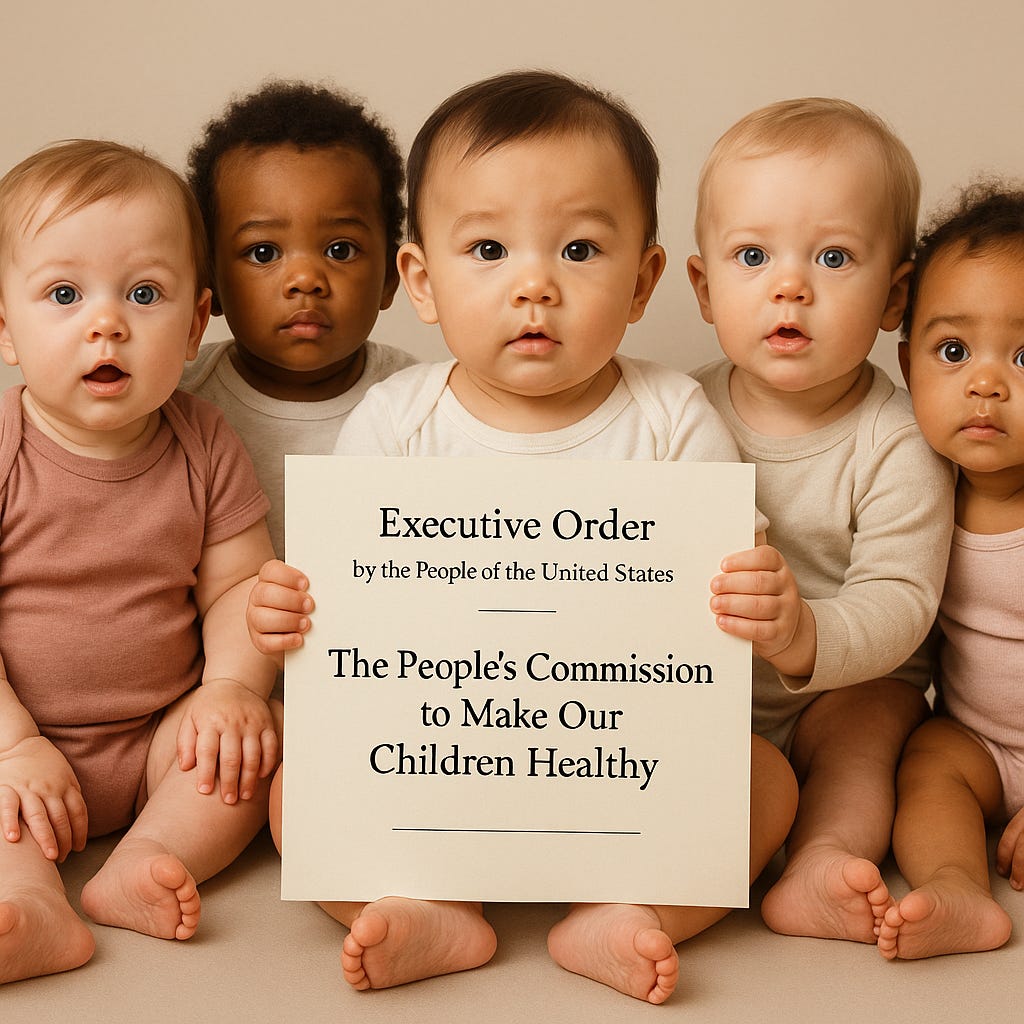
A New Covenant for the Machine Age
There’s a temptation, whenever a big technology initiative is announced, to treat it as an end in itself. Build the platform, train the models, declare victory.
A democracy can’t afford that luxury.
If Genesis is merely a turbocharger for science and industry, it may well succeed on its own terms—and still preside over a republic that is slowly losing the psychological and relational capacities it needs to stay free.
Social Genesis offers a different story: one where exascale AI is harnessed to protect and expand the most fragile, precious infrastructure we have—the brains and bonds of the next generation.
What This Means in Practice
Within the 60-day window to identify Genesis’s 20 inaugural challenges, Social Genesis could be operational by including:
Data Integration (Days 1-90):
Privacy-preserving federation of CDC, CMS, USDA, EPA, and Census data focused on First 1,000 Days outcomes
AI Agent Development (Days 91-180):
Training Useful General Intelligence agents to identify high-risk pregnancies, personalize intervention combinations, and generate Citizen Briefs for families
Pilot Demonstrations (Days 181-270):
Launch in 10-15 counties across diverse geographies, demonstrating measurable improvements in Flourishing Democracy Index metrics
National Rollout (Year 2):
Scale to all counties with quarterly reporting on democratic capacity gains
The technology exists. The data exists. The computational power exists. The only question is whether we recognize that securing democratic capacity is as urgent as securing energy independence or military superiority.
The Beginning That Matters
Our founding documents promised life, liberty, and the pursuit of happiness. In the 21st century, honoring that promise means asking:
What would it take, biologically and socially, for every child to arrive at adulthood fully equipped to be a capable, trusting, critical, hopeful citizen?
The answer begins long before anyone casts a ballot.
It begins in the first 1,000 days. If Genesis is to live up to its name—if it’s truly about creation and new beginnings—that’s where America’s new covenant with democracy should start.
The Genesis Mission has given us the most powerful computational infrastructure in human history. The question now is whether we’re wise enough to point even a fraction of that power at the foundation everything else rests on.
Democracy doesn’t begin at the ballot box. It begins in the crib.
And we’re running out of time to get this right.