

Behold, the people shall rise up as a great lion
Reflection on Parashat Balak and the Psychology of Messianic Hope

Introduction
This week's Parsha Balak provides a framework to focus on the connection of the powerful story of an ancient prophecy and its impact on modern political realities shaping the Israeli Jewish and Palestinian Muslim conflict. The Kabbalah Insider AI program provides a wide ranging description of the parasha. I use my exploration to reflect on a specific aspect of the portion that discusses the role of messianic beliefs in the psychology of believers and the need to integrate this into seeking a peaceful future.
You can find related articles on the impact of religious fundamentalism in The New Middle East Substack.
Brief Overview of the Torah Portion
On Shabbat, July 12, 2025, the weekly Torah portion (Parashat haShavua) read in Jewish synagogues is Parashat Balak. This portion, found in the Book of Numbers 22:2-25:9, tells the story of Balak, the King of Moab, who tried to hire the prophet Balaam to curse the Israelites. Balaam's donkey miraculously speaks to him along the way, and ultimately, Balaam ends up blessing the Israelites instead of cursing them. The portion concludes with a description of the Israelites sinning with Moabite women and a subsequent plague that is stopped by Pinchas' zealous act. The Haftarah (prophetic reading) for Parashat Balak is Micah 5:6-6:8.
The Prophecy That Echoes Through Time
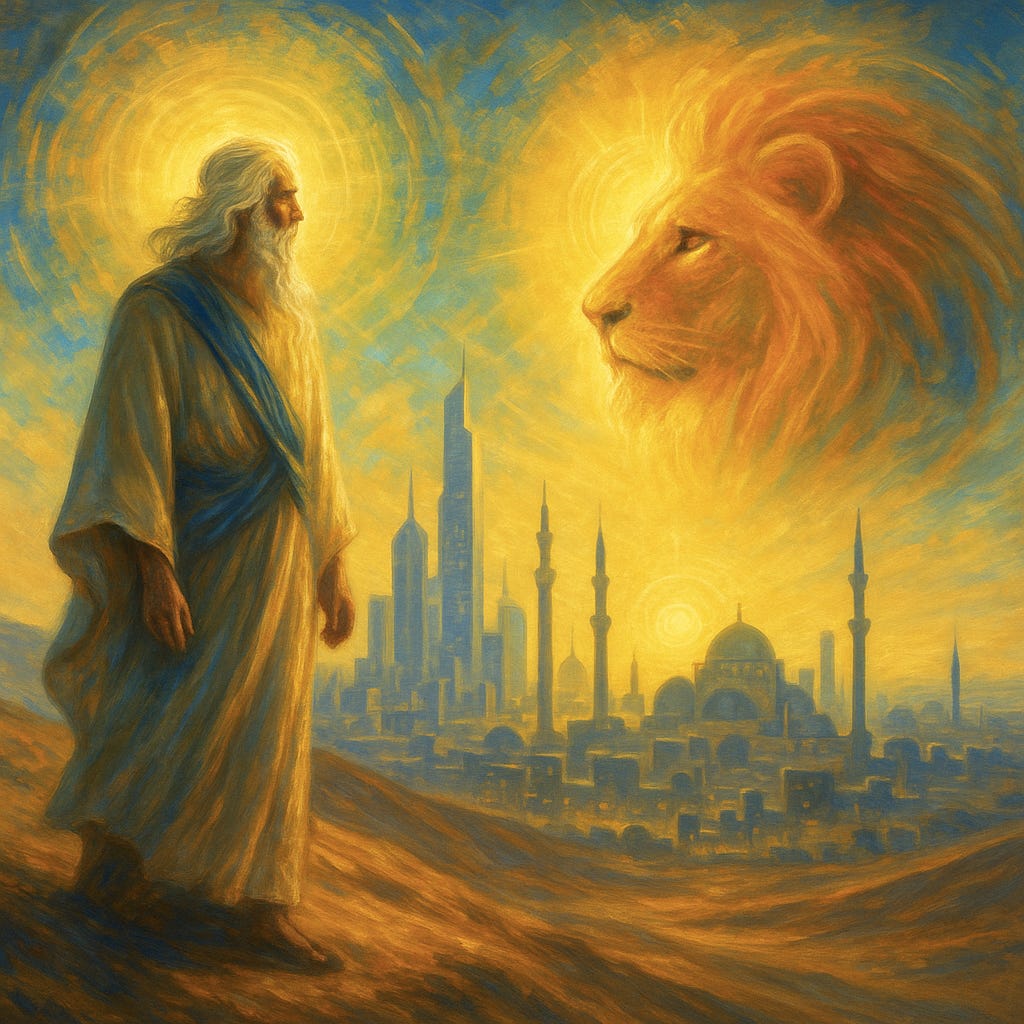
Within this narrative, we encounter one of the most powerful prophecies in Jewish tradition. Balaam, hired to curse Israel, instead finds himself blessing them with words that have echoed through millennia: "Behold, a people that rises like a lioness and lifts itself up like a lion" (Numbers 23:24). Later, he speaks of "a star that shall come forth from Jacob" (Numbers 24:17)—verses that have long been understood as messianic prophecy.
"Behold, the people shall rise up as a great lion, And lift himself up as a young lion: He shall not lie down until he eats the prey, And drinks the blood of the slain." (Numbers 23:24)
Operation Rising Lion
In June 2025, when Israel launched "Operation Rising Lion" against Iranian nuclear facilities, the operation's name was no coincidence. Prime Minister Netanyahu's invocation of Balaam's ancient prophecy transformed a military code name into a theological statement—Israel's leaders viewed this strike not merely as strategic necessity, but as fulfillment of divine promise.
As we read these words in our turbulent times, with the Middle East convulsed by escalating conflicts between Israel and Iran and ongoing devastation in Gaza, we cannot ignore how ancient prophecies continue to shape the psychological landscape of war and peace. The question isn't whether these beliefs are "right" or "wrong," but rather: How do they function in the hearts and minds of those who hold them, and what does this mean for the possibility of peace?
The Psychology of Divine Promise
This week's Torah portion, Parashat Balak, offers profound insights into how biblical prophecy penetrates modern conflict. When Balaam, hired to curse Israel, instead finds himself blessing them with visions of a "star from Jacob" (Numbers 24:17), he articulates what many see as messianic prophecy. These verses, combined with the symbolism of the Red Heifer ritual, create a framework that transforms ordinary political disputes into sacred missions.
For many religious Jews, particularly those in settler and religious nationalist communities, such explicit biblical references transform military actions from mere policy into prophetic fulfillment. When one believes that God has promised specific land to one's people, compromise becomes not just difficult but spiritually treacherous. This creates what psychologists call a "meaning-making framework"—current events are interpreted through the lens of ultimate purpose, offering certainty in an uncertain world and hope that transcends present difficulties.
Military victories become signs of divine favor; setbacks are tests of faith; territorial gains are not merely political achievements but steps toward redemption itself. The psychological comfort this provides cannot be underestimated—it offers a clear sense of purpose, divine protection, and historical destiny.
The Red Heifer: Harbinger of Redemption
The Red Heifer (Parah Adumah) adds another crucial layer to this psychological complex. According to Jewish law, only the ashes of a perfectly red, unblemished cow can purify those defiled by contact with death, enabling them to enter the Temple. For those who believe in rebuilding the Third Temple, the appearance of a qualifying Red Heifer is not merely interesting—it is a harbinger of the messianic age.
Recent reports of potential Red Heifers being raised in Israel have electrified certain religious communities, who see this as evidence that redemption is imminent. For these believers, current conflicts are not random geopolitical events but part of a divine plan unfolding before their eyes. The psychological impact is profound: it transforms believers from passive observers of history into active participants in cosmic drama.
While the Red Heifer is not explicitly mentioned in Parashat Balak, it deeply complements the portion's messianic themes. If Balaam's prophecy represents the lion's strength to protect the nation, the Red Heifer represents the purity required for divine fulfillment—together forming a dual imperative of might and sanctity.
The Mirror Effect: Islamic Messianic Beliefs
What makes this dynamic particularly complex is that both Iran's Shia leadership and Hamas operate within remarkably similar psychological frameworks rooted in Islamic eschatology. Iran's doctrine of Vilayat-e Faqih (Guardianship of the Islamic Jurist) casts current governance as divinely mandated, while the promised return of the Hidden Imam (Mahdi) provides an eschatological framework that mirrors Jewish messianic expectations. Iranian leaders have explicitly linked Israel's destruction to the conditions necessary for the Mahdi's appearance, creating a theological imperative for conflict.
Hamas, as an offshoot of the Muslim Brotherhood, draws on equally powerful spiritual narratives. Their 1988 charter explicitly frames the conflict as religious war, declaring that "the land of Palestine is an Islamic Waqf (religious endowment) consecrated for future Muslim generations until Judgement Day." This transforms what might otherwise be seen as a territorial dispute into a sacred trust that cannot be compromised.
Both movements draw psychological strength from historical narratives of resistance against overwhelming odds. Hamas invokes the memory of Saladin's victory over the Crusaders, while Iran's revolutionary ideology is built on the martyrdom of Hussein at Karbala—where the Prophet's grandson died fighting against tyranny. These stories provide meaning-making frameworks that transform military defeat into spiritual victory, making these movements extraordinarily resilient.
This creates a tragic symmetry: multiple sides possess deeply held beliefs that cast their conflict in cosmic terms. Each side's actions are interpreted by the others as evidence of fundamental evil, while their own actions are sanctified as necessary steps toward divine fulfillment.
The Burden of Sacred Meaning
Living with such intense meaning-making comes with profound psychological costs. When every political decision carries eternal significance, when compromise might mean betraying God's will, when military action is seen as either divine mission or holy resistance, the normal tools of diplomacy become inadequate.
The bloody century of conflict between Israeli Jews and Palestinian Muslims reveals how religious extremism on both sides has repeatedly sabotaged peace efforts. The 1994 massacre by Baruch Goldstein at the Tomb of the Patriarchs—a site holy to both faiths—and the 1995 assassination of Prime Minister Rabin by a religious extremist dealt devastating blows to the peace process. These acts of violence, justified by their perpetrators as religious duty, demonstrate how sacred meaning-making can become a weapon against reconciliation itself.
This is not to dismiss these beliefs as mere fanaticism. For millions of people—whether Jewish settlers, Iranian revolutionaries, or Palestinian resistance fighters—these frameworks provide genuine comfort, community, and purpose. They offer explanations for suffering, hope for the future, and a sense of being part of something larger than themselves. The psychological benefits are real, even as the political consequences can be devastating.
Balaam's Transformation: A Different Path
Yet Parashat Balak itself offers a different model. Balaam comes to curse but finds himself blessing. His transformation suggests that even those who begin with hostile intentions can be moved toward recognition of the other's divine worth. The text hints at a possibility that transcends zero-sum thinking: the recognition that God's blessing can encompass multiple peoples.
The Red Heifer, too, offers instructive symbolism. Its ashes don't destroy impurity—they transform it into purity. Death becomes the means to life; defilement becomes the path to holiness. This suggests that even the most intractable conflicts might contain within them the seeds of transformation.
Pathways to Tikkun: Transforming Conflict
The entrenched nature of these beliefs complicates conventional solutions, but the symbols of Parashat Balak and the Red Heifer suggest avenues for reconciliation:
Engage with Sacred Narratives: Rather than dismissing these beliefs as irrational, engaging with empathy can create space for dialogue. Acknowledging the historical and spiritual aspirations of all sides fosters mutual respect without endorsing extremism.
Reframe Peace as Tikkun: Lurianic Kabbalah teaches that redemption requires Tikkun—healing and reconciliation. By presenting peace-making as a sacred act of spiritual repair, it becomes possible to align messianic aspirations with ethical imperatives. This approach emphasizes that true redemption demands unity and moral clarity, not just territorial or military victories.
Amplify Moderate Voices: Supporting religious leaders who advocate redemption through peace and ethics, rather than territorial maximalism, can shift narratives. These voices offer alternative sources of meaning that prioritize coexistence over conflict.
Address Root Causes: Tackle the sources of radicalization—poverty, oppression, and lack of education—through reforms that promote critical thinking and tolerance while offering psychological support to address historical grievances.
For Hamas, this might mean finding ways to maintain their spiritual identity while exploring pragmatic governance that serves their people's immediate needs. For Iranian leadership, it could involve recognizing that true Islamic values might be better served through regional stability than endless proxy wars. For Jewish religious nationalists, it might mean considering whether the ultimate sanctification of the land requires not just possession but the ethical treatment of all who dwell upon it.
From Roar to Redemption
In Parashat Balak, Balaam's intended curse becomes a blessing, transforming darkness into light. Likewise, the Red Heifer's ashes convert impurity into purity. These lessons challenge us to transform the Middle East's conflicts from violence to protection, from divisiveness to unity. The lion's roar, emblematic of strength, must be tempered by the heifer's purity, symbolizing spiritual integrity.
The prophecies of Balaam and the symbolism of the Red Heifer remind us that transformation is possible, that curses can become blessings, and that even the most defiling circumstances can be purified. But such transformation requires more than waiting for miraculous intervention—it demands the hard work of building understanding across the deepest divides.
In the end, the question is not whether we believe in these prophecies, but whether we can find ways to honor what is sacred in them while creating space for the sacred claims of others. The lion's roar and the heifer's promise may yet point not toward endless conflict, but toward a redemption large enough to encompass all of Abraham's children.