
Rituals for Modern Citizens
Rabbi Jonathan Sacks' “Treatment Plan” for Our Challenging Times

Editor’s Note
As Thanksgiving 2025 approaches, Americans face a profound crisis of connection.
We’re besieged by fragmentation, polarization, and the persistent sting of social strife. The anxiety is pervasive. Our nation is embroiled in a fundamental struggle—one that has accompanied us since our founding—over our shared identity, core values, and future prospects. For many, a hopeful path forward remains elusive.
It is precisely against this gloomy backdrop that we must seek new ideas for reunion.
We found a powerful light in the reflections of the late Rabbi Jonathan Sacks. Before his untimely death in September 2020, Rabbi Sacks articulated a plan to address the challenges facing citizens in democratic governments worldwide, and the U.S. in particular. Appearing on the Tim Ferriss Podcast to promote his book Morality: Restoring the Common Good in Divided Times, he proposed a visionary remedy: building national cohesion through a shared national story, meaningful national rituals, and the empowerment of young people.
This article provides background on Project 2026’s Founding Principles: Rituals for Modern Citizens initiative. A Civic Ritual for Thanksgiving: Gratitude in the Age of Contempt takes Rabbi Sacks’s wisdom as its foundation, offering a concrete plan to implement these ideas and begin the necessary work of healing the American soul.
Explanatory Video generated with assistance of NotebookLM
As Thanksgiving 2025 approaches, many Americans are not gathering with a sense of unqualified gratitude, but with a deep-seated anxiety. Our political environment is characterized by fragmentation, social strife, and an increasingly polarized discourse that often seems to promote division over unity. We are currently embroiled in a fundamental struggle—one that has accompanied the nation since its founding—over our shared identity, core values, and future prospects. It is against this gloomy backdrop of national uncertainty that we must seek a way forward.
We believe that the path to reunion lies not just in policy, but in culture—specifically, in the creation of meaningful, shared civic practices.
This realization is illuminated by the wisdom of the late Rabbi Jonathan Sacks, who, in his work on restoring the common good, articulated a powerful diagnosis for divided times. He suggested that democratic societies need three components to enhance cohesion and a shared identity:
A National Story
A meaningful National Ritual
The Empowerment of Young People to make the world better.
The Crisis of Civic Cohesion
As a clinical psychiatrist, I’ve been intrigued by this formula as a “treatment plan” for our body politic’s pathology. We have national holidays, of course, designed to celebrate the institutions and ideals we hold sacred, but they have largely become times for recreation and commerce, largely devoid of the unifying civic content they were meant to transmit.
In keeping with Rabbi Sacks’s suggestions, our Founding Principles: Rituals for Modern Citizens initiative is building a national ritual, reflecting the American creed, that aims to include a shared narrative, structured rituals, and concrete activities to bridge the many divides that separate us.
We are launching the A Ritual of Thanksgiving as a “prototype” into the national conversation, inviting fellow citizens to build on their own personal experiences and co-create this essential framework.
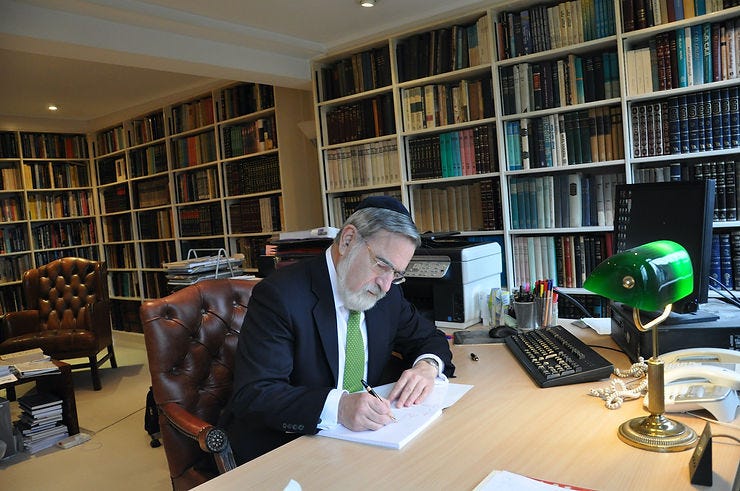
Rabbi Jonathan Sacks in his study. Credit: The Rabbi Sacks Legacy.
The Framework: Story, Reflection, and Action
Our ritual is deliberately structured, drawing heavily from the form and function of the Jewish holiday of Passover, the Seder. The Seder is a timeless model of how a shared meal and story can be transmitted from generation to generation across millennia. This structure provides a safe, modular framework for telling the national story of “We the People,” reconnecting us to the principles of our democratic experiment and individual freedom.
1. The National Story: From Subjects to Citizens
The American story is a complex and contested tale, one of revolutionary enlightenment and unimaginable brutality, of pilgrims and slaves, of settlers, immigrants, and marginalized persons. It is a continuous, troubled journey driven by the motto: “E Pluribus Unum” (Out of Many, One).
The central text of the Civic Ritual of Thanksgiving is the Declaration of Independence’s soaring vision: “We hold these truths to be self-evident. That all men are created equal; that they are endowed by their Creator with certain unalienable rights; that among these are life, liberty, and the pursuit of happiness.”
The ritual provides a framework to personalize this evolving narrative, allowing participants to integrate their individual, familial, and community identity into the greater tapestry of “We the People.” This creates a “safe container” for difficult communication, promoting empathy, knowledge, and dialogue over difference.
2. The National Ritual: A Time to Imagine
Similar to the Seder’s intention for participants to feel as though they were slaves freed from Egypt, the Thanksgiving ritual invites participants to imagine being part of the British King’s subjects and to actively participate in the ratification of the Constitution. This act of imagination transforms passive reflection into active ownership.
The ritual is an invitation to exploration and reflection, ensuring all voices are heard. It includes:
Establishing an intention for presence and focus.
Questions for exploration.
Themes of gratitude and recognition.
Identifying the “current plagues” confronting us (e.g., systemic polarization, climate change, inequality) and recognizing the narrow places we currently inhabit in American history.
Empowering the youngest participants to lead the continuing journey toward freedom and justice.
3. Empowerment of Young People: Keeping the Republic
Collective narratives and shared rituals serve as a vital adhesive, but they are not enough. We must translate them into action.
The Civic Ritual of Thanksgiving explicitly empowers the next generation to be active citizens. Building on the constitutional framework, citizens across the nation can join together to discuss strategies to solve national problems and unite across regions, religions, and ideologies.
This is a mandate for active citizenship—to educate ourselves to counter factionalism, hold political parties accountable, and jointly confront the plagues that threaten our future, from systemic injustice to existential environmental challenges.
Conclusion: A Republic, If We Can Keep It
“These are the times that try men’s souls,” Thomas Paine wrote at the height of the Revolution. The same can be said of our present moment.
This Thanksgiving 2025 offers a tremendous opportunity. We invite our fellow Americans to engage in co-creating a national story and a ritual that reflects the cultural richness and diverse tapestry of “We the People.” It is a chance to reclaim our role as citizens and commit to the ongoing work of self-governance.
At the conclusion of the Constitutional Convention, Benjamin Franklin was asked what the founders had given the people. “A republic, if you can keep it,” he replied. The Constitution did not come with a user guide for the citizen. This Thanksgiving, by engaging in the Civic Ritual of Thanksgiving, we can all commit to co-authoring that guide and moving our nation toward its full potential: “a more perfect union.”
A Civic Ritual for Thanksgiving: A Citizen Guide