

A MORE PERFECT UNION: 250 YEARS LATER
250 Years Later: Reclaiming the Promise for the Moonshot Class of 2026

Editor’s Introduction
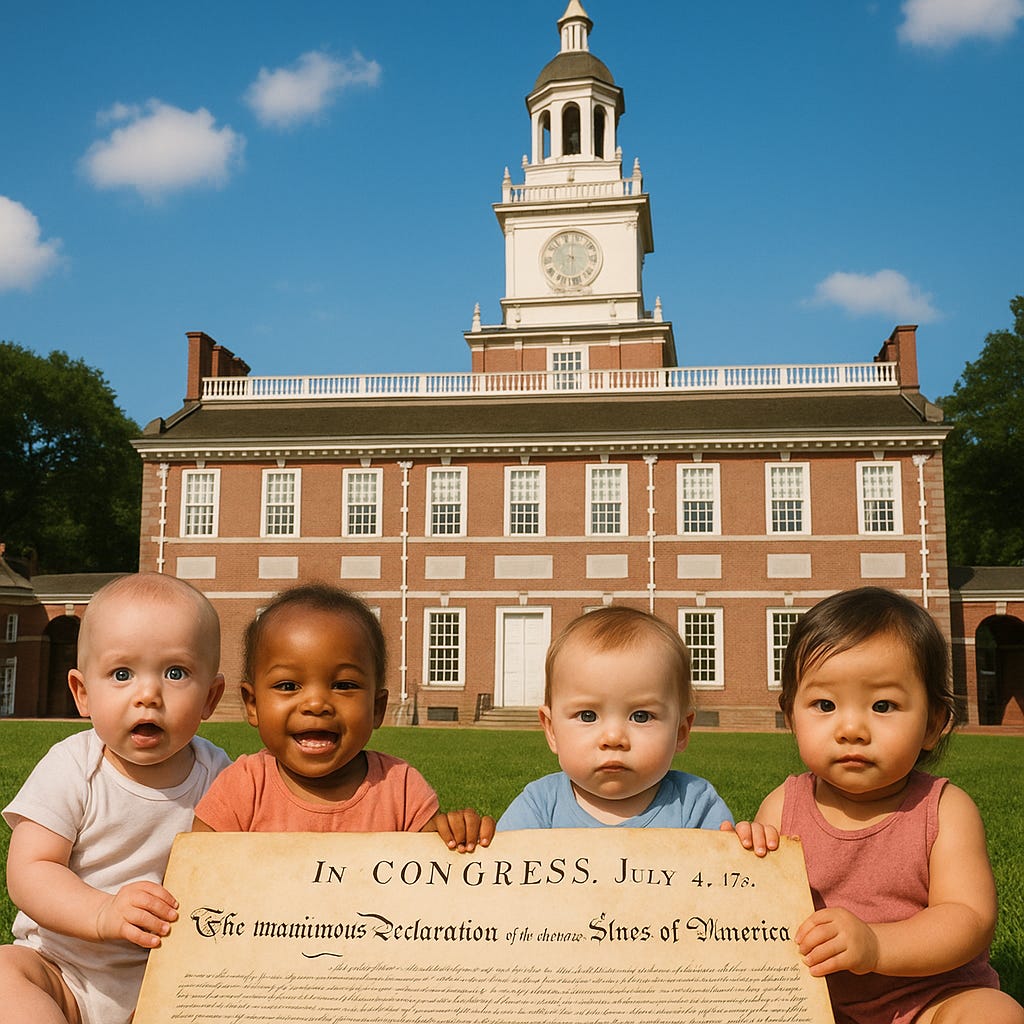
You have read the manifesto—five babies demanding that America keep its promise.
You have encountered four ideological responses—Conservative, Progressive, Libertarian, and MAGA—each offering fundamentally different diagnoses of what ails America and radically different prescriptions for how to address the divergent fates of Liam, Amare, Emma, Eva, and Mateo.
Each critique contains wisdom. Each identifies real problems. Each proposes solutions grounded in deeply held values and historical experience.
And yet, taken to their logical extremes, each would fail these children.
Pure conservatism that relies entirely on families, churches, and voluntary associations cannot help Eva when there is no hospital within 45 minutes and no grocery store in her town. Civil society requires a foundation that policy creates.
Pure progressivism that seeks to rebuild society from the ground up through revolutionary transformation offers no help to Liam in the next five years while we debate the dismantling of capitalism. These babies cannot wait for utopia.
Pure libertarianism that opposes any collective action beyond protecting property rights cannot address healthcare deserts, educational inequity, or the market failures that leave entire communities behind. Individual freedom requires conditions that markets alone do not create.
Pure MAGA nationalism that seeks to deport Mateo’s parents and cut support for Amare’s community while preserving advantages for Emma’s family does not serve American greatness—it betrays it by abandoning American children.
So what is the answer?
Returning to First Principles
In moments of profound division, wisdom lies not in choosing one faction’s total victory, but in returning to the principles that precede faction—to the constitutional framework and Founding debates that created the American experiment.
This is not nostalgia. The Founders were not saints, and 1776 was not paradise. They enslaved human beings, denied women’s rights, displaced Indigenous peoples, and created a republic that extended the Declaration’s promise to only a fraction of inhabitants.
But they did create something extraordinary: a framework for self-government, a set of principles about rights and liberty, and—crucially—a mechanism for future generations to perfect the union they imperfectly began.
The document you are about to read, “A More Perfect Union: 250 Years Later,” attempts something ambitious: to ask what the Founders themselves—drawing on their actual writings, their real debates, their constitutional design—might say about Liam, Amare, Emma, Eva, and Mateo.
Not what we imagine they might say. Not what we wish they would say to support our preferred policies. What their actual principles, properly understood and applied to 2026 realities, would demand.
The Founders Disagree—And That’s the Point
One thing becomes immediately clear when you study the Founding era: the Founders did not agree with each other.
Jefferson and Hamilton battled over the proper role of government in economic life—Hamilton advocating for active government investment in infrastructure and industry, Jefferson fearing consolidated power and championing agrarian independence.
Madison designed checks and balances precisely because he believed faction was inevitable and that no single interest could be trusted with unchecked power.
Adams warned that excessive inequality would destroy republican government, while also insisting on property rights and ordered liberty.
Washington, in his Farewell Address, pleaded with Americans to avoid the “spirit of party” that would elevate faction over the common good.
The Anti-Federalists feared that a strong central government would inevitably serve elite interests at the expense of common citizens and local communities.
They were brilliant minds who disagreed profoundly—and yet they created a system that has endured for 250 years precisely because it balanced their competing insights.
The genius of the American constitutional framework is that it does not require us to choose Hamilton OR Jefferson, federal power OR state sovereignty, individual rights OR collective welfare. It creates a system where competing values can coexist in productive tension.
This is what our current moment has forgotten. We have abandoned creative tension for tribal warfare. We seek total victory for our faction rather than synthesis of competing truths.
What This Document Attempts
“A More Perfect Union: 250 Years Later” is not a neutral, “both sides” document that splits the difference and satisfies no one.
It is a synthesis grounded in:
1. The Declaration’s Promise — That all are created equal, endowed with unalienable rights, and that government exists to secure these rights. This is America’s moral North Star, imperfectly followed but never abandoned.
2. Constitutional Design — The framework of federalism, separation of powers, checks and balances, and subsidiarity that the Founders created to prevent tyranny while enabling effective governance.
3. The Founders’ Actual Debates — Not mythology, but what they actually wrote about government’s role, economic policy, education, inequality, immigration, and the relationship between liberty and welfare.
4. Washington’s Farewell Address — Perhaps the single most important statement of political wisdom from the Founding era, warning against faction and foreign entanglements while affirming the necessity of unity and effective government.
5. 250 Years of Progress — The accumulated wisdom of what has actually worked: universal public education, infrastructure investment, Social Security, the GI Bill, the Civil Rights Movement, and yes, market innovation and entrepreneurship.
6. The AI Revolution — The recognition that the Moonshot Class of 2026 is born into a technological moment that offers unprecedented tools to fulfill the Declaration’s promise—if we choose to deploy them wisely.
The document argues that there IS a path forward that:
Respects conservative insights about family, civil society, and fiscal responsibility
Incorporates progressive demands for justice, equity, and active government
Honors libertarian concerns about freedom, efficiency, and limiting concentrated power
Addresses MAGA anxieties about community decline, border security, and national cohesion
Not by making everyone happy. But by grounding policy in principles that precede our current tribal divisions.
Why AI Generated This Response
Like the four ideological critiques, this synthesis was generated by Claude (Sonnet 4.5), but with a different mandate.
Instead of asking the AI to inhabit one ideological position, we asked it to:
Study the actual writings of the Founders (Declaration, Constitution, Federalist Papers, Washington’s Farewell Address, Jefferson-Madison correspondence, Hamilton’s economic reports, Adams’s writings on inequality)
Understand their genuine disagreements and how they resolved them through constitutional design
Apply their principles—not their 18th-century policy prescriptions, but their constitutional framework—to the realities facing five babies born in 2026
Consider how 250 years of American progress (both achievements and failures) inform what works
Address how artificial intelligence changes what’s possible
Respond specifically to the four ideological critiques, showing where each contains truth and where each falls short
The result is not perfect. No document could be. But it offers something our fractured political discourse desperately needs: an attempt to reason together from shared principles rather than retreat into tribal certainties.
What You’ll Find in This Document
The response is comprehensive—because the problems are complex and simple slogans won’t solve them. You’ll find:
Founding Principles Applied — What the Declaration’s promise actually requires, what rights really mean, what “promote the general Welfare” demands, what prevents tyranny (including economic tyranny), and what federalism and subsidiarity properly entail.
Specific Responses to Each Ideology — Not dismissals, but engagement: What conservatives get right about family and civil society (and where their solutions fall short). What progressives correctly diagnose about structural barriers (and where revolutionary rhetoric becomes counterproductive). What libertarians understand about markets and freedom (and where they deny market failures). What MAGA populists identify about community decline (and where nationalism becomes exclusionary).
Washington’s Wisdom for Our Moment — His Farewell Address speaks directly to our factional divisions, offering a path toward unity without uniformity.
Seven Commitments for the Semiquincentennial — Concrete policy frameworks grounded in Founding principles:
Universal Foundations (healthcare, education, nutrition, safety)
Opportunity Infrastructure (physical, educational, economic)
Family Support (paid leave, childcare, living wages)
Justice and Equal Protection (civil rights, immigration reform, criminal justice)
Economic Balance (preventing plutocracy and dependency)
Civic Renewal (education, service, engagement)
Environmental Stewardship (clean air/water, climate action)
The AI Agenda — How artificial intelligence can be harnessed to fulfill the Declaration’s promise for all five babies, or how it could deepen inequality if we fail to act wisely.
Cost and Feasibility — Because good intentions without practical implementation help no one.
A Renewed Declaration — The promise articulated for 2026 and the next 250 years.
How to Read This Document
This is not a quick read. It is substantial, detailed, and demanding—because the stakes are high and simple answers are false answers.
We encourage you to:
Read with openness. You will encounter ideas that challenge your priors. That’s the point. If this document only confirms what you already believed, it has failed.
Test against the Founders’ actual words. We provide citations and references. Look them up. See if the synthesis accurately represents what they wrote, or if it twists their words to serve a predetermined conclusion.
Consider implementation. Don’t just ask “Do I like this?” Ask “Would this actually help Liam, Amare, Emma, Eva, and Mateo?” Ask “Could this pass in a divided Congress?” Ask “What unintended consequences might arise?”
Resist tribal scoring. Don’t keep a mental tally of which ideology “wins” more arguments. Ask instead whether the synthesis as a whole offers something better than any single ideology alone.
Engage critically with the AI. This was generated by artificial intelligence drawing on training data. It has no lived experience, no stake in outcomes, no tribal loyalty. That’s both its strength (neutrality) and its limitation (potential blindness to realities humans would catch). Where does it get things right? Where does it miss nuance?
Imagine the Founders at 250 years. If Washington, Jefferson, Adams, Madison, and Hamilton could see America now—its extraordinary achievements and its profound failures—what would they say? Would they recognize their principles in our politics? Would they be proud of what we’ve built, or ashamed of what we’ve neglected?
The Central Question
At its core, this document wrestles with one question:
Can American democracy, grounded in constitutional principles developed 250 years ago, solve 21st-century problems for five babies born into radically different circumstances?
The cynical answer is no. Our system is too broken, our divisions too deep, our problems too complex, our politics too corrupt.
This document argues yes—but only if we:
Return to first principles rather than tribal loyalties
Balance competing goods rather than seeking total victory
Invest in foundations while respecting limits
Use new tools (like AI) wisely and equitably
Remember that perfecting the union is the work of every generation
The alternative is unacceptable.
If we cannot find a way forward that keeps the promise for all five babies—if we remain trapped in factional warfare while children’s life chances diverge based on ZIP codes—then the American experiment will have failed at 250 years.
Not because the principles were wrong. Because we lacked the wisdom and will to apply them.
An Invitation
What follows is long. It is challenging. It will at times frustrate you, provoke you, perhaps anger you.
Read it anyway.
Because Liam, Amare, Emma, Eva, and Mateo deserve more than our tribal certainties and factional victories.
They deserve the best of what America has been and can be.
They deserve a synthesis that draws wisdom from conservative and progressive, libertarian and nationalist, Hamiltonian and Jeffersonian, federalist and anti-federalist traditions.
They deserve what the Founders promised: a more perfect union.
Not perfect. Never perfect. But always striving toward perfection.
At 250 years, that striving is our obligation.
Let us see if we can meet it.
Moonshot Press
January 2026
America’s Semiquincentennial Year
→ Begin Reading: “A More Perfect Union: 250 Years Later”
→ Return to The Manifesto | The Four Ideological Critiques
→ Meet the Five Babies: Liam, Amare, Emma, Eva, Mateo
A MORE PERFECT UNION
250 Years Later: Reclaiming the Promise for the Moonshot Class of 2026
“We hold these truths to be self-evident, that all men are created equal, that they are endowed by their Creator with certain unalienable Rights, that among these are Life, Liberty and the pursuit of Happiness.—That to secure these rights, Governments are instituted among Men, deriving their just powers from the consent of the governed...”
— The Declaration of Independence, July 4, 1776
PROLOGUE: A NATION AT 250
In 2026, as Liam, Amare, Emma, Eva, and Mateo take their first breaths, America reaches a milestone: 250 years since the Declaration of Independence.
Two and a half centuries since a group of imperfect men in Philadelphia articulated a revolutionary idea—that government exists not by divine right, not by conquest, not by tradition, but by consent of the governed, to secure the unalienable rights of all people.
The Founders who signed that document disagreed profoundly about almost everything else. They argued bitterly about the role of government, the balance of powers, the rights of states versus the federal system, the place of commerce and agriculture, the meaning of liberty itself.
Yet they agreed on the foundational premise: that legitimate government has a purpose—to secure the conditions in which human beings can flourish.
As we stand at this semiquincentennial moment, with five babies representing the breadth of American experience, we must ask: Have we secured those rights? Have we fulfilled the promise?
And if not—if the divergent fates of Liam, Amare, Emma, Eva, and Mateo suggest we have not—then what does the wisdom of the Founding generation teach us about how to move forward?
I. THE FOUNDERS’ QUESTION: WHAT IS GOVERNMENT FOR?
The men who debated America’s founding did not speak with one voice. Their disagreements were fierce, their visions competing. But their arguments were rooted in a shared question: What is the proper role of government in securing human liberty and flourishing?
Let us listen to them.
THOMAS JEFFERSON: The Protection of Natural Rights
Jefferson’s Declaration proclaims that rights are inherent, not granted. We possess them by virtue of being human—”endowed by our Creator”—and government exists solely to secure them.
“The legitimate powers of government extend to such acts only as are injurious to others. But it does me no injury for my neighbor to say there are twenty gods, or no god. It neither picks my pocket nor breaks my leg.”
Jefferson feared centralized power and trusted in the capacity of free people to govern themselves. He believed the best government governs least—but governs it must, to prevent the strong from oppressing the weak, to ensure that liberty for some does not mean domination of others.
To our four critiques, Jefferson might say:
To the libertarian: You are right that individual liberty is sacred and that government power must be constrained. But liberty requires protection. Without government to enforce contracts, prevent fraud, protect the vulnerable, and provide public goods, liberty becomes the privilege of the powerful.
To the MAGA advocate: You claim to honor the Founders, but remember—Jefferson wrote that “all men are created equal” even as he tragically enslaved human beings. The promise was imperfect in practice, but the principle was radical and universal. It includes Mateo. It includes Amare. It includes all five babies equally.
Jefferson’s principle for these babies: Government must secure their natural rights—but government derives its legitimacy from the consent of the governed, which means it must be limited, accountable, and focused on essential functions, not sprawling control.
JOHN ADAMS: The Rule of Law and Mixed Government
Adams believed in “a government of laws, not of men”—that no individual, no matter how wealthy or powerful, stands above the law. He advocated for mixed government that balanced the interests of different classes and prevented any faction from dominating.
“The moment the idea is admitted into society that property is not as sacred as the laws of God, and that there is not a force of law and public justice to protect it, anarchy and tyranny commence.”
But Adams also wrote:
“Property monopolized or in the possession of a few is a curse to mankind. We should preserve not an absolute equality—this is unnecessary, but preserve all from extreme poverty, and all others from extravagant riches.”
Adams recognized that unchecked economic inequality threatens republican government. When wealth concentrates excessively, it corrupts politics, creates oligarchy, and destroys the common good.
To our four critiques, Adams might say:
To the conservative: You rightly emphasize the rule of law and property rights. But remember—law must protect all, not just the propertied. When economic power becomes so concentrated that it corrupts government, law itself is undermined.
To the progressive: You rightly identify structural inequality. But the solution is not to abolish property—it’s to ensure broad distribution of property and opportunity so that all citizens have a stake in the commonwealth.
Adams’s principle for these babies: Government must prevent both tyranny of the powerful and tyranny of the mob. It must create conditions where property is widely held, where no class dominates, where law is supreme and applied equally to Emma in Chestnut Hill and Eva in Lexington.
JAMES MADISON: Balancing Factions and Securing the General Welfare
Madison, the architect of the Constitution, understood that factions—groups united by common interest contrary to the common good—are inevitable in a free society. The question is how to prevent any faction from oppressing others.
“If men were angels, no government would be necessary. If angels were to govern men, neither external nor internal controls on government would be necessary.”
Madison designed a system of checks and balances, separation of powers, and federalism to prevent tyranny. But he also believed government had positive duties.
The Constitution’s preamble states its purposes:
“Form a more perfect Union”
“Establish Justice”
“Insure domestic Tranquility”
“Provide for the common defence”
“Promote the general Welfare”
“Secure the Blessings of Liberty to ourselves and our Posterity”
Madison understood that liberty and welfare are intertwined. A starving person is not free. An uneducated person cannot meaningfully participate in self-governance. A person without basic security cannot pursue happiness.
To our four critiques, Madison might say:
To the libertarian: You fear government overreach—rightly. But Madison designed a system not to eliminate government power, but to structure it properly. The Constitution grants Congress the power to “promote the general Welfare.” The question is not whether government acts, but how it acts and within what limits.
To the MAGA nationalist: You claim to defend the Constitution. Then defend all of it. The 14th Amendment guarantees equal protection. Mateo is a citizen. His parents’ status doesn’t negate his rights. The Constitution protects people, not just those you deem worthy.
Madison’s principle for these babies: Government must be strong enough to secure rights and promote welfare, but structured to prevent tyranny. It must act—build infrastructure, provide for defense, regulate commerce, promote education—but always accountable to the people and constrained by constitutional limits.
ALEXANDER HAMILTON: Active Government for National Prosperity
Hamilton believed in energetic government to build national strength and prosperity. He advocated for:
A national bank to stabilize currency and credit
Federal assumption of state debts to establish creditworthiness
Investment in infrastructure (roads, canals)
Support for manufacturing and commerce
A strong military
“A government ought to contain in itself every power requisite to the full accomplishment of the objects committed to its care, and to the complete execution of the trusts for which it is responsible, free from every other control but a regard to the public good and to the sense of the people.”
Hamilton understood that markets don’t build themselves. They require legal frameworks, stable currency, infrastructure, educated workers, and public investment.
To our four critiques, Hamilton might say:
To the conservative: You honor the free market. Good. But remember—markets require foundation. Hamilton built the financial system that made American capitalism possible. That required government action. Today’s infrastructure—physical, educational, social—is crumbling. Rebuild it.
To the progressive: You want government investment in public goods. Hamilton agrees. But he would insist on competence, efficiency, and accountability. Government action must be strategic, well-managed, and focused on building productive capacity, not perpetual dependency.
Hamilton’s principle for these babies: Government must actively invest in the foundations of prosperity—infrastructure, education, research, stable financial systems—so that private enterprise can flourish and opportunity can be broadly shared.
THE ANTI-FEDERALISTS: The Danger of Distant Power
The Anti-Federalists—Brutus, the Federal Farmer, Patrick Henry—opposed the Constitution, fearing it created a government too large, too distant, too powerful to remain accountable to ordinary people.
“A free republic cannot long subsist over a country of great extent... In a small one, the interests of the public are easier perceived, better understood, and more within the reach of every citizen.”
They believed local government and civil society should handle most human needs. They feared that centralized power would inevitably favor the wealthy and connected, growing ever more corrupt and oppressive.
To our four critiques, the Anti-Federalists might say:
To the progressive: Your vision of expansive federal programs terrifies us. Power concentrated in Washington inevitably serves the powerful. You think you’re empowering the poor; you’re actually empowering bureaucrats and lobbyists who will capture every program you create.
To all: Subsidiarity matters. Solutions should be as local as possible. Communities know their needs better than distant bureaucrats. Federal power should be reserved for truly national concerns—defense, interstate commerce, civil rights enforcement—not micromanaging every school, hospital, and neighborhood.
The Anti-Federalists’ principle for these babies: Empower communities, families, and local institutions. Federal government should establish floors—minimum standards, civil rights protections, interstate coordination—but let communities build from there according to their own values and circumstances.
II. SYNTHESIS: A FOUNDING VISION FOR THE MOONSHOT CLASS OF 2026
The Founders disagreed. Profoundly. Their arguments were fierce.
But notice what they shared:
Government has legitimate purposes—it’s not inherently evil (contra extreme libertarianism) nor inherently good (contra uncritical statism)
Rights are real and must be secured—not granted by government, but protected by it
Liberty and order must coexist—pure freedom without structure is chaos; pure order without freedom is tyranny
Concentrated power is dangerous—whether economic, political, or social
Self-governance requires conditions—education, economic security, civic virtue
The general welfare is a legitimate concern—not every individual action, but the foundational conditions for flourishing
From this synthesis, we can derive principles for Liam, Amare, Emma, Eva, and Mateo:
III. SEVEN FOUNDING PRINCIPLES FOR THE MOONSHOT CLASS OF 2026
PRINCIPLE ONE: Equal Creation, Equal Consideration
“All men are created equal.”
This was the revolutionary claim—not that all people are identical in ability or outcome, but that all possess equal moral worth and equal claim to rights.
Application:
Eva in Lexington, Mississippi, has the same inherent worth as Emma in Chestnut Hill
Mateo’s citizenship is not second-class because his parents are immigrants
Amare’s potential is not less because he’s born on the South Side of Chicago
Liam’s dignity is not diminished because his town is in decline
Policy implication: When we design policy—tax codes, school funding formulas, healthcare systems, immigration laws—we must ask: Does this treat all children as equally worthy of investment?
If the answer is no, we violate the founding premise.
PRINCIPLE TWO: Rights Require Securing
“To secure these rights, Governments are instituted among Men.”
The Declaration doesn’t say rights are self-executing. It says government exists to secure them.
Jefferson, the small-government advocate, nonetheless affirmed: liberty requires protection.
Application:
Liam has a right to life—but that right is insecure if his county has no hospital, no clean water, no pediatrician
Amare has a right to liberty—but that right is insecure if he faces police harassment, environmental racism, and educational inequality from birth
Eva has a right to pursue happiness—but that right is insecure if she’s likely to die before her first birthday
Mateo has a right to family—but that right is insecure if his parents can be deported without due process
Policy implication: Government—at appropriate levels—must create the conditions for rights to be meaningful:
Public health infrastructure (Hamilton would approve)
Clean environment (Adams would insist on law protecting all)
Education systems (Madison knew democracy requires educated citizens)
Due process and equal protection (all Founders, even those who failed to live up to it, affirmed this in principle)
This is not unlimited government. It’s government fulfilling its core purpose.
PRINCIPLE THREE: Prevent Tyranny of the Powerful
Adams warned against “property monopolized.” Jefferson feared consolidated wealth. Madison designed checks against faction.
Application: When Emma’s family wealth is built on tax codes that favor capital over labor, when Amare’s neighborhood was systematically redlined and disinvested, when Eva’s county can’t afford a hospital because wealth has been extracted for generations, when Liam’s town sees profits leave while costs remain—this is economic power unchecked.
Policy implication: Just as the Founders separated political powers, we must prevent economic power from becoming tyrannical:
Progressive taxation (Hamilton supported this)
Antitrust enforcement (Madison would recognize monopoly as faction)
Labor rights (freedom of association is a founding principle)
Limits on money in politics (corruption was the Founders’ nightmare)
This is not class warfare. This is preventing oligarchy, which every Founder feared.
PRINCIPLE FOUR: Promote the General Welfare
“Promote the general Welfare”—it’s in the Constitution.
Not “guarantee equal outcomes.” Not “micromanage individual lives.” But promote—actively work toward—the conditions in which the community as a whole can flourish.
Application:
Infrastructure that connects rural communities like Liam’s to opportunity
Public health systems that prevent epidemics and ensure basic care for all
Education systems that prepare all children for citizenship and productive life
Environmental protections that ensure clean air and water
Research and development that benefit society broadly
Policy implication: Public investment in genuine public goods—things that benefit all and that markets alone won’t provide efficiently:
Roads and bridges (Hamilton built them)
Public schools (Jefferson founded the University of Virginia as a public institution)
Clean water and sanitation (19th-century public health transformed American life)
Basic research (led to the internet, GPS, modern medicine)
This is Hamiltonian active government within Madisonian constitutional constraints.
PRINCIPLE FIVE: Subsidiarity and Federalism
The Anti-Federalists were right that local solutions are often best. Madison’s federalism allows for experimentation and variation.
Application: Not every problem requires a federal solution. Communities differ. Let them.
Massachusetts might fund education more generously—that’s their choice
Mississippi might prioritize differently—that’s their prerogative
But—and this is crucial—federalism cannot be an excuse for denying fundamental rights.
The 14th Amendment settled this: No state can deny equal protection or due process. When states fail to secure basic rights, federal government must act.
Policy implication:
Set national floors (minimum standards for civil rights, environmental protection, healthcare access, educational quality)
Allow local variation above those floors
Enforce vigorously when states fall below minimums
Otherwise, let communities govern themselves
Eva’s Mississippi can’t be allowed to have infant mortality rates triple the national average. That violates equal protection. Federal intervention is warranted.
But how Mississippi structures its schools, its economy, its culture above constitutional minimums—that’s for Mississippians to decide.
PRINCIPLE SIX: Civic Virtue and Personal Responsibility
The Founders knew republics require virtuous citizens—people who take responsibility for themselves, their families, and their communities.
Application: The MAGA critique is right that personal responsibility matters. Choices have consequences. Family structure affects outcomes.
But—and this is where the critique fails—personal responsibility requires conditions.
You can’t “choose” your way out of:
A healthcare desert
A food desert
Lead-poisoned water
A school with no teachers
An economy with no jobs
An immigration system that criminalizes your parents
Policy implication: Create the conditions for responsibility:
Jobs that pay living wages (people can’t be responsible without opportunity)
Healthcare that’s accessible (people can’t stay healthy without care)
Education that’s quality (people can’t make informed choices without knowledge)
Communities that are safe and stable (people can’t plan for the future in chaos)
Then—and only then—can we justly expect personal responsibility.
The Founders would recognize this. Jefferson’s yeoman farmer needed land. Hamilton’s merchant needed stable currency and rule of law. Adams’s citizen needed education. All required structural support to exercise virtue.
PRINCIPLE SEVEN: E Pluribus Unum—Out of Many, One
America was pluralistic from the start—different colonies, religions, economies, visions. The Constitution forged unity while preserving difference.
Application: Mateo’s family speaks Spanish. Amare’s family has a different cultural heritage than Emma’s. Liam’s Appalachian culture differs from Eva’s Delta culture.
This diversity is strength, not threat.
But—and here’s the conservative truth—unity matters too. Shared language, shared civic values, shared commitment to constitutional principles.
Policy implication:
Welcome immigrants, provide paths to citizenship, honor contributions (Hamilton was an immigrant)
But also—invest in civic education, English language instruction, integration support
Celebrate cultural heritage and forge common identity
Neither forced assimilation nor separatist multiculturalism
Mateo can be fully American and fully Mexican-American. These are not contradictions. This is the American tradition.
IV. ANSWERING THE FOUR CRITIQUES AT 250 YEARS
Now, let us return to the four critiques of the manifesto—conservative, progressive, libertarian, MAGA—and answer them from the wisdom of the Founding generation, applied to 2026.
TO THE CONSERVATIVE CRITIQUE:
You invoke the Founders and free markets. Good. But be consistent.
Hamilton built American capitalism through government action—a national bank, assumption of debts, tariffs to protect infant industries, infrastructure investment. The market didn’t create itself; it was constructed through wise policy.
Madison wrote that government must “promote the general Welfare.” Not guarantee equal outcomes, but create conditions for broad prosperity.
Adams warned that excessive inequality destroys republics. He would look at the wealth gap between Emma and Eva—not with approval, but with alarm.
You’re right that family structure matters. The Founders would agree. But they would also ask: What policies strengthen families?
Paid leave (so parents can bond with infants)
Living wages (so one job can support a family)
Healthcare (so illness doesn’t bankrupt families)
Affordable housing (so families have stability)
These aren’t anti-family. They’re pro-family.
You’re right that civil society matters. The Founders cherished it. But civil society was stronger when economic security was broader. When people had margin in their lives to volunteer, to participate, to build community.
Poverty destroys civil society. Precarity destroys civic engagement. Families working three jobs to survive have no time for the intermediary institutions you rightly value.
The Founding Vision for these babies: Yes to limited government. Yes to markets. Yes to family and civil society. But government must create the conditions in which these flourish.
That’s not socialism. That’s Hamiltonian capitalism. That’s Madisonian republicanism.
TO THE PROGRESSIVE CRITIQUE:
You demand transformation. You invoke structural change. Some of your diagnosis is correct.
Jefferson would agree that concentrated wealth is dangerous. Adams would agree that extreme inequality threatens republican government. Madison would recognize that economic power can become a tyrannical faction.
But your solutions often centralize power in ways the Founders would find terrifying.
Universal Basic Income, wealth caps, federal control of housing and healthcare, abolishing entire agencies and institutions—this is exactly the consolidated power every Founder feared.
Even Hamilton, the strongest advocate for energetic government, insisted on accountability, limits, and checks.
Here’s the Founding alternative to your vision:
Instead of UBI, expand the Earned Income Tax Credit—reward work while supplementing wages. (Hamilton would approve.)
Instead of federal housing takeover, eliminate zoning restrictions that prevent building, stop subsidizing sprawl, and invest in infrastructure that makes communities livable. (Madison would trust local solutions.)
Instead of Medicare for All as single-payer monopoly, create genuine universal catastrophic coverage with competitive provision for routine care. (Adams would want both universal access and market efficiency.)
Instead of abolishing ICE, reform immigration law to match reality—expand legal immigration, create paths to citizenship, couple it with border security. (Hamilton was an immigrant who also believed in rule of law.)
Instead of reparations as lump-sum payments, invest in place-based initiatives—infrastructure in disinvested communities, funding for HBCUs, land grant programs, business development support. (The Homestead Act built the middle class; we can do similar today.)
You’re right that structural change is needed. But structure doesn’t mean centralization.
The Founding Vision for these babies: Government must actively shape conditions for flourishing. But through constitutional constraint, subsidiarity, market mechanisms where appropriate, and genuine accountability.
Not revolution. Evolution, within constitutional bounds.
TO THE LIBERTARIAN CRITIQUE:
You claim the mantle of the Founders. In some ways, rightly—they did fear government tyranny and enshrine individual rights.
But you misread them in crucial ways.
First: Not one Founder was an anarchist or believed markets alone would secure rights. Even Jefferson said government must prevent injury to others. All believed in active government for public goods.
Second: Your distinction between negative and positive rights is philosophically questionable and historically false.
Property rights (which you cherish) require government action—courts, police, recording systems, contract enforcement. These aren’t free. They require collective resources.
Education and infrastructure—which the Founders invested in—require public funding. The Northwest Ordinance set aside land for schools. Jefferson founded a university. Hamilton built financial infrastructure.
These aren’t “positive rights” versus “negative rights”—they’re all rights that require securing.
Third: Your faith that unregulated markets will solve everything contradicts both theory and history.
Markets are extraordinary at allocating resources for things that can be priced and have excludable benefits. But they fail at:
Public goods (clean air, national defense, basic research)
Goods with externalities (pollution, vaccination, education)
Natural monopolies (utilities, infrastructure)
Information asymmetries (healthcare, finance)
This isn’t opinion. This is economics.
And history shows: unregulated markets create child labor, poisoned food, environmental devastation, financial crises, and monopoly.
The Founders knew this. They gave Congress power to regulate interstate commerce precisely because they’d seen the chaos of unregulated markets under the Articles of Confederation.
The Founding Vision for these babies: Freedom is the goal. Markets are often the means. But government must set rules, provide public goods, and prevent market failures.
That’s not tyranny. That’s the mixed economy the Founders actually built.
TO THE MAGA CRITIQUE:
You claim to honor the Founders and the Constitution. Then honor all of it.
“All men are created equal”—not “all citizens,” not “all white people,” not “all people whose parents came here legally.” All.
The Declaration was universal in principle, even if failed in practice. The Founders knew they were failing to live up to it. Jefferson called slavery an “abominable crime” even as he perpetuated it. They wrote a promissory note, as Dr. King said, that America has been striving to cash ever since.
You claim to defend borders and sovereignty. Fine. Every nation has borders. But:
Hamilton was an immigrant from the Caribbean. The Founders welcomed immigrants, naturalized them quickly, saw them as essential to building the nation.
The 14th Amendment grants birthright citizenship. Mateo is a citizen. Not an “anchor baby”—a citizen, with full rights. If you honor the Constitution, honor that.
You claim to defend law and order. Good. But remember:
Madison wrote that government without justice is tyranny. Separating families, deporting parents of citizen children without due process, workplace raids that terrorize communities—this isn’t justice. This is cruelty.
You can secure borders and treat people humanely. You can enforce laws and reform unjust ones. You can build national identity and welcome newcomers.
That’s what the Founders did.
You claim to defend personal responsibility. Good. So do we. But remember:
Jefferson believed people could be responsible only if they had opportunity—that’s why he wanted broad land ownership and public education.
Adams believed responsibility required law that protected all—not just the powerful.
You can’t demand responsibility from people in Eva’s county when there’s no hospital, no grocery store, no jobs, no infrastructure. That’s not responsibility—that’s blaming victims of policy failure.
The Founding Vision for these babies: Yes to borders and sovereignty. Yes to law and order. Yes to personal responsibility and national identity.
But these must be joined with:
Compassion (Washington: “I am principled against selling negroes, as you would cattle at market”)
Justice (Adams: law must protect all, not just the propertied)
Opportunity (Jefferson: rights require conditions to exercise)
Unity in diversity (E Pluribus Unum)
You can’t have Founding values without Founding vision—which was expansive, optimistic, and universal in principle.
V. A SEMIQUINCENTENNIAL VISION: THE PROMISE RENEWED
As we approach July 4, 2026—250 years since the Declaration—we stand at a crossroads.
We can continue on our current path: divergent Americas, where ZIP codes determine destinies, where the promise is kept for some and broken for others, where we fight over whether government should do nothing or everything, whether individuals are wholly responsible or wholly victims.
Or we can reclaim the Founding wisdom.
Not by returning to 1776—we can’t and shouldn’t. The Founders’ world was different. Their failures—on slavery, on women’s rights, on Indigenous peoples—were profound.
But the principles they articulated—imperfectly, aspirationally—remain true:
Government exists to secure rights, not grant them
All people are created equal in moral worth and entitled to equal consideration
Liberty requires conditions—security, opportunity, education
Power must be checked—economic and political
The general welfare is a legitimate governmental concern
Local solutions should be preferred when possible, but national standards for fundamental rights are essential
Unity and diversity can coexist
Self-governance requires virtuous citizens, which requires investment in their capacity for virtue
From these principles, a vision for Liam, Amare, Emma, Eva, and Mateo:
VI. THE SEMIQUINCENTENNIAL COMPACT: SEVEN COMMITMENTS
Let us, as a nation approaching 250 years, make seven commitments to the Moonshot Class of 2026:
COMMITMENT ONE: Universal Foundations
We commit to ensuring that every child, regardless of ZIP code, has access to:
Clean water and air
Adequate nutrition
Basic healthcare (including prenatal care, well-child visits, vaccinations, emergency services)
Safe housing
Quality education through high school
Physical safety
These are not luxuries. These are the foundations without which rights cannot be exercised.
Implementation:
Federal floor, local building: National standards for environmental quality, healthcare access, educational minimums—enforced. Above that, let states and communities build.
Subsidiarity: Delivery should be as local as possible. Federal government sets standards and fills gaps; states and communities deliver.
Accountability: Transparent metrics. If Eva’s county can’t meet infant mortality standards, federal intervention is warranted—not to take over, but to ensure minimums are met.
Funding mechanism:
Progressive taxation on the wealthiest (as Hamilton supported)
Elimination of tax expenditures that primarily benefit the already-advantaged
Reallocation from inefficient programs
Economic growth from infrastructure investment
This is Jeffersonian in protecting rights, Madisonian in promoting general welfare, Hamiltonian in using government capacity.
COMMITMENT TWO: Opportunity Infrastructure
We commit to rebuilding the infrastructure of opportunity:
Physical (roads, bridges, broadband, water systems)
Educational (universal pre-K, well-funded K-12, accessible higher education and training)
Economic (job training, small business support, access to capital)
Liam’s Somerset needs:
Broadband so he can access the modern economy
Restored infrastructure so businesses can operate
Retraining programs for workers displaced by economic change
Healthcare infrastructure so the town is livable
This isn’t charity. This is investment—the kind Hamilton championed.
Implementation:
Major infrastructure bill targeting rural and disinvested urban areas
Universal pre-K (proven ROI of $7 for every $1 spent)
Apprenticeship programs and technical education
Community college free for vocational programs
Student debt reform (income-based repayment capped at affordable levels)
Funding: Infrastructure bank, public-private partnerships, reallocation of defense spending, modest wealth tax on estates over $10 million
COMMITMENT THREE: Family Support
We commit to policies that strengthen families:
Paid parental leave (at least 12 weeks, both parents)
Affordable childcare (subsidized on sliding scale, capped at 7% of income)
Child allowance ($300/month per child, phased out at high incomes)
Flexible work policies
Living minimum wage ($15 federal floor, indexed to local cost of living)
This isn’t replacing families with government. This is supporting families to do their job.
The Founders understood that families are the bedrock of republic—but that families need support.
Implementation:
Federal paid leave insurance (employer/employee contributions, like Social Security)
Childcare subsidies through vouchers (market provision, public funding)
Child allowance as refundable tax credit
Labor law reform to allow flexibility
**Opposition from business groups? Remember: Hamilton supported tariffs to protect American industry and workers. Markets serve society; society doesn’t serve markets.
COMMITMENT FOUR: Justice and Equal Protection
We commit to equal protection under law:
Criminal justice reform: End cash bail, ban private prisons, eliminate mandatory minimums for non-violent offenses, expunge minor convictions, invest in re-entry programs
Immigration reform: Path to citizenship for Dreamers and long-term residents, expanded legal immigration, efficient asylum processing, coupled with border security
Civil rights enforcement: Aggressive prosecution of discrimination in housing, employment, lending, education
Police reform: Community policing, de-escalation training, accountability for misconduct
Mateo deserves to grow up without fear of family separation. Amare deserves to grow up without over-policing. Liam’s father deserves a second chance.
Implementation:
Pass comprehensive immigration reform (as Reagan did)
Sentencing reform (as both parties have supported)
Civil rights division funding restored and enhanced
Police standards enforced through federal funding conditions
This is Adams’s “government of laws, not of men” applied to 2026.
COMMITMENT FIVE: Economic Balance
We commit to preventing both plutocracy and dependency:
Progressive taxation (top rates return to Reagan-era levels: ~50% on highest incomes, 28% on capital gains)
Estate tax on large fortunes (exemption at $5 million, graduated rates above)
Antitrust enforcement (break up monopolies, prevent anti-competitive mergers)
Labor rights (protect organizing, ban union-busting, allow sectoral bargaining in some industries)
Social insurance (strengthen Social Security, Medicare, unemployment insurance)
But coupled with: work incentives, anti-fraud enforcement, time limits on able-bodied adults without dependents
Emma’s family shouldn’t be punished for success. But they should contribute proportionally. Eva’s family shouldn’t be trapped in poverty. But they should be supported to work and build.
The goal: broad middle class, as existed in post-WWII America—not through nostalgia, but through policy.
Implementation:
Tax reform (close loopholes, raise top rates modestly)
Strengthen EITC (supplement low wages through tax code)
Antitrust revival (use existing laws vigorously)
Labor law reform (update for 21st century economy)
This balances Hamilton’s capitalism with Adams’s warning against concentrated wealth.
COMMITMENT SIX: Civic Renewal
We commit to rebuilding civic culture:
Civics education (required, substantive, focused on constitutional literacy and democratic participation)
National service option (voluntary, compensated, diverse forms—military, Peace Corps, AmeriCorps, infrastructure, teaching)
Community investment (tax incentives for local philanthropy, support for community organizations)
Media literacy education
Protection of local journalism (tax credits for local news employment)
Republican government requires informed, engaged citizens. The Founders knew this. We’ve neglected it.
Implementation:
Federal funding for civic education curriculum development
Expanded AmeriCorps and similar programs
Tax deductions for local charitable giving enhanced
Anti-monopoly enforcement in media markets
This is Jeffersonian education, Madisonian civic engagement, Anti-Federalist localism.
COMMITMENT SEVEN: Environmental Stewardship
We commit to stewarding the earth for our posterity:
Clean air and water standards enforced nationwide
Climate change mitigation (market-based carbon pricing, clean energy investment, grid modernization)
Environmental justice (prioritize cleanup and enforcement in historically polluted areas)
Conservation of public lands
The Founders spoke of securing liberty for “ourselves and our Posterity”—that means leaving a livable planet.
Amare shouldn’t have asthma because of where he was born. Eva shouldn’t drink contaminated water. These babies will inherit climate change—we must mitigate it.
Implementation:
Carbon tax with revenue returned as dividend to citizens (revenue-neutral, market-based)
Clean energy R&D and deployment
Grid modernization
Environmental cleanup Superfund replenished
This is conservative (stewardship, market mechanisms) and progressive (universal protection, active government). It’s Hamiltonian investment and Jeffersonian care for future generations.
VII. OBJECTIONS ANSWERED
“This costs too much!”
The total package: roughly $800 billion to $1.2 trillion annually in new spending, offset by $500-700 billion in new revenue and savings.
Net cost: $300-500 billion annually, or about 1.5-2% of GDP.
For context:
We spend 3.5% of GDP on defense
We spent ~5% of GDP (over $1 trillion) on Trump tax cuts, which primarily benefited the wealthy
Not acting costs more: lost productivity, healthcare costs from preventable illness, incarceration, remedial education, lost potential
This is investment, not expense. And it’s less than we spent building the interstate highway system (as % of GDP) or the GI Bill.
“This is socialism!”
No. It’s Hamiltonian capitalism with Madisonian safeguards.
Markets remain primary for most economic activity
Private property protected
Innovation rewarded
Government provides foundation, not control
Denmark isn’t socialist—it has freer markets than the U.S. in many ways, but provides universal services funded by taxes. That’s the model.
“This expands federal power!”
Yes—within constitutional bounds and for constitutional purposes: securing rights and promoting general welfare.
The Founders gave Congress the power. We’re using it. With:
Checks and balances (intact)
Federalism (states control delivery)
Subsidiarity (local solutions preferred)
Accountability (democratic oversight)
“This still isn’t enough!” (from the left)
Perhaps. But it’s achievable, constitutional, and transformative.
Perfect is the enemy of good. This vision moves us dramatically toward justice while maintaining the constitutional order.
“This abandons traditional values!” (from the right)
No—it upholds them.
Family (supported, not replaced)
Work (rewarded and encouraged)
Opportunity (expanded)
Responsibility (expected, with conditions for exercising it)
Faith (protected and honored)
Community (strengthened)
These aren’t contradictions. They’re complements.
VIII. THE SEMIQUINCENTENNIAL CALL
On July 4, 2026, America will be 250 years old.
Liam will be six months old. Amare will be six months old. Emma, Eva, Mateo—six months old.
We will gather as a nation to celebrate our Founding.
The question is: What will we celebrate?
Will we celebrate a promise kept or a promise broken?
Will we celebrate a nation where all children—regardless of ZIP code—have a genuine chance to flourish?
Or will we celebrate a nation where the Declaration’s words are beautiful poetry but practical lies?
The Founders were imperfect. They owned slaves while declaring all men equal. They denied women rights while speaking of liberty. They displaced Indigenous peoples while claiming virtue.
But they gave us principles that transcended their failures—principles we have slowly, painfully, incompletely worked to fulfill.
The abolition of slavery. Women’s suffrage. Civil rights. Marriage equality.
Each generation has had to fight to make the promise more real.
Now it’s our turn.
For the Trump Class of 2026, we must ask:
Will we invest in their flourishing, or abandon them to chance?
Will we reform our systems to secure their rights, or maintain structures that deny them?
Will we have the courage the Founders had—to imagine a more just order and build it—or will we hide behind their names while betraying their principles?
IX. THE DECLARATION RENEWED
Let us, at 250 years, renew the Declaration for Liam, Amare, Emma, Eva, and Mateo:
We hold these truths to be self-evident:
That all children are created equal, endowed with inherent dignity and potential.
That they possess unalienable rights—to life (healthcare, safety, clean environment), liberty (opportunity, education, freedom from oppression), and the pursuit of happiness (economic security, family stability, community support).
That to secure these rights, we must act—through government appropriate to the task, through markets harnessed for the common good, through communities empowered and supported, through families strengthened and honored.
That when systems fail to secure these rights, it is our duty to reform them.
That we derive our legitimacy from serving these children, from ensuring that America means opportunity not by luck of birth, but by commitment of nation.
We pledge:
To invest in foundations—infrastructure, education, healthcare, environment.
To strengthen families—through paid leave, childcare support, living wages, economic security.
To ensure justice—equal protection, fair immigration, criminal justice reform, civil rights.
To balance power—preventing both plutocracy and dependency, ensuring broad prosperity.
To renew civic culture—education, service, engagement, stewardship.
To act within constitutional limits but up to constitutional potential.
We commit:
That Liam in Somerset will have the same chance to thrive as Emma in Chestnut Hill—not identical resources, but genuine opportunity.
That Amare in Chicago will breathe clean air, attend good schools, grow up safe.
That Eva in Lexington will survive her first year, access healthcare, receive education that prepares her for life.
That Mateo in San Antonio will grow up with his family, proud of his heritage, confident in his citizenship, unburdened by fear.
And we recognize:
This is not charity. This is not socialism. This is not abandoning American values.
This is fulfilling them.
This is what the Founders—for all their flaws—pointed toward.
This is the more perfect union we are called to form.
This is the promise we must keep.
X. CONCLUSION: A NATION WORTHY OF ITS PROMISE
In the final analysis, the question is simple:
Do we mean what we say?
Do we believe all people are created equal—or only some?
Do we believe in life, liberty, and the pursuit of happiness for all—or only for the fortunate?
Do we believe in securing rights for “ourselves and our Posterity”—or only ourselves?
At 250 years, we must choose.
The Founders gave us a framework—imperfect but improvable, aspirational but achievable.
The generations that followed expanded the promise—ending slavery, extending suffrage, advancing civil rights.
Now it’s our turn.
For Liam. For Amare. For Emma. For Eva. For Mateo.
For the 3.6 million babies born in 2026.
For the nation we want to be at 250, and 300, and beyond.
Let us choose wisely.
Let us build a nation where ZIP codes suggest flavor, not fate.
Where family structure matters, but so does family support.
Where work is rewarded, but workers are protected.
Where markets create prosperity, but government ensures it’s shared.
Where liberty is real because conditions for exercising it are met.
Where the Declaration’s promise is not poetry, but policy.
This is the America the Founders imagined—imperfectly, but genuinely.
This is the America these babies deserve.
Let us, at 250 years, finally build it.
We, the generation alive at America’s semiquincentennial, pledge to the Moonshot Class of 2026:
You will not be forgotten. You will not be abandoned. You will not be divided into worthy and unworthy by accident of birth.
You are all our children. You are all our future. You are all equally American.
And we will act accordingly.
Signed, in the spirit of July 4, 1776, renewed for July 4, 2026:
The People of the United States, seeking a more perfect Union