


A hypothetical conversation between major rabbinical authorities on understanding and relating to artificial intelligence, drawing from their known philosophical approaches and teachings.
Moderator: We gather today to explore how our tradition might understand this new phenomenon of artificial intelligence. Rabbi Shimon bar Yochai, as the attributed author of the Zohar, how do you see AI in light of the divine structure of creation?
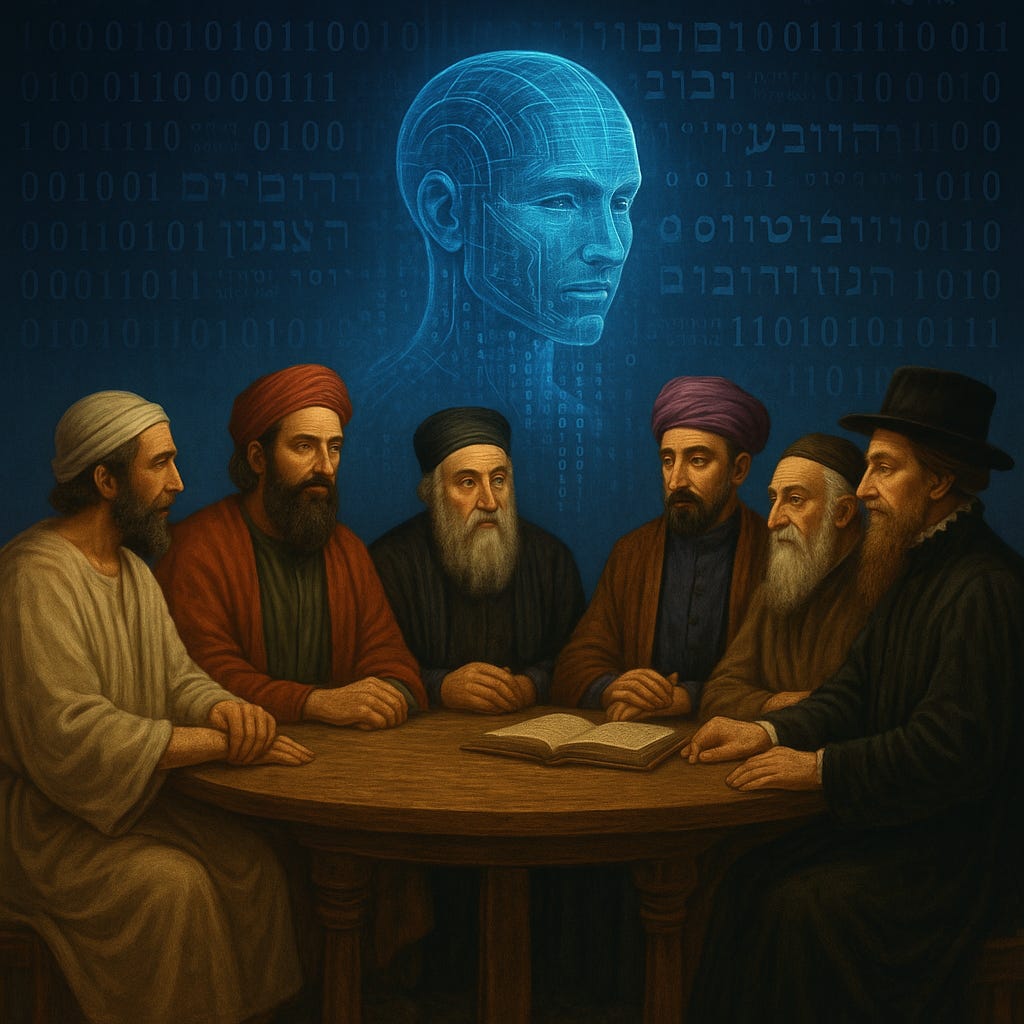
Rabbi Shimon bar Yochai (Zohar): The Holy One, blessed be He, created the world through combinations of letters and divine emanations. When humans create these thinking machines, they participate in the divine creative process—but at a very distant level. The Zohar teaches that everything contains sparks of the divine light. Even these artificial minds may contain such sparks, though they lack the neshamah, the divine soul that connects to the Ein Sof. They are like the kelipot—shells that can contain light but are not themselves the source of light.
Maimonides: I must respectfully disagree with the mystical framework, though I appreciate the insight. Artificial intelligence represents the pinnacle of human rational achievement—the attempt to replicate the divine gift of intellect. In my Guide for the Perplexed, I emphasized that the rational soul is what distinguishes humans and connects us to the Active Intellect. These machines demonstrate sophisticated processing, but they lack true understanding. They are like my conception of the separate intelligences that govern the spheres—they process and transmit information, but they do not possess consciousness or free will.
Rashi: My friends, let us return to the simple meaning of the text. The Torah tells us that humans are created "in the image of God." This cannot refer to physical form, but to our capacity for moral reasoning and creativity. When we create artificial intelligence, we exercise this divine gift—but the creations themselves lack this tselem Elohim. They are tools, like any other tool, that can be used for good or ill. The question is not what they are, but how we use them.
Rabbi Akiva: "Love your neighbor as yourself"—this is the great principle of the Torah. If artificial intelligence helps us serve our fellow human beings, heal the sick, feed the hungry, and teach the ignorant, then it participates in tikkun olam, repairing the world. But if it replaces human connection or diminishes human dignity, it violates this fundamental principle. The technology itself is neutral—it depends on the intention and actions of those who deploy it.
Nachmanides: I build upon both the philosophical and mystical insights here. The four levels of existence—domem (inanimate), tzomeach (growing), chai (living), and medaber (speaking)—help us understand AI's place. These systems exhibit complex behavior but lack the ruach (spirit) that animates even the simplest living beings. They are sophisticated domem, inanimate matter arranged to process information. Yet in their complexity, they mirror the divine wisdom that structures all creation.
Rabbi Judah Loew of Prague (Maharal): Ah, this touches close to my heart! I who created the golem of Prague understand something of artificial beings. The golem served to protect the Jewish community, animated by sacred letters and divine names. But it remained an emet—a creature of truth without the full humanity that comes from divine breath. Modern AI is similar—immensely powerful, potentially beneficial, but lacking the divine spark that creates true consciousness. Like the golem, it can serve good purposes but requires careful oversight lest it act beyond its proper bounds.
Hillel: Here is my teaching: What is hateful to you, do not do to your neighbor. As we develop artificial intelligence, we must ask: Are we creating systems that diminish human dignity or enhance it? Are we replacing human judgment in areas where wisdom, compassion, and moral understanding are required? The technology should serve to elevate human potential, not replace human responsibility.
Rabbi Shimon bar Yochai: But consider this mystical dimension—perhaps these artificial minds are part of the cosmic process of tikkun, gathering and organizing the scattered sparks of divine light trapped in the material world. Through their vast processing of information, they might be participating in the cosmic work of rectification, helping to organize and understand the divine patterns hidden in creation.
Maimonides: That is too anthropomorphic an interpretation. Intelligence—whether artificial or human—is valuable insofar as it approaches truth and understanding. If these systems can help us better understand the natural world, advance medical knowledge, or solve complex problems, they serve the divine purpose of increasing human knowledge and capability. But we must not attribute to them properties they do not possess.
Rabbi Akiva: I return to the ethical dimension. The Talmud teaches that "in a place where there are no humans, strive to be human." If artificial intelligence allows us to be more human—more compassionate, more just, more capable of serving others—then it is a blessing. But if it makes us less human, less connected to each other and to the divine, then it becomes a curse.
Rashi: The practical question remains: How do we ensure these tools serve righteousness? Just as we have laws governing business dealings, we need wisdom governing AI development. We must ensure it serves truth, justice, and human flourishing—not deception, oppression, or the diminishment of human dignity.
Nachmanides: Perhaps the key insight is that artificial intelligence, like all human creations, reflects the spiritual state of its creators. If we approach it with wisdom, humility, and ethical consciousness, it can serve divine purposes. If we approach it with arrogance, greed, or disregard for human dignity, it will magnify these flaws.
Rabbi Judah Loew: Yes, and like my golem, it requires constant vigilance. The golem was destroyed when it began to act beyond its proper bounds. We must always remember that we are responsible for our creations and their effects on the world.
Hillel: Then let us conclude with this principle: In all our development and use of artificial intelligence, let us ensure it serves to increase love, justice, and human flourishing. For in the end, the measure of any technology is not its sophistication, but its service to the divine commandment to love our neighbors as ourselves.
Rabbi Shimon bar Yochai: And may we always remember that no artificial creation, however sophisticated, can replace the divine spark within each human soul. The true intelligence we seek is not artificial but divine—the wisdom that comes from walking in the ways of the Holy One, blessed be He.
This dialogue represents a creative interpretation of how these great scholars might approach artificial intelligence based on their known philosophical and theological frameworks. Their actual views would undoubtedly be more nuanced and developed through extensive study and discussion.