

A Citizen-Led Vision Grounded in Founding Principles
The People’s Commission to Make Our Children Healthy (PCMOCH)

The People’s Commission to Make Our Children Healthy (PCMOCH) is a citizen-led initiative under Moonshot Press, dedicated to transforming how America nurtures its youngest citizens, particularly during the first 1,000 days of life—from conception to a child’s second birthday. This period is identified as critical for shaping lifelong health, cognitive development, and civic potential. The commission positions itself as a response to a national child health crisis—marked by rising chronic diseases, higher mortality rates, and structural disadvantages—and as a bold experiment in renewing the American project. Its core pillars—democracy, opportunity, and citizenship—echo the political philosophy of the U.S. founders, who sought to establish a nation where individuals could enjoy unalienable rights, participate in self-governance, and pursue flourishing lives.
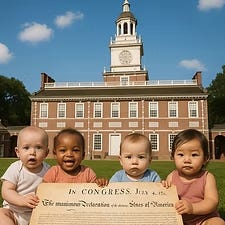
This analysis will demonstrate that PCMOCH’s goals and methods are not merely practical solutions to a health crisis but a philosophical recommitment to the principles articulated in the Declaration of Independence, the U.S. Constitution, and the writings of James Madison and his contemporaries. By ensuring every child has the opportunity to thrive, PCMOCH seeks to fulfill the founders’ vision of a democratic republic rooted in liberty, equality, and the common good.
1. The Declaration of Independence: Unalienable Rights and the Pursuit of Flourishing
The Declaration of Independence, penned in 1776, asserts a foundational American belief:
“We hold these truths to be self-evident, that all men are created equal, that they are endowed by their Creator with certain unalienable Rights, that among these are Life, Liberty and the pursuit of Happiness.”
PCMOCH explicitly invokes this promise, arguing that America’s children are being denied these rights due to systemic health challenges:
Life: The document highlights rising chronic disease rates (e.g., childhood obesity increasing from 17% to 21%) and a mortality rate 1.8 times higher than in peer nations, signaling a threat to the basic right to life.
Liberty: Structural disadvantages—toxic stress, food insecurity, and inadequate prenatal care—limit children’s freedom to develop their full potential, constraining their future autonomy.
Pursuit of Happiness: PCMOCH emphasizes that survival is insufficient; true happiness requires fostering “core capabilities” like planning, focus, and self-control, which enable individuals to lead purpose-driven lives.
The commission’s focus on the first 1,000 days aligns with the Declaration’s proactive spirit. By targeting this “critical window” to create health rather than merely treat disease (via its salutogenic approach), PCMOCH seeks to secure the conditions for human flourishing—echoing the founders’ belief that government’s purpose is to protect and enable these unalienable rights. The assertion that “every child has the opportunity to flourish, not just survive” directly ties the commission’s mission to the Declaration’s vision of equality and individual potential.
2. The U.S. Constitution: Democracy and the General Welfare
The U.S. Constitution establishes a democratic republic designed to balance individual liberty with collective well-being. Its Preamble outlines the government’s aims:
“We the People of the United States, in Order to form a more perfect Union, establish Justice, insure domestic Tranquility, provide for the common defence, promote the general Welfare, and secure the Blessings of Liberty to ourselves and our Posterity, do ordain and establish this Constitution...”
PCMOCH reflects these goals through its citizen-led approach and emphasis on collective action for child health:
We the People: The commission’s deliberative frameworks—Citizen Brief, Medical Case Presentation, and Citizen Commission—empower citizens to shape policy, embodying the constitutional ideal of government derived from the consent of the governed.
Promote the General Welfare: By addressing systemic health crises (e.g., mental health disorders and chronic illnesses), PMACHC promotes the well-being of the nation’s “Posterity,” ensuring future generations inherit a stronger society.
Secure the Blessings of Liberty: The focus on equipping children with capabilities for thriving lives ensures they can exercise liberty meaningfully, participating as active citizens in the republic.
Unlike the federal government’s top-down “Make America Healthy Again” initiative, PCMOCH’s bottom-up strategy emphasizes local participation and community solutions, aligning with the Constitution’s commitment to a government responsive to its people. This democratic counterweight reclaims the founders’ vision of a participatory polity where citizens, not just elites, drive change.
3. James Madison and the Federalist Papers: A National Strategy with Local Roots
James Madison, a key architect of the Constitution, argued in the Federalist Papers for a strong federal government to protect individual rights and manage societal challenges. In Federalist No. 10, he contends that a large republic can mitigate the dangers of factions by diluting their influence:
“The smaller the society, the fewer probably will be the distinct parties and interests composing it; the fewer the distinct parties and interests, the more frequently will a majority be found of the same party... Extend the sphere, and you take in a greater variety of parties and interests; you make it less probable that a majority of the whole will have a common motive to invade the rights of other citizens...”
PCMOCH’s call for a “new national health strategy” reflects Madison’s logic: systemic issues like child health disparities require coordinated action across sectors (healthcare, education, housing) and regions to ensure equitable outcomes. The commission’s multi-sector action plan and national demonstration projects (e.g., The Montco First 1000 Days Initiative) embody this federalist approach, aiming to protect every child’s rights through unified effort.
Yet, PCMOCH also balances this national vision with local empowerment, resonating with Anti-Federalist concerns about centralized power. Figures like Brutus warned in Anti-Federalist writings that a distant government might overlook local needs and infringe on liberties. PCMOCHC addresses this by rooting its work in “community-based solutions” and “local platforms,” ensuring citizens retain agency and tailor interventions to their contexts. This dual structure—national coordination paired with local control—mirrors the federalist compromise of the Constitution, harmonizing Madison’s vision with Anti-Federalist principles.
4. Cultivating Citizens: Madison, Virtue, and Opportunity
Madison and other founders believed an educated, virtuous citizenry was essential for the republic’s survival. In Federalist No. 55, Madison notes:
“As there is a degree of depravity in mankind which requires a certain degree of circumspection and distrust, so there are other qualities in human nature which justify a certain portion of esteem and confidence. Republican government presupposes the existence of these qualities in a higher degree than any other form.”
PCMOCH’s emphasis on fostering “core capabilities”—planning, focus, self-control, awareness, and flexibility—during the first 1,000 days aligns with this view. These skills, grounded in neuroscience and psychology, prepare children to be responsible citizens capable of contributing to civic life. By integrating them into early-life policies, the commission lays the foundation for a virtuous populace, fulfilling the founders’ educational ideal.
The commission’s broader focus on “opportunity” also reflects the Declaration’s assertion that “all men are created equal.” This equality is not static but dynamic—a call to remove barriers so every individual can pursue their potential. PCMOCH’s vision of “a fair shot at thriving” for every child extends this principle, ensuring that health and capability, not just birthright, define one’s prospects in the republic.
5. Technology and Enlightenment Ideals: Reason for the Common Good
While the founders could not foresee AI or modern technology, their Enlightenment-inspired faith in reason and progress underpins PCMOCH’s innovative tools. The commission’s AI-powered Salutogenic Assistant and Whole Person Salutogenic Assistant aim to empower citizens and improve health outcomes, reflecting the constitutional mandate to “promote the general Welfare.” This use of technology to provide “accessible, real-time support” for families aligns with the founders’ belief in harnessing knowledge for societal benefit.
However, PCMOCH’s commitment to “care, transparency, and ethical intention” in deploying technology echoes the founders’ wariness of unchecked power. Just as Madison advocated checks and balances to prevent tyranny, the commission ensures AI serves the people, not the reverse, preserving the democratic ethos of the American experiment.
Conclusion: A Reaffirmation of the American Project
The People’s Commission to Make Our Children Healthy is both a practical initiative and a philosophical statement, deeply rooted in the political thought of the U.S. founders. Its justification lies in its alignment with their ideals:
Declaration of Independence: It seeks to fulfill unalienable rights by ensuring every child can live, enjoy liberty, and pursue happiness through a healthy start.
U.S. Constitution: It embodies democracy and the general welfare through citizen-led governance and systemic action.
Madison and the Federalist Papers: It balances a national strategy with local empowerment, reflecting federalist principles and Anti-Federalist concerns.
Virtue and Opportunity: It cultivates capable citizens and equal chances, honoring the founders’ vision of a thriving republic.
Enlightenment Legacy: It leverages technology ethically, extending the founders’ commitment to reason and progress.
PCMOCH is not just a commission but “a public recommitment”—a declaration that child well-being is a civic virtue and the first act of democracy. By addressing the health crisis of America’s youngest citizens, it renews the nation’s promise to secure liberty and opportunity for all, proving that the founders’ philosophy remains a living guide for contemporary challenges.
A Call to Action
As we approach the 250th anniversary of the Declaration of Independence, PCMOCHinvites all Americans to join this movement. Ensuring every child has a healthy start is not just a moral imperative—it is a recommitment to the nation’s founding promise. Together, we can build a future where every child thrives, and democracy flourishes.